Article
April 26, 2026
5 min read
How AI Is Moving Team Collaboration Into Working Software
AI-assisted development is making prototypes a shared workspace where teams can shape product ideas, narrative, and experience inside working software.
By Cristiano Pierry
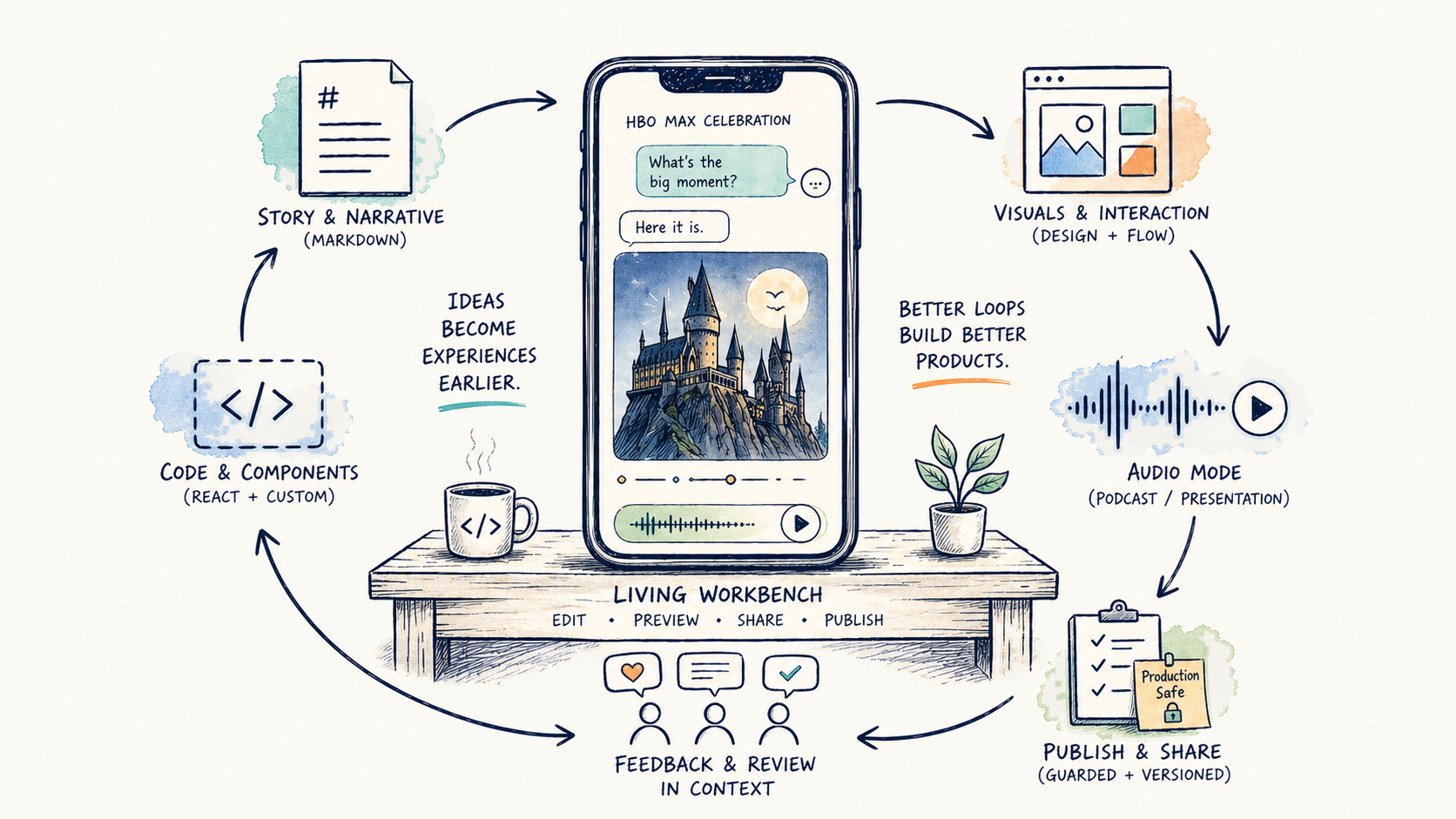
I used to think of prototypes as artifacts you made after the idea was clear. A weekend work project reminded me that the best prototypes can become the place where the idea gets clear. Over the last few days, we built something that started as a celebration demo and quickly became a glimpse of a different way to shape product experiences.
The project was a polished, mobile-style journey for a premium celebration moment. It needed to feel coherent, run deterministically enough to record, and tell a clear story through scripted chat, rich visual answers, and a flow that could hold up in front of an audience.
What made the project even more striking was the team behind it. This was not built by a staffed product squad with dedicated product, design, user research, engineering, and AI support. It was created by three senior executives from different parts of the company, working directly with frontier coding tools to shape the idea, the narrative, and the experience in real time. That would have been very difficult to imagine even a short time ago.
The interesting part was what formed when we started building with OpenAI Codex rather than starting in Microsoft Word.
As we built, the demo stopped being just a playback experience. It became an authoring environment. The story could be edited, previewed, reordered, reviewed, and published without turning every copy change into an engineering cycle.
Instead of treating the prototype as a static deliverable, we treated it as a living workspace. The narrative lived in markdown. Custom React components handled the moments that needed more than text or a static image. The editor made iteration visible. Shareable previews made feedback easier. Guarded publishing kept production copy from drifting backward. A podcast mode turned the same source material into a deterministic, audio-led presentation.
In four focused days, the project moved through 151 commits and 27,000 lines of code.
Commit count and lines of code do not measure quality, impact, or craft. Here they only show how much the artifact changed during a short, focused build.
In that short window, the work moved from a deterministic phone-style demo into a working content and presentation system with scripted playback, local authoring, custom visuals, production-safe publishing, and generated audio.
Product ideas became tangible earlier. Content decisions happened in context. Visual polish and narrative polish could move together. We could try a beat, watch it inside the actual experience, adjust the story, refine the interaction, and keep moving without waiting for a long handoff cycle.
A familiar path moves an idea from document to deck to Figma flow to prototype and then to engineering. Complex products still need the rigor, alignment, architecture, and production discipline behind that path. But during early exploration, each translation can separate the words, interaction, data, and production constraints before the full experience is visible.
With Codex, the artifact became concrete early enough for us to make those decisions together.
We were not only talking about the story. We were watching it unfold. We were not only debating the experience. We were editing it. We were not only imagining how the visuals might land. We were seeing them in the flow. And because the system was built to be editable, the cost of trying a new version stayed low.
High-fidelity demos often trade beauty for resilience, speed for durability, or collaboration for deployability. This experience reduced some of those tradeoffs. It was deterministic enough to record and present reliably. It was editable enough for narrative iteration. It was extensible enough to support bespoke visual moments. It was structured enough that the same content could power multiple formats, including the main chat journey and an audio presentation mode.
Instead of asking people to interpret a static deck, you can put them inside the experience.
That does not eliminate the need for strong product thinking. It raises the bar for it. When the iteration gets faster, weak ideas can also move faster. More output is not automatically better output.
The team still needs taste. It still needs editorial judgment. It still needs a clear sense of what problem is being solved and why the experience should matter to a customer.
AI-assisted development is changing the cadence of collaboration itself.
The shift is not that one person can produce more code faster. Cross-functional teams can now think together inside working software earlier than before. For teams working across product, design, content, engineering, data, and AI, that is a significant change.
The artifact becomes a shared surface. Leadership can respond to something concrete. And the team can keep moving without forcing every small change through a heavy process.
That does not mean every prototype should become a platform. It does not mean every demo should become production. It definitely does not mean speed should outrun strategy.
It means the boundary between concepting and building is becoming more fluid.
The useful change is a tighter loop between idea and expression, feedback and revision, narrative and experience, and craft and implementation.

The future I am excited about is not one where prototypes are cheaper throwaways. It is one where prototypes become the place where teams think together.
A demo can be more than a persuasive object at the end of a process. In this project it became the working environment where three people could shape the narrative and experience while both were still easy to change.
That is the operating model I want more teams to experience: shared context, a tangible artifact, and fewer lossy handoffs between the people shaping the product.
This writing reflects my personal perspectives on product management, AI, and content discovery. It does not represent the official position of my employer or any affiliated organization.