Article
April 28, 2026
4 min read
Move Fast, But Don’t Break the Magic
Why AI product teams need release systems that protect quality, trust, and the workflows users depend on.
By Cristiano Pierry
I have been thinking a lot about release velocity in AI products.
For the last two years, the industry has treated speed as a competitive advantage. In AI, product behavior changes with models, prompts, tools, context, and defaults, so faster shipping can produce faster learning and earlier user feedback.
But I think we are also starting to see the other side of that curve.
As a user, I have noticed that some products that felt magical a few months ago now occasionally feel inconsistent. Not broken. Not unusable. Just subtly worse. A coding assistant that crashes more often. A model that gives a shallower answer.
Anthropic’s April 23, 2026 Claude Code postmortem was a useful example. The issue was not simply that “the model got worse.” Anthropic traced the experience to product-level changes: reasoning defaults, a caching bug that dropped prior reasoning, and a system prompt change.
Inside the company, those are separate systems. To the person using the product, they collapse into one experience.
The user does not experience the model, prompt, cache, tool layer, routing logic, and product surface as separate things. They experience one question: did this help me do the work?
That matters more now because these tools are no longer side experiments. They are becoming part of the daily workflow. People are relying on them to write code, debug, research, analyze, plan, draft, and make decisions. Once a tool becomes part of the work itself, the expectation changes. Novelty can tolerate rough edges. Workflow cannot.
This is where I think there is something to learn from Windows Update.
Windows publishes monthly security updates, optional nonsecurity previews for early validation, and out-of-band releases when an issue cannot wait for the regular schedule. That cadence creates value in two ways: it gives users more stability, and it gives Microsoft time to test, stage, validate, and communicate changes.
I am not arguing that AI companies should ship once a month. That would be too slow for this market. I would like my updates more frequently too.
But once a day may also be too fast for changes that affect quality, trust, or core workflows.
The useful distinction is between speed that creates learning and speed that creates churn. The first gives users new capability without destabilizing the workflows they depend on; it is instrumented, staged, reversible, and intentional. The second can optimize cost, latency, or verbosity while quietly degrading the user’s outcome.
AI products need a release architecture that can sustain their development speed.
Deploy fast, but release deliberately.

Feature flags, canaries, staged rollouts, holdbacks, soak periods, and fast rollback paths are not process theater. They are how teams keep moving without making every user part of the test population.
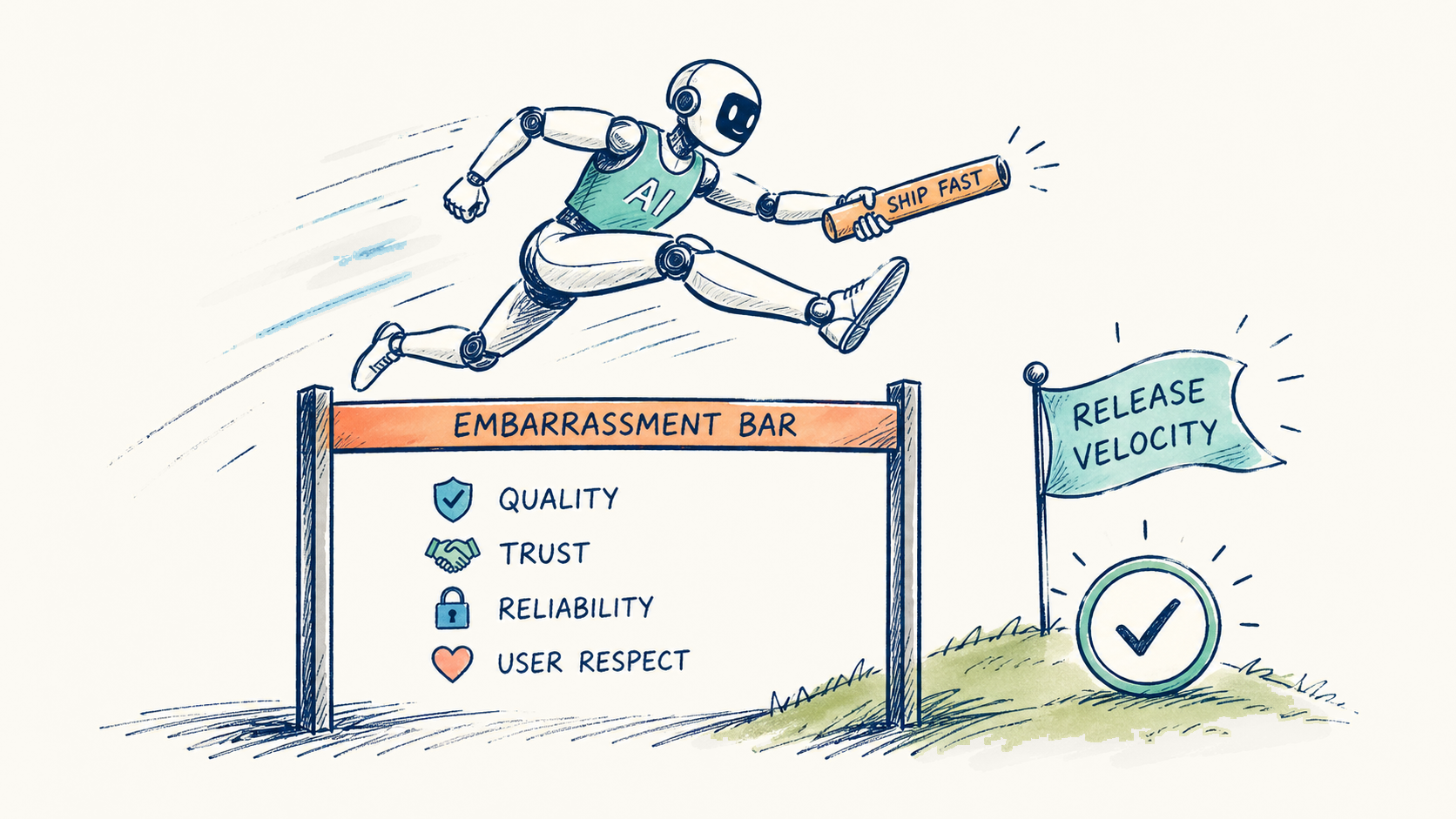
Most importantly, define the minimum trust bar. Every team needs a threshold below which a change simply does not ship.
For AI products, that bar cannot only be crash rates and latency. It has to include output quality, instruction following, task completion, workflow continuity, user trust, and whether the product still feels as capable as it did yesterday.
Not every change needs the same process. A small UI improvement can move quickly. An invisible backend optimization can move quickly if it is reversible. A critical bug fix should move immediately.
But changes to reasoning behavior, system prompts, model routing, memory, coding agents, and user-facing defaults deserve a higher bar. In AI products, those are not implementation details. They are the product.
That architecture makes quality part of the speed system. Evals matter, but they are not the whole answer. Teams also need to dogfood the production experience, measure user-perceived quality alongside benchmark performance, and make behavior—not only code—easy to roll back.
Speed is still an advantage. Trust is the condition that makes it durable.
Trust grows when users feel the product improving without becoming unstable—when yesterday’s workflow still works tomorrow and new capability does not come at the cost of consistency. Ship fast, learn fast, and never ship below the minimum trust bar.
This writing reflects my personal perspectives on product management, AI, and content discovery. It does not represent the official position of my employer or any affiliated organization.