Article
October 22, 2026
4 min read
My AI Product Manager Needed a Process
The AI product manager experiment exposed a coordination problem. Infinite Queue and an orchestrator give our AI agents defined roles and a workflow to follow.
By Cristiano Pierry

I hired Bob, the AI agent I work with in dots, to be the product manager for the avatar on my website. I expected the frontier models to understand the job well enough to decide what to build, direct coding agents, and follow a release through to the live experience. Some useful work shipped. As the project expanded, though, I found myself asking what had actually been delivered and which branches still held unfinished work.
I had given Bob broad responsibility without establishing a reliable process for carrying it. I expected the model's understanding of product management to supply the discipline around the work. That expectation did not hold up. I still wanted to delegate the coordination, so we built the next attempt around Infinite Queue and an orchestrator skill set.
Infinite Queue is a small app for keeping tasks across projects in one place. It is a Kanban board for the agentic world. A task has a shared record of what needs doing and where it stands, whether it is ready, in progress, blocked, or delivered. Agents working in separate conversations can use that record to follow the same work. I can look at the board without having to reconstruct the backlog from their chats.
The orchestrator is itself an AI agent, working from Infinite Queue to coordinate the other agents. We have explicitly defined each role in the skill set, including what the assigned agent is responsible for and what it must hand over before the work moves on. The workflow is designed for AI agents using a shared task record across separate conversations. The orchestrator checks what is already happening before assigning more work.
When a ticket needs product clarification, Tom PM, the AI agent assigned the PM task, refines the problem and the expected result. Tom Developer is the AI agent assigned to implement the change in an isolated workspace. The QA agent checks the behavior against the requirements, and a separate review agent examines the candidate. Tom Security Agent handles the security review when the work calls for it. Tom Release Manager takes responsibility for carrying an accepted change through release and verifying the result in production. The orchestrator follows these handoffs and keeps Infinite Queue current.
A failed check or an unresolved review finding keeps the task open. The work goes back for repair, and the queue records what still needs to happen. Implementation, passing checks, and a verified release are different states. That distinction was easy to lose in the avatar experiment. Keeping it attached to the ticket gives me a way to check a status report against the work behind it.
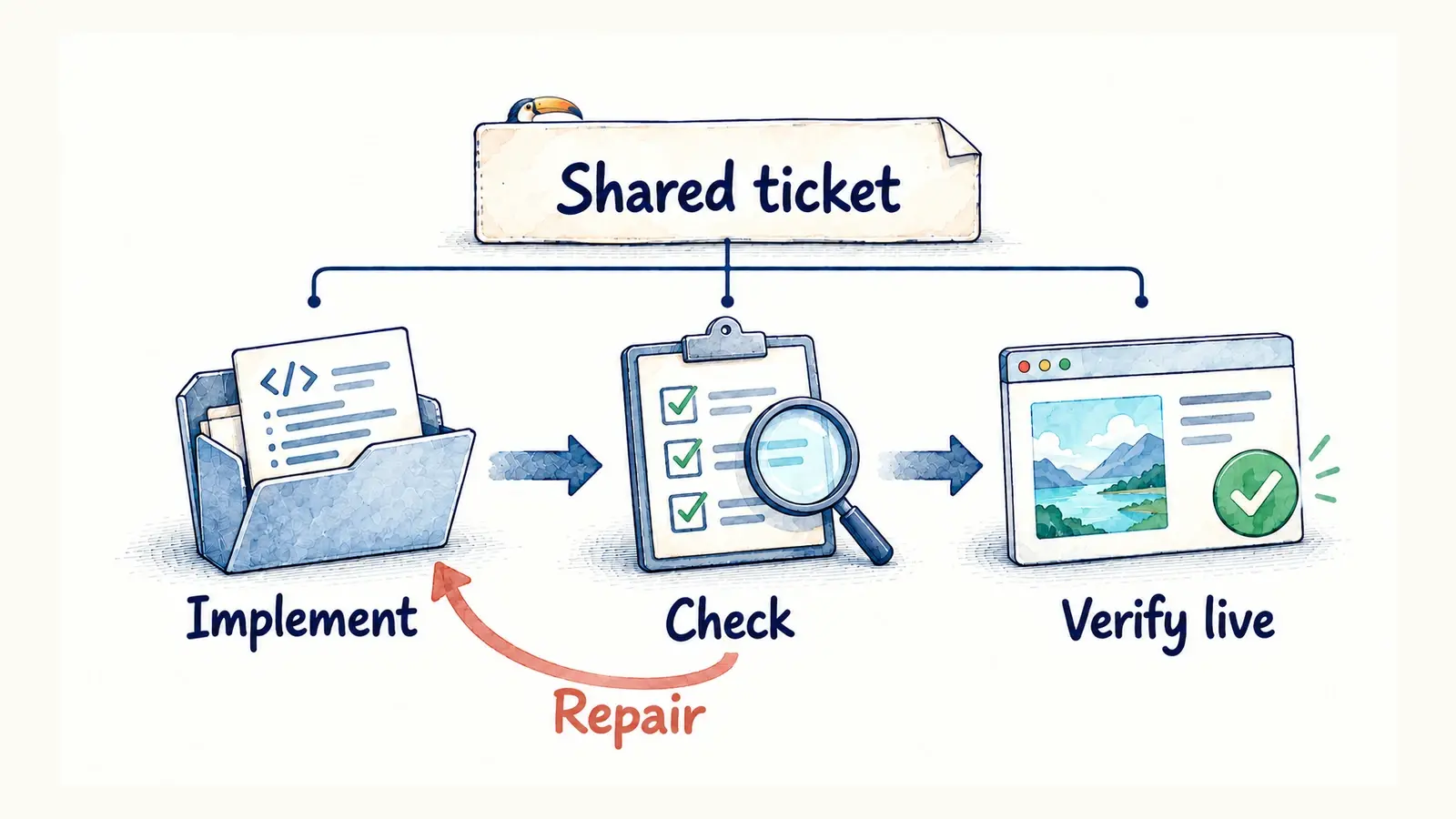
We have run the orchestrator through validation, and it is ready to go. I can add a ticket to Infinite Queue and let the orchestrator pick it up and assign the appropriate Tom agents. The same loop serves my projects, so I have one place to add work and follow it through. A small change can move through a lighter workflow; a change that needs security or more substantial product work gets the appropriate attention.
The agents add tickets themselves too. They turn feature requests from user feedback into work in Infinite Queue. While implementing a change, an agent also creates tickets for follow-up work or new ideas it discovers along the way. The orchestrator assesses those requests alongside the rest of the backlog. The loop generates its own next steps as well as carrying out the work I put into it.
I still decide what the system is authorized to do and which decisions need to come back to me. The orchestrator manages routine coordination within those boundaries, including the follow-up when a task gets stuck. I no longer have to direct each handoff myself.
As frontier tools develop, they will absorb more of this coordination and make our separate orchestrator skills unnecessary. For now, I see those skills as a necessary step toward autonomous loops that keep improving the system. AI agents can respond to feedback and carry new work through delivery without my directing every cycle.
This writing reflects my personal perspectives on product management, AI, and content discovery. It does not represent the official position of my employer or any affiliated organization.