Article
May 20, 2026
7 min read
The 20/70/10 Rule for Working With AI
The 20/70/10 model keeps AI workflows fast without letting speed replace context, verification, judgment, or ownership.
By Cristiano Pierry
The most important shift with AI is that it changes where the real work lives. First drafts, first options, first summaries, first analyses, and first versions are all becoming cheaper and faster to create. The difficult work is deciding what is true, what is useful, what is specific, and what is worth putting your name on.
I have been thinking about AI workflows through a 20/70/10 model.
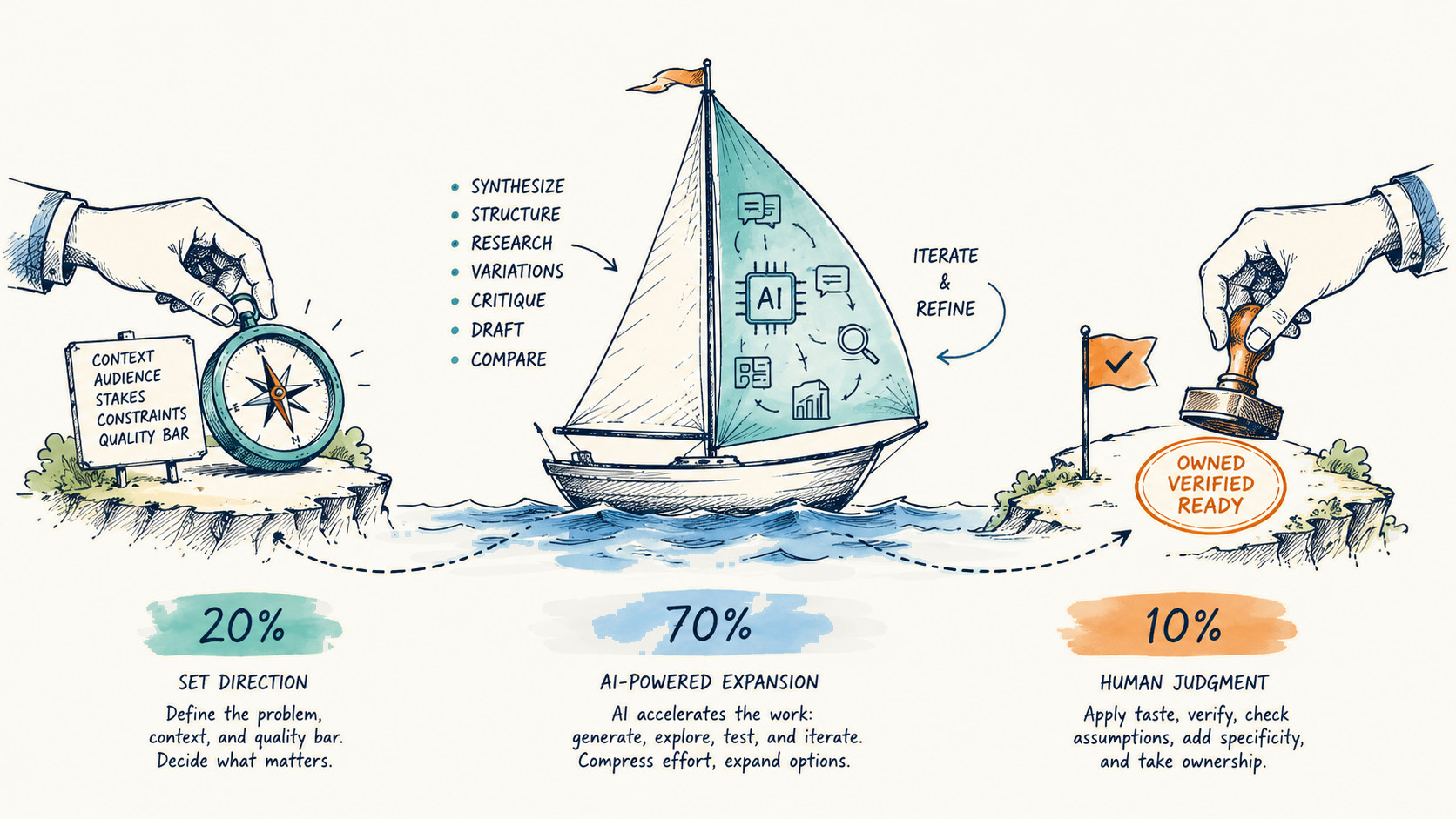
Spend the first 20% of the time setting the right context and direction.
Let AI do 70% of the middle work: synthesis, structure, research, variations, critique, drafting, and comparison.
Then spend the final 10% applying human taste, judgment, verification, and ownership. These percentages are a mnemonic, not a timesheet; the principle is to use AI to compress effort, not accountability.
This is especially true in the kind of product and technology work many of us do every day: discovery, personalization, search, experimentation, customer analysis, strategy memos, launch narratives, and cross-functional decision-making. In those settings, the value of AI is not that it can produce a polished paragraph. The value is that it can help us move faster through ambiguity, synthesize messy inputs, compare options, and pressure-test our thinking. But that only works when the human provides the right context up front: the audience, the stakes, the customer signal, the strategic priority, the tradeoffs, and the quality bar.
The danger is not AI itself. The danger is going on autopilot.
Two common failure modes sit at opposite ends of the spectrum. One is delayed adoption, where someone has too few opportunities to build practical fluency. The other is over-delegation, where the work loses a human point of view. Both leave capability on the table. The better path is intentional leverage: use AI deliberately while keeping authorship, comprehension, and judgment with the human.

This hesitation can appear even among capable practitioners with deep product judgment. It is not a failure of ability; practical fluency requires reps. Skepticism is healthy when it sharpens judgment, and leaders should make room for people to test the tools safely, challenge the economics, and learn from real work rather than treating caution as resistance.
The other failure mode is more subtle because it often looks productive from the outside. A polished customer brief can still fall apart when the discussion moves beyond the surface and its owner cannot explain the evidence or tradeoffs. That is the risk of delegating understanding. AI can help prepare the brief, organize the evidence, summarize customer themes, and even anticipate objections. But it cannot own the meeting for you. It cannot be the person who understands the customer, the tradeoff, the implication, or the decision.
This is why the first 20% matters so much. The first 20% is not “prompt setup.” It is direction-setting. It is the human deciding what matters before the model starts expanding the work. In that phase, you should be giving the LLM the same context you would give a smart teammate: what problem you are trying to solve, who the audience is, what decision the work should support, what source material matters, what constraints exist, what tradeoffs are acceptable, what tone is appropriate, and what a high-quality answer should look like.
In the kind of product and technology work I spend time on, this context might include customer signals, usage patterns, business goals, experiment results, audience needs, edge cases, product limitations, and examples of prior work. It also includes what is strategically important right now. Are we trying to increase confidence in a launch decision? Are we trying to understand why a customer segment behaves differently? Are we trying to prioritize opportunities, pressure test a recommendation, or clarify a tradeoff? The more clearly I frame the work, the less the model has to guess. And when the model guesses less, the output gets better.
The middle 70% is where AI adds real value. Once the context is strong, the LLM can help expand the work in ways that would be time-consuming for a human to do manually. It can organize messy notes, find themes, create a first draft, generate alternative framings, critique an argument, compare options, identify gaps, rewrite for different audiences, and turn scattered thinking into a structured artifact. This is the part of the workflow where speed matters. It is where AI can compress hours of blank-page effort into minutes of structured iteration.
But the middle 70% is not a handoff. It is a loop. The best results come when the human keeps directing the model: make this sharper, separate facts from assumptions, show me the strongest counterargument, rewrite this for an executive audience, identify what evidence is missing, make the recommendation more specific, remove anything generic. The LLM is useful because it can keep iterating without fatigue. But iteration is only valuable when the human is steering it toward a clear outcome.
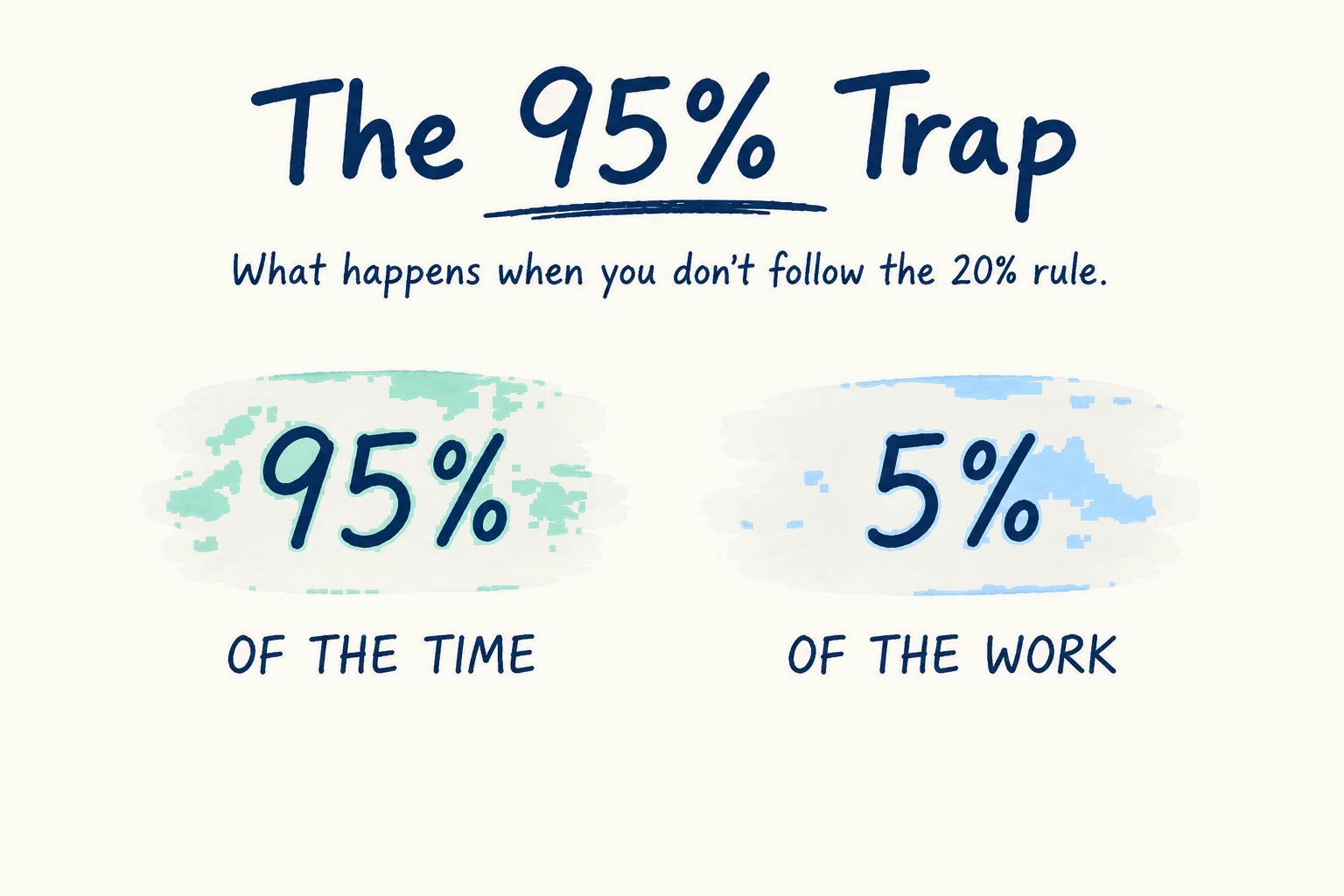
This brings us to the 95/5 trap, which is one of the most common frustrations people have with AI-generated work. A colleague recently described it well: AI rips through the initial stages, but then creates a long and frustrating refinement process, placing “95% of the workload on that final 5%” to reach human-level quality and nuance. I know many people have experienced this frustration. The draft appears almost done, but somehow the last mile becomes endless. You keep editing, correcting, reshaping, adding nuance, and trying to make the work feel less generic.
I diagnose that problem differently. When 95% of the effort gets trapped in the final 5%, it usually means the first 20% was under-specified. The frame was too vague. The audience was not clear enough. The model did not know what mattered. The quality bar was implicit instead of explicit. The source material was incomplete. The human had not made the hard choices up front, so all of those choices came back as cleanup work at the end.
That is why 20/70/10 is a better operating model than simply saying “let AI do most of the work.” AI can only expand the middle effectively if the beginning is strong. If the context is weak, the model will produce a smooth draft that still requires painful human repair. If the context is strong, the model has a better chance of producing something that is not just polished, but directionally useful. The extra time at the start is not overhead. It is how you prevent endless refinement later.
The final 10% is where the human applies taste. That word can sound subjective, but in this context taste is not vibes. Taste is a quality filter. It is the discipline of noticing when something sounds finished before it has earned trust. It is asking whether the output says something specific, whether the evidence is strong enough, whether the argument would hold up in a real conversation, whether the language is too convenient, and whether the work helps someone make a decision.
This is also where the human removes the generic language that AI often produces. AI is very good at reasonable abstractions: improve the customer experience, align stakeholders, drive engagement, unlock insights, increase efficiency. None of those phrases are necessarily wrong, but they often fail to say enough. The human pass needs to make the work concrete. Which customer? Which experience? Which stakeholder? Which engagement behavior? Which decision? Which tradeoff? Which evidence?
The final 10% is not just editing. It is ownership.
Ownership also means verification. Numbers need to be checked. Sources need to be inspected. Privacy and sensitivity need to be considered. Edge cases need to be evaluated. Claims need to be grounded. The model can help with this, but it cannot be the final authority. A polished AI output is not the same as a trusted output. Trust is earned when a human can explain the work, defend the reasoning, and stand behind the decision.
The pattern I want is human, AI, human. The human frames the problem, audience, stakes, and constraints. AI generates options, summaries, drafts, critiques, and comparisons. The human inspects the work for gaps, risks, missing context, and weak assumptions, then decides what ships, what gets escalated, and what gets cut. AI can help at every stage, but the human control points have to remain visible.
AI changes the economics of knowledge work; the ability to produce output is no longer enough. The differentiator becomes knowing what to ask, what context to provide, what to ignore, what to challenge, what to keep, and what to own. People who avoid AI will lose leverage. People who blindly delegate to AI will lose authorship. The people who benefit most will be the ones who learn how to combine AI’s speed with human direction and accountability.

20/70/10 is a way to stay in control while moving faster. The opening share forces clarity, the middle creates leverage, and the finish protects quality, specificity, and trust. The ratio will change with the task, but the accountability should not: start with context, use AI to expand the work, and end with human judgment.
Use AI to compress effort, not accountability.
This writing reflects my personal perspectives on product management, AI, and content discovery. It does not represent the official position of my employer or any affiliated organization.