Article
April 19, 2026
5 min read
Five Advantages That Matter More as AI Expands
As AI expands the supply of plausible outputs, taste, context, exclusivity, trust, and distribution become more important sources of durable value.
By Cristiano Pierry
AI Creates Abundance. Discovery Turns It Into Decisions
The most important effect of AI is not that it diminishes the value of creativity. It is that it expands the range of options around creative work.
A single title can now be described, packaged, tested, personalized, and surfaced in far more ways than before. Great storytelling remains the center of gravity. What changes is the scale of variation around that core asset, and the speed at which those variations can be generated, evaluated, and deployed.
The challenge becomes deciding what deserves attention, for which person, in which moment, under which constraints.
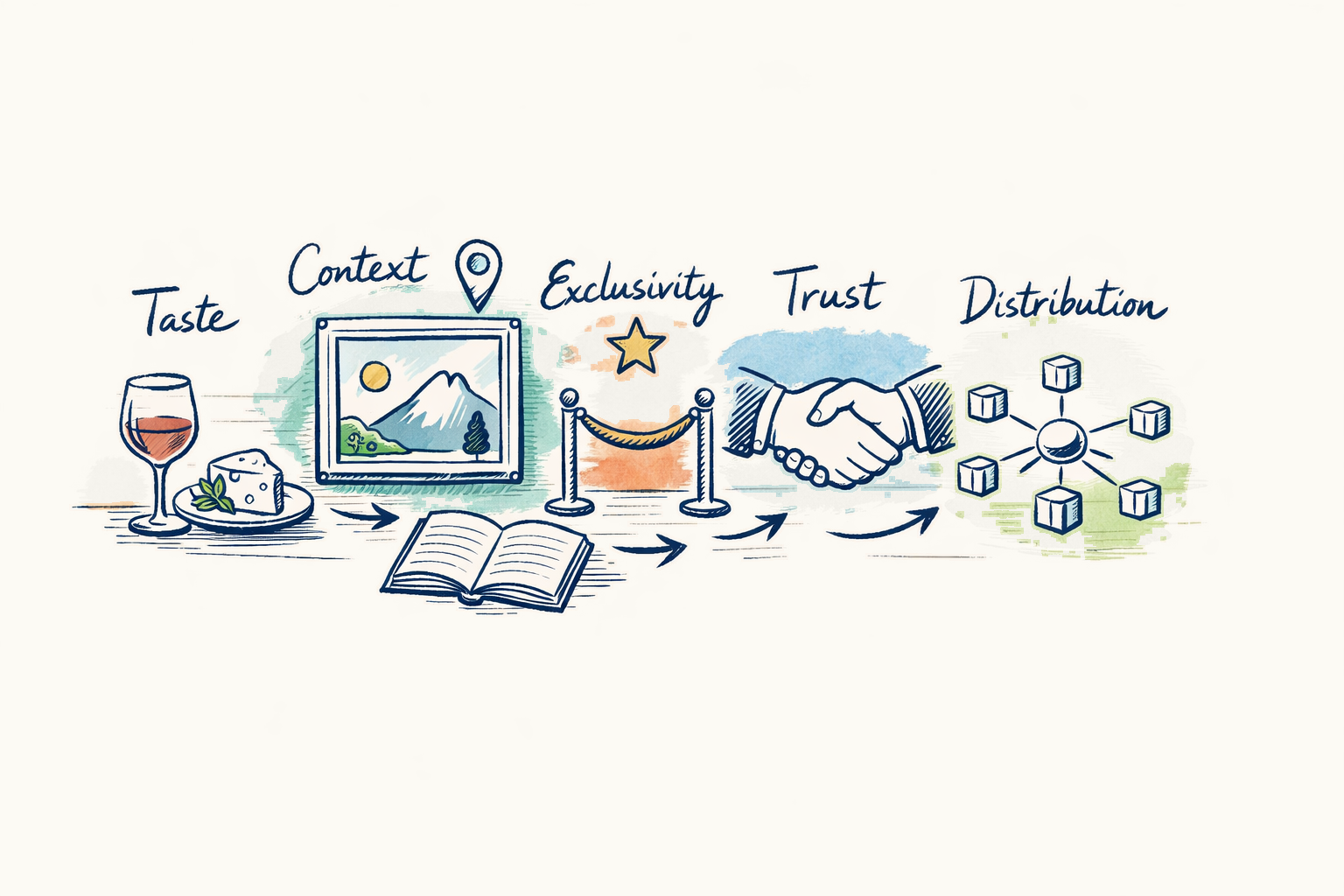
I think raw access to models will matter less than five scarcer assets around them: taste, context, exclusivity, trust, and distribution. AI can amplify each one, but access to the same model does not create them automatically.

Taste is probably the most misunderstood because it is often treated as a soft aesthetic concept. In practice, it combines product, editorial, and design judgment.
It is the ability to look at ten plausible outputs and know which one reinforces the brand, which one clarifies the choice, which one overpromises, and which one misses the emotional truth of the experience.
AI can generate variation at scale, but it cannot own a point of view.
In discovery, taste shows up in ranking, packaging, framing, sequencing, and language. It is present in the title art that gets selected, the synopsis that gets written, the recommendation that gets elevated, and the action the experience asks the user to take next.
Ranking, in other words, is editorial judgment expressed in code. As the number of possible outputs grows, that judgment becomes more valuable, not less.
Context is where generic intelligence either becomes useful or stays generic. The highest-value input on the internet is not public data in the abstract. It is the specific context that surrounds a user, a company, or a decision: customer relationships, behavioral history, inventory, rights windows, regional availability, device state, current priorities, contractual constraints, brand standards, and the countless local details that determine what should actually happen next.
Anyone who works in streaming learns quickly that the gap between what exists and what can actually be surfaced is not a footnote. It is part of the product. The same is true well beyond media. The model may be general, but the outcome is always situated.
The real advantage will come from combining model capability with first-party context that is clean, governed, and operationally useful.
AI is general. Value is specific.
Exclusivity makes the argument more strategic. As model capability becomes more widely available, the premium shifts toward what is uniquely yours: exclusive rights, proprietary inventory, permissioned data, a direct customer relationship, a distinctive signal, a closed-loop workflow, or the authority to act in ways others cannot.
In my world, exclusivity is not just about owning IP. It is about the right to surface and monetize that IP in the right market, in the right window, and in the right experience. Rights and metadata are not back-office details. They are part of the control plane.
More broadly, every company should be asking the same question:
What is truly unique in our stack, and are we structuring our systems so that advantage is actually usable?
In a market where many players will have access to similar models, exclusivity is a much more durable source of differentiation than generic capability.
Trust becomes decisive as AI moves closer to action. It is one thing for a system to generate an answer. It is another for a person or an enterprise to rely on that answer, or let the system take the next step on their behalf. That requires more than fluency. It requires provenance, consistency, explanation, safeguards, and confidence that someone stands behind the outcome when the stakes are real.
The real question is whether the system is built, governed, and owned in a way that makes it trustworthy enough to be included in consequential workflows.
As AI moves from recommendation to action, trust stops being a soft brand attribute and becomes operating infrastructure.
Distribution is the category I still think many companies underestimate. For years, distribution mostly meant human discovery: search ranking, home screen placement, merchandising, paid acquisition, brand strength, and app store visibility. All of that still matters. But a new layer is being added.
Can agents find you? Can they interpret your metadata, verify your availability, understand your offer, and interact with your services safely? Can they decide that you are trustworthy enough to include in a recommendation, a transaction, or a workflow?
The next phase of distribution adds machine legibility to human discovery. Businesses will increasingly need to make their offers easy for agents to find, interpret, verify, and invoke safely on a person's behalf.
Taken together, these five forces move value away from generic generation and toward governed decisions. In an environment of abundance, discovery becomes the layer that turns choice into attention, attention into engagement, and engagement into value.
Routine generation, analysis, and iteration around content will continue to become faster and more scalable. At the same time, the highest-leverage work moves toward problem definition, system design, evaluation, taxonomy, experimentation, rights management, governance, and deciding what the system should optimize for.
Search, personalization, editorial, merchandising, experimentation, and growth start to look less like adjacent teams and more like one connected decision system. Legal, policy, trust, and safety have to move upstream into product design instead of reviewing outputs at the end. Metadata stops being a maintenance task and becomes a product asset.
Bolting AI onto an existing workflow may create incremental productivity. Reorganizing around decision quality and governed action can create a more durable advantage.
What do you own that still matters when model capability becomes dramatically better and broadly accessible? If the answer is only access to AI, that advantage will be temporary. If the answer is taste, context, exclusivity, trust, and distribution, you are building on something much harder to commoditize.
AI is changing both how the internet produces and how it decides.
As generation expands, durable value will depend on the ability to decide, contextualize, authorize, verify, and deliver what matters.
This writing reflects my personal perspectives on product management, AI, and content discovery. It does not represent the official position of my employer or any affiliated organization.