Article
July 7, 2026
7 min read
The Discovery Brain: Where LLMs Can Strengthen Streaming Recommendations
LLM-native discovery can unify streaming recommendations when grounded catalog truth, governed memory, validation, and feedback protect user trust.
By Cristiano Pierry
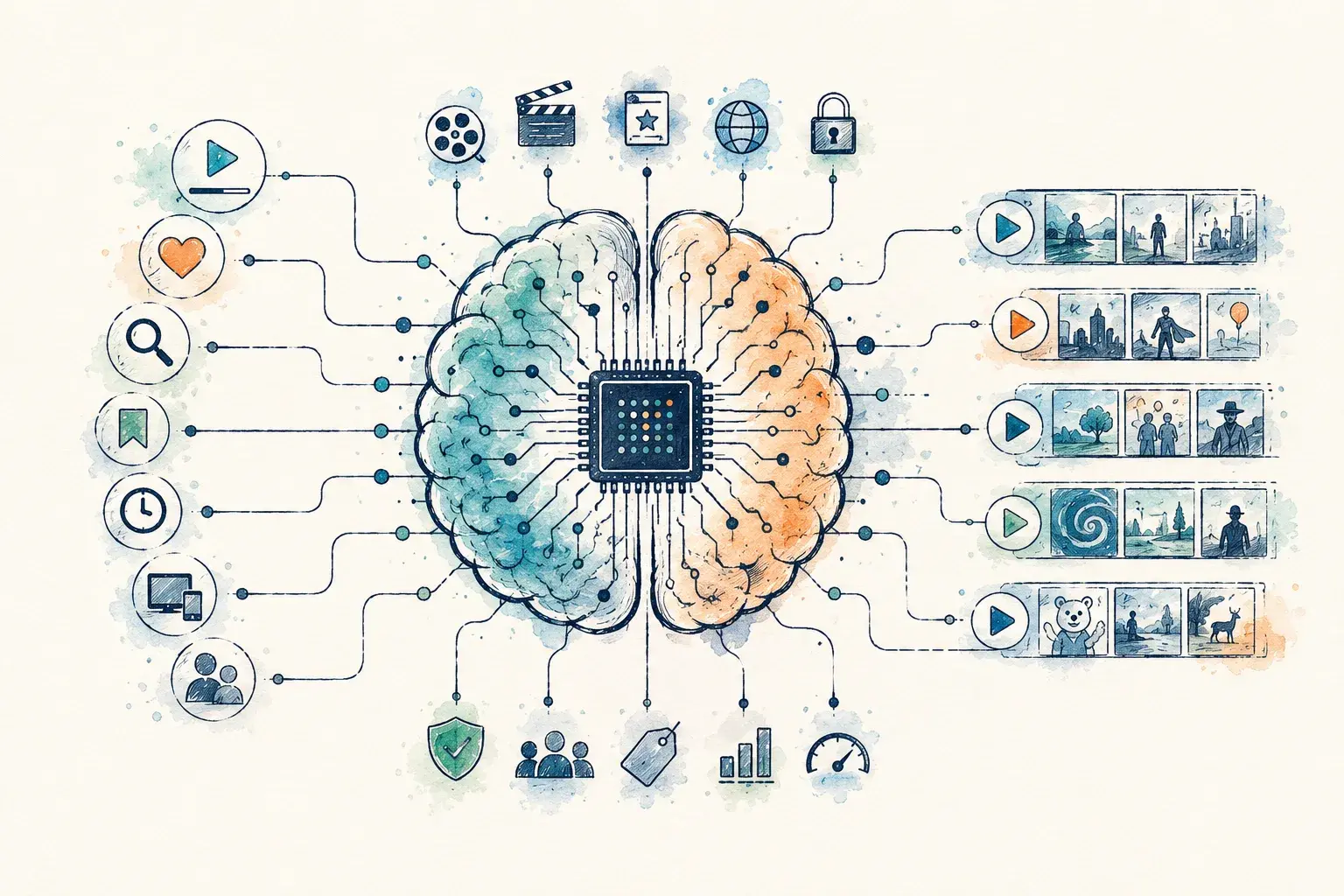
Every streaming product begins with a deceptively simple question: what should this person watch next?
A useful answer depends on behavior, current intent, catalog understanding, availability, profile rules, device, language, and context. The customer who wants a prestige drama on Sunday night may want a comfort comedy after work, a documentary with a parent, or something short while traveling. The person has not changed. The recommendation problem has.
For years, the industry has treated this primarily as prediction: given a user, catalog, surface, and moment, estimate which title should appear next. That framing gave us personalized homepages, smarter search, continuation experiences, title similarity, editorial blends, and increasingly sophisticated ranking systems.
But I think the next generation of streaming recommendations will not simply be a better prediction system. It will be a reasoning system.
A prediction system asks, “What is this user likely to watch?” A reasoning system asks a fuller product question: “What is this user trying to accomplish now, what can they actually watch, what does the catalog contain, what tradeoffs matter, and which recommendation can we defend?”
LLMs do not magically know what everyone should watch, and a chatbot is not the future of streaming discovery. But an LLM can become a shared reasoning layer across the discovery experience.
If I were building a streaming service from scratch today, I would not begin with separate intelligence for search, post-play, homepage rows, franchise pages, collections, and conversational discovery. That is how systems accrete over time, not the architecture I would choose intentionally.
I would build one discovery brain.
The platform knows. The model reasons.
The discovery brain would not be one unconstrained model improvising from memory. It would be a grounded, governed decision platform with access to compact representations of the facts and signals the product is willing to stand behind:
- profile and session context
- content understanding and catalog relationships
- rights, maturity, territory, and subscription constraints
- editorial and business intent
- engagement and feedback history
The LLM should reason. The platform should know.
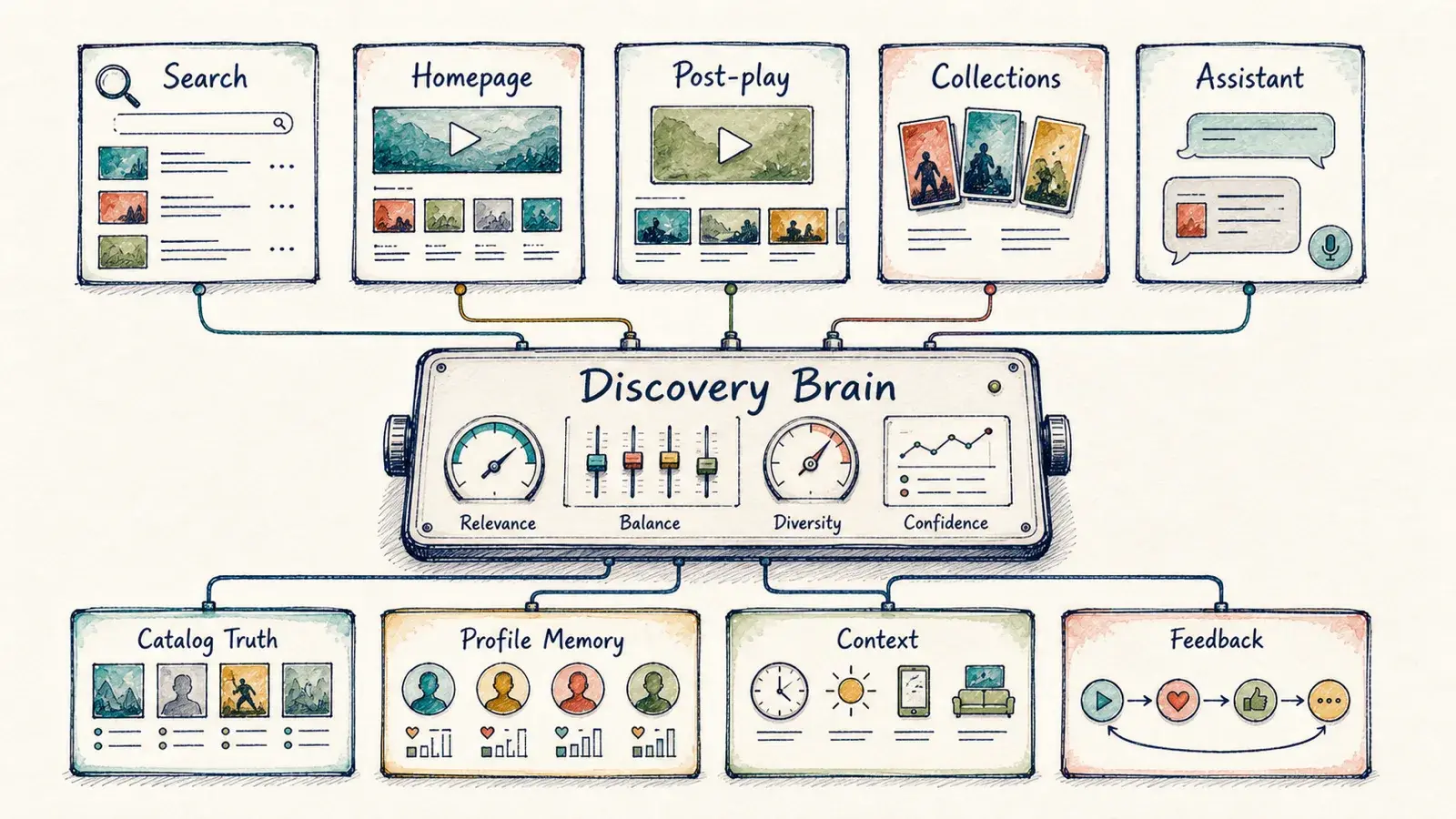
The catalog remains the source of truth. Rights systems remain the source of truth. Availability, maturity, profile boundaries, territory, tier, suppressions, and policy constraints are deterministic product facts. Catalog and rights systems, not the LLM, should decide whether a title exists and whether the product can show it.
Its job is to reason over an eligible slate. It can weigh tone, mood, pacing, novelty, familiarity, fatigue, intensity, format, franchise adjacency, and current context. It can understand that “something like this, but lighter” is different from “more of the same.”
Traditional recommenders model many parts of this well, especially when behavioral history is rich. But entertainment taste is also semantic, emotional, social, and situational. People do not merely consume genres. They choose experiences.
Behavior alone can be ambiguous. A user may abandon a movie because they disliked it or because the session was interrupted. They may finish a series and want more of its world, or they may feel exhausted by it. A household profile can mix preferences from several people. A discovery brain has to treat these signals as evidence with different levels of confidence rather than a single, permanent statement of taste.
That is what makes LLMs interesting for streaming. They can translate the language people use for entertainment into structured intent, connect soft attributes that are difficult to encode in one ranking feature, and explain recommendations from supplied facts.
Their fluency is also the risk. A model can invent a title, misdescribe one, ignore availability, or sound confident about a recommendation that should never render. A weak recommendation is forgettable. A confidently wrong recommendation breaks trust.
Explanations raise the stakes further. “Because you watched” is a modest product claim. A generated sentence about why a title fits the user’s mood can imply knowledge about both the catalog and the person. Every additional claim needs a source, a confidence level, or enough restraint not to say it at all.
A proposal must survive the product
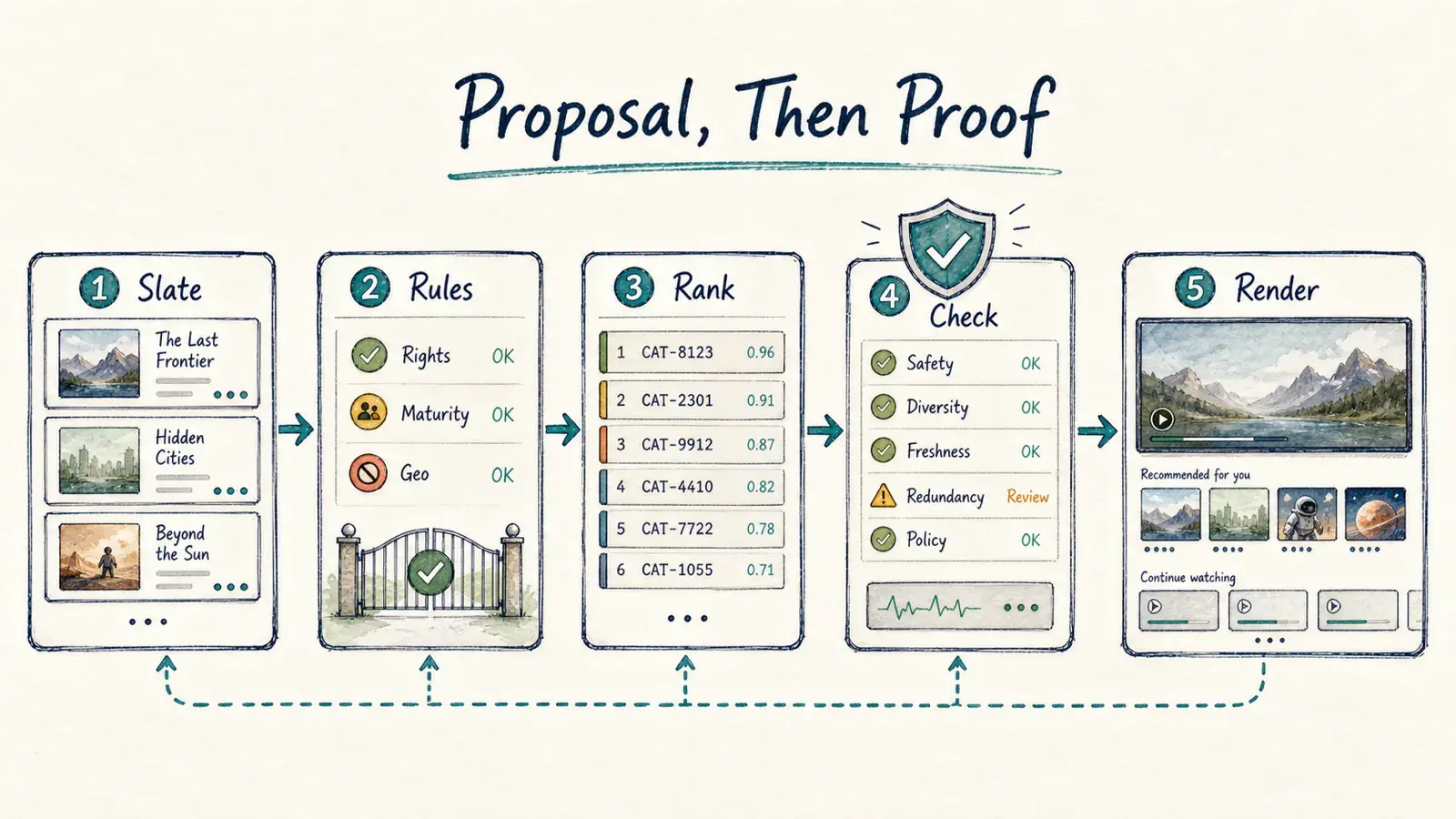
The architecture is not “ask the LLM what to show.” It is “ask the LLM to rank a grounded, eligible slate under a clear contract, then validate the response before the customer sees it.”
Classical systems retrieve candidates from collaborative signals, content similarity, search intent, continuation logic, editorial programming, trending systems, and business context. Deterministic filters remove titles the product cannot show.
The LLM receives a compact decision packet: broad profile context, the current session, the requesting surface, the objective, eligible catalog IDs, and approved facts about each title. It ranks the slate and may produce grounded explanations.
Then a validator asks:
- Are all returned catalog IDs valid and eligible?
- Are there duplicates or policy violations?
- Is every explanation supported by supplied facts?
- Did the output leak spoilers or make an unsupported claim?
- Does the response satisfy the schema?
If not, the system repairs, retries, or falls back to a deterministic path.
That is not a compromise. It is how probabilistic intelligence belongs inside a production product. The model output is a proposal. The product output is what survives validation.
One foundation, many discovery surfaces
Unifying discovery should not mean deleting retrieval, ranking, experimentation, feedback loops, or constraints. It should mean reducing duplicated or disconnected intelligence.
Search, homepage, post-play, collections, and assistants should become clients of the same discovery foundation. A better content representation, user memory, validator, or satisfaction signal then improves every surface instead of one isolated service.
That shared foundation also reduces contradiction. Search should not interpret a customer one way while the homepage expresses a disconnected profile and the assistant invents a third understanding. The surfaces can have different objectives and interaction models while drawing from the same governed facts and memory.
In this architecture, the LLM becomes the interface between human intent and machine decisioning.
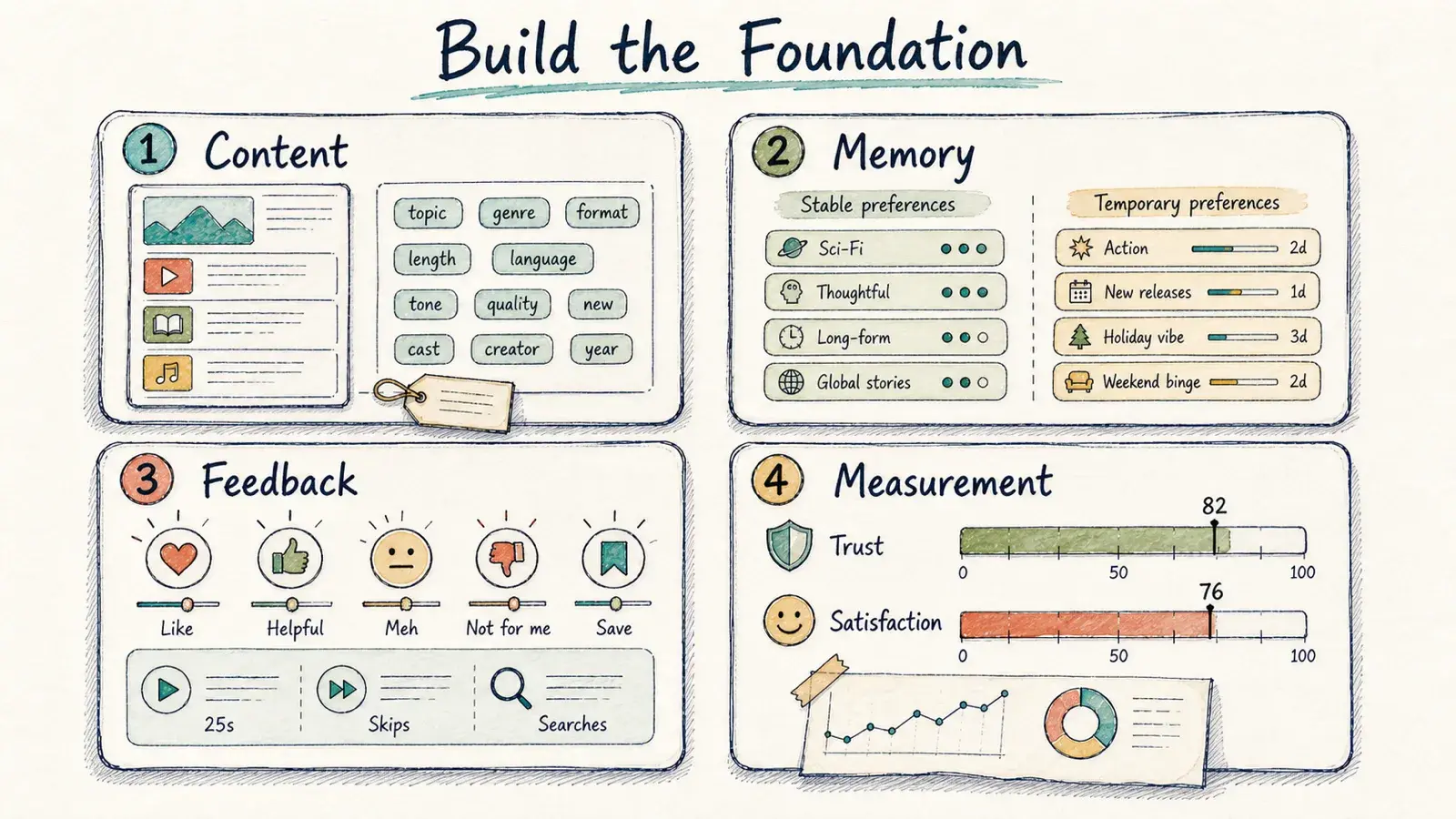
That changes where teams should invest:
- Content understanding. Catalog representations need spoiler-safe descriptions of tone, themes, pacing, intensity, humor, emotional payoff, audience fit, setting, and franchise relationships.
- Profile memory. The platform must distinguish stable preferences from temporary intent and accidental behavior. Memory should be conservative, profile-specific, privacy-aware, and legible.
- Feedback. Starts, completion, abandonment, saves, hides, and rewatching matter, but satisfaction may require lightweight ways to understand what the experience felt like.
- Measurement. The system must beat strong non-LLM baselines while protecting diversity, trust, latency, cost, rights, and profile rules.
Content understanding is especially foundational. The model cannot reason reliably about “comforting but not sentimental,” “shared-screen safe,” or “similar in atmosphere but faster” if the catalog representation contains only genre, cast, and synopsis. Those richer attributes also need confidence and provenance so the product knows which claims are safe to use.
Memory deserves the same discipline. Stable preferences, session intent, and accidental behavior should not collapse into one profile. A customer who wants a light comedy tonight has not renounced political thrillers. The system needs a way to honor the moment without rewriting the person.
AI excitement should not lower the launch bar. It should raise it.
I would begin with clear intent and a focused slate: post-watch recommendations, “because you watched,” or another moment where the system has fresh context and a manageable fallback. Prove the contract, validator, measurement, and trust model before touching the highest-blast-radius surfaces.
A focused launch also creates a cleaner comparison with the existing system. The team can measure whether the LLM improves ordering and explanation quality, inspect failures, and understand latency and cost without simultaneously redesigning the entire homepage. If the model adds no durable value over a strong baseline, the product should learn that before expanding the architecture.
Then expand deliberately.
The homepage can become less like independently optimized rows and more like a coherent expression of the customer’s relationship with the catalog. Search can become more intent-aware. Post-play can become more emotionally intelligent. Editorial programming can become more targeted without becoming manipulative.
Business strategy still needs a place. Premieres, tentpoles, live events, expiring titles, and franchise moments are part of a streaming product. But strategic signals should have a seat at the table, not the steering wheel. They can create measured exposure or break ties; they should not rescue an otherwise indefensible recommendation.
Their scope should be explicit: what the team is promoting, to whom, for how long, for what reason, and under which measurement plan. A governed strategic signal is visible and auditable. A quiet distortion of personalization is not.
The customer has to feel that the product is listening. If it starts to feel like it is merely promoting, personalization has failed.
The discovery brain
“LLM as recommendation engine” is wrong if it means handing a catalog to a model and asking it to improvise. It is right if the LLM becomes the primary reasoning layer over grounded, eligible slates while classical systems retrieve, deterministic systems enforce truth, validators protect the customer, and feedback teaches the platform what satisfaction means.
LLMs do not make recommendation science obsolete. They give us a new way to connect retrieval, ranking, context, constraints, and feedback to human intent.
The streaming service I would bet on is not the one that lets an LLM invent recommendations. It is the one that uses an LLM to unify discovery around a grounded, trusted, and continuously learning decision platform.
This writing reflects my personal perspectives on product management, AI, and content discovery. It does not represent the official position of my employer or any affiliated organization.