Article
May 25, 2026
5 min read
The Next-Week AI Playbook
Teams can make AI adoption concrete by redesigning one real workflow around evidence, reviewable artifacts, and accountable human judgment.
By Cristiano Pierry
Most AI adoption stays too abstract.
People attend a demo. They try a few prompts. They admire the tools. Then they return to the same workflow, with the same handoffs, the same blank-page friction, the same hidden assumptions, and the same review bottlenecks.
The better question is not, "How do we use AI?"
What recurring workflow should we redesign next week?
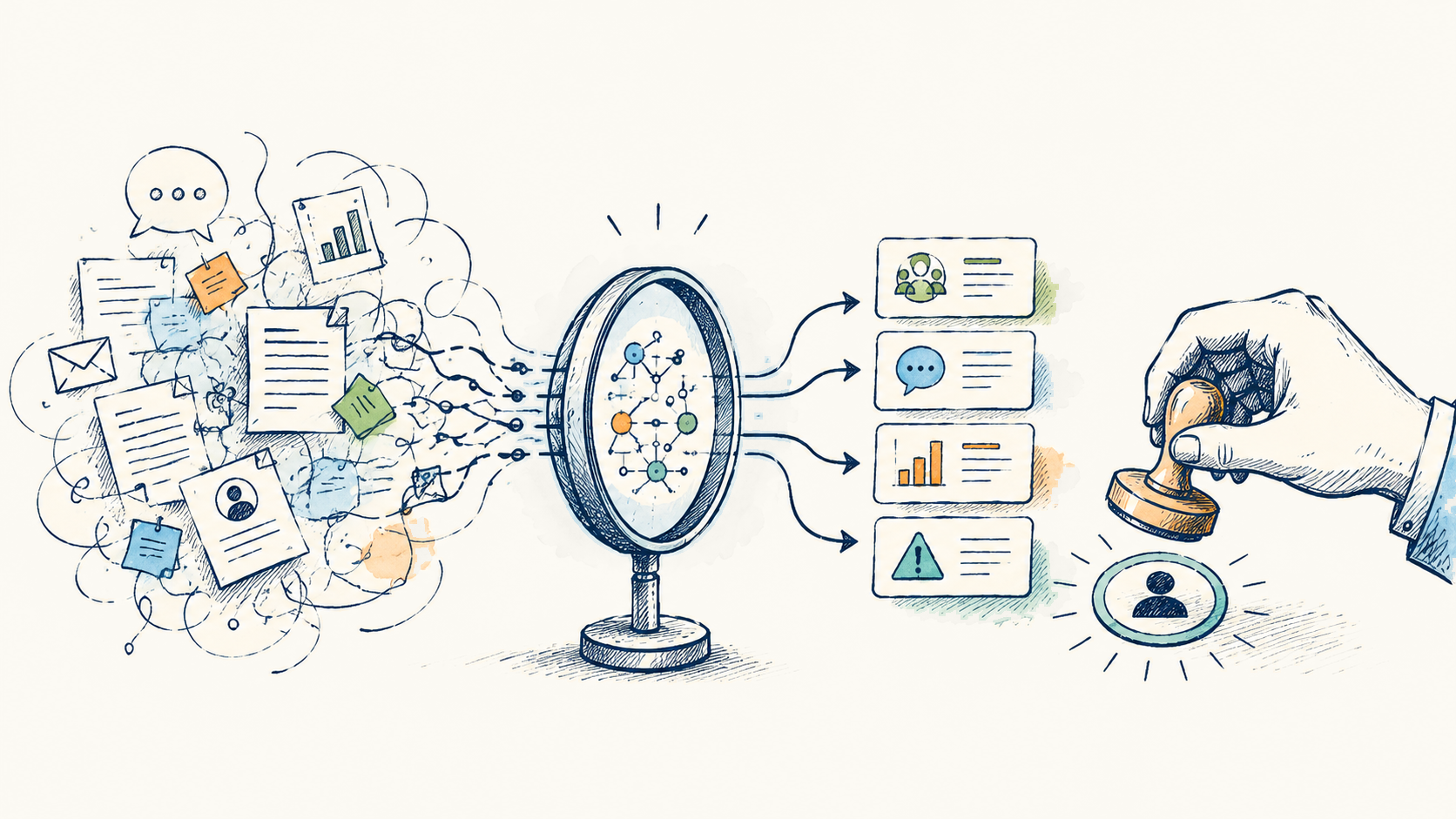
AI adoption becomes real when it changes the operating loop around actual work. Start with one recurring source of friction and one artifact the team already needs to produce, review, and trust—not an entire company transformation.
The target is better preparation, clearer evidence, faster iteration, visible verification, and more human attention on the judgment layer, not automation for its own sake.
Here is the playbook.

Choose
Pick a workflow that is real, repeated, and a little painful.
Good candidates usually have messy inputs, repeated judgment, avoidable blank-page work, or a review step where assumptions often stay hidden.
Examples:
- PRD cleanup
- Incident summary
- Roadmap option framing
- Meeting prep brief
- Customer feedback synthesis
- Test-plan generation
- Promotion packet prep
- Launch readiness review
Do not start with the biggest workflow in the organization. Start with a workflow close enough that you can inspect the inputs, understand the quality bar, and see whether the result improved the decision.
Define
Before you ask AI to do anything, define the work.
Name the output. Name the audience. Name the decision the artifact is supposed to support. Name the constraints. Name the source material. Name what good looks like.
This is the part teams are tempted to skip, and it is usually the reason AI output feels almost useful but not trustworthy.
The first prompt is not the work. The frame is the work.
The AI needs the same context a strong teammate would need:
- What are we trying to decide?
- Who will use the output?
- What sources should be trusted?
- What sources should be ignored?
- What is sensitive or off limits?
- What should be treated as unknown?
- What would make the output useful enough to review?

The clearer the frame, the less the model has to guess.
Build
Build a small AI-assisted version using real source material.
This does not mean building a production system. It means creating a working loop that produces the artifact in a new way.
For a PRD cleanup workflow, the loop might take rough notes, user feedback, and product constraints, then produce a tighter problem statement, open questions, missing evidence, and decision points.
For an incident summary, the loop might take logs, timeline notes, customer impact, and remediation steps, then produce a structured summary with unresolved questions and source links.
For a roadmap option review, the loop might take candidate bets, customer signals, engineering constraints, and strategic goals, then produce options, tradeoffs, risks, and questions for the team.
The important thing is that the output should be reviewable. It should make the team's thinking easier to inspect, not harder.
Verify
Verification is where the workflow earns trust.
Check claims. Check calculations. Check source quality. Check privacy. Check policy. Check assumptions. Check edge cases. Mark what is unknown.
Do not verify the generated output against itself. Go back to the source material.
This is the move that keeps AI from becoming autopilot. The model can help prepare the work, but the team still owns the standard.
A useful AI workflow should make uncertainty more visible.
It should expose missing evidence, unsupported claims, weak assumptions, and decisions that still require human judgment.
If the workflow makes a polished artifact while hiding uncertainty, it is not ready.
Share
The final step is to turn one useful workflow into a reusable pattern.
Save the prompt. Save the source checklist. Save the example artifact. Save the verification step. Write down what failed. Write down what improved. Write down where the human still had to decide.
Adoption spreads through concrete examples of work that became clearer, faster, more reviewable, and more trustworthy—not vague encouragement to "use AI more."
The best next-week artifact is not just the output. It is the loop:
- The input sources
- The framing prompt
- The generated artifact
- The verification checklist
- The human decision
- The lesson the team can reuse
What not to do
Do not start with a giant automation project.
Do not use sensitive data before the workflow is approved.
Do not treat the first output as finished.
Do not measure only speed.
Do not automate a workflow nobody understands.
Do not create more output unless it improves the quality of the decision.
AI can make weak thinking faster. The point of the playbook is to make good thinking easier to repeat.
What good looks like
A good next-week workflow should produce a clearer artifact, fewer blank-page starts, more visible assumptions, easier review, and a human-owned final decision.
The team should be able to say:
- Here is the old workflow.
- Here is the AI-assisted loop.
- Here is what stayed human.
- Here is what improved.
- Here is what we would reuse.
- Here is what we would not trust yet.
One honest loop is enough to teach the team how to work differently.
Next week, do not ask everyone to use AI more.
Ask each team to bring one redesigned workflow: the prompt, the artifact, the verification step, and the lesson learned.
Repeated, reviewed loops are how AI adoption becomes an operating habit.
This writing reflects my personal perspectives on product management, AI, and content discovery. It does not represent the official position of my employer or any affiliated organization.