Work in progress
The Art of Making Algorithms Understandable
One of the hardest parts of leading search and recommendations is explaining the system well enough that other people can make decisions about it.
The user sees a row of titles. An executive sees a homepage. Marketing sees a campaign. A scientist sees a model. An engineer sees retrieval, ranking, and constraints. Each view is legitimate, but none explains the whole product.
The product manager has to connect them without making the system sound simpler, more deterministic, or more magical than it is.

PRDs, architecture diagrams, strategy decks, dashboards, ranking examples, and verbal walkthroughs all help. They are still necessary. But probabilistic and personalized systems expose the limits of each artifact.
A PRD describes intent but may not show behavior. A dashboard shows that a metric moved but may not explain why. A system diagram names components but may not build intuition. A ranking formula can be accurate and still lose the room.
When intelligence remains invisible, stakeholders reason from symptoms. They see one surprising recommendation or campaign placement and try to infer the system from that outcome. That is a poor way to understand a complex product and an even worse way to govern it.
The explanation gap
Most AI product teams live with a gap between the people building the system and the people making decisions about it.
The builders know which signals are strong, noisy, experimental, or constrained. They understand retrieval, ranking objectives, calibration, feature interactions, and edge cases.
The decision-makers need a different level of detail. Executives need to understand strategic tradeoffs. Marketing and editorial teams need to know how their intent enters personalization. Designers need to know what behavior the interface should expose. Legal, policy, and brand teams need to see where safety and judgment enter the system.
They do not all need the model architecture. They do need a faithful mental model.
“The model personalizes the experience” is too vague to trust. A technically complete description of candidate generation, embedding spaces, contextual features, slate optimization, and post-ranking constraints may be too dense to use in the meeting where a decision has to be made.
Product translation preserves the important logic without burying the audience in implementation detail.
That is not dumbing the system down. It is choosing the layer of explanation that lets the audience reason correctly.
The gap becomes wider with concepts that are both technical and invisible. A sequence model can use earlier behavior to interpret what a user may want next, but “attention,” “embeddings,” and “context” do not automatically create intuition outside the technical team. Even familiar product words become slippery. Personalization, relevance, optimization, and AI-driven can each describe several different mechanisms and objectives.
An explanation has to convert those words into observable behavior. What evidence changes the ranking? Which rule can overrule the model? What happens when signals disagree? Where can a human intervene? If the artifact cannot answer those questions, it may be describing the components without explaining the product.
Show the decision, not only the components
Search and recommendation systems are difficult to explain because the visible result hides a sequence of decisions.
The system interprets a user or query, gathers candidates, scores them, applies availability and policy constraints, balances objectives, assembles a slate, and learns from what happens next. The interface compresses all of that into a row, a result, or a module.
A single recommendation is easy to criticize because it is visible. The system that produced it is harder to defend because it is abstract. An explanatory artifact has to make enough of that system visible for the disagreement to become useful.
LLMs give product managers a new explanatory medium. They can help transform a technical design into a walkthrough, storyboard, animation, or interactive simulation. The useful shift is from describing the machinery to showing how the machinery behaves.
The traditional artifact describes the system. The new artifact can show the system behaving.
I explored this through an Algorithm Animation project built around a concrete question: what should happen when a campaign enters a personalized discovery environment?
A campaign is not operating in empty space. It is interacting with a recommendation environment. In the animation, I wanted that interaction to be explicit enough to debate: should campaign intent create eligibility, boost an already relevant title, reserve placement, or leave a user's slate alone?
Consider three eligible titles. One has high predicted relevance for the user. One is broadly popular. A third is part of a strategic campaign but has weaker personal evidence. A static diagram can show the signals. An animation can show the decision changing:
- Candidate titles enter the slate.
- Personal and contextual signals shape the initial order.
- Campaign intent enters as a bounded influence rather than a magic override.
- Frequency and diversity rules constrain that influence.
- The final slate makes the tradeoff visible.
That sequence makes the point of disagreement visible. The team can debate where the rule belongs, which constraints should contain it, and what evidence would justify it.
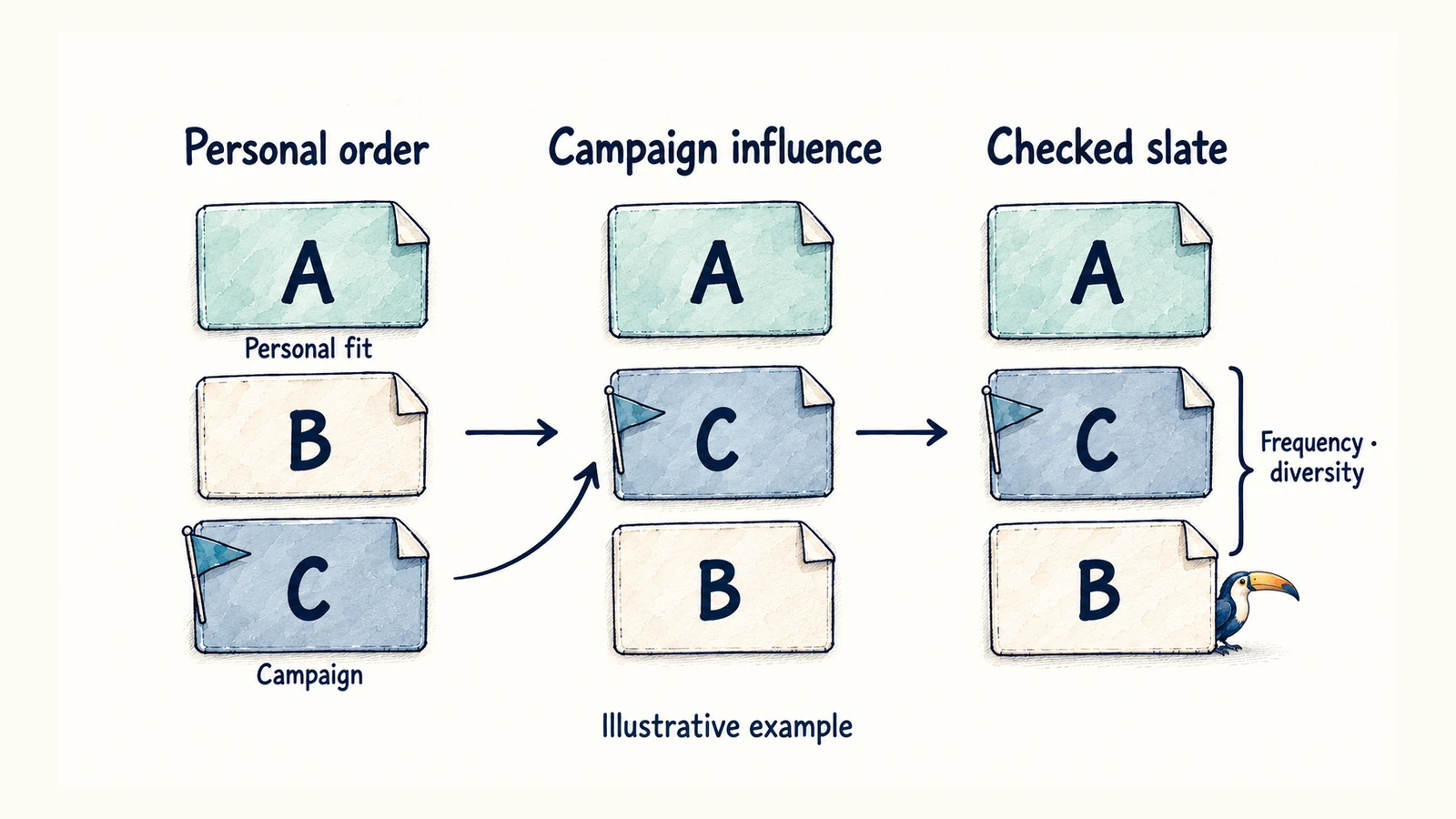
It can also expose choices that a static phrase conceals. “Campaigns should influence recommendations” sounds like one requirement. In practice, it could mean adding candidates, changing scores, reserving inventory, reordering a row, or applying a temporary business constraint. Each mechanism has different implications for personalization, fatigue, experimentation, and accountability.

The explanation is valuable because it makes the argument inspectable. It does not ask the room to accept “AI-driven personalization” as an answer.
Animation is only one format. The same principle can produce a narrative walkthrough, a storyboard, a simulated user journey, or an interactive tool that lets a stakeholder change an input and observe the result. The medium matters less than the ability to connect a product decision to visible system behavior.
This does not replace technical documentation. Architecture diagrams, model cards, experiment readouts, and requirements remain sources of truth. The explanatory artifact sits above them as a shared surface for reasoning across disciplines.
Faithful is more important than complete
A good explanation does not need every implementation detail. It does need to preserve the relationships that matter.
It should show which forces interact, where constraints apply, and which tradeoffs are intentional. It should not imply that a probabilistic system is deterministic, that one signal controls a multi-signal outcome, or that an LLM knows facts the platform has not supplied.
This is where LLMs are both useful and dangerous. They are good at translating a dense explanation for different audiences. They can find analogies, produce a sequence, and turn abstract behavior into a concrete scene. They can also make a wrong explanation sound elegant.
The model can draft and simplify. The PM still has to inspect. Scientists and engineers still have to validate the mechanics. The final artifact must be checked against what the system actually does—or clearly labeled as an intended future design.
The target is not the easiest explanation. It is the simplest faithful representation of the system.
Faithfulness also requires being explicit about uncertainty. The artifact should distinguish measured behavior from a product hypothesis, a deterministic rule from a learned preference, and a current implementation from an intended future state. A simulation that blurs those categories may create alignment in the meeting and confusion during implementation.
That is why review by technical partners is not a ceremonial final step. A scientist should be able to challenge the strength of a claim. An engineer should be able to identify a constraint shown in the wrong place. The artifact improves when those disagreements become visible before the explanation hardens into organizational belief.
A reviewable artifact changes the conversation
Executives rarely need code-level detail. They do need enough understanding to decide whether personalization is reducing editorial control, whether a campaign can reach an audience without degrading trust, whether the system can discover deeper catalog titles, and whether the objective favors short-term clicks or long-term satisfaction.
Those are product strategy questions with technical foundations. Treating the algorithm as a black box prevents the organization from answering them honestly.
A useful executive explanation focuses on the shape of the system. It should reveal where customer intent enters, how business priorities participate, which protections are non-negotiable, and what evidence tells the team that the experience is improving. Executives do not need to reproduce the ranking pipeline, but they should be able to ask what the system optimizes and what it is allowed to sacrifice.
The artifact should not merely persuade. It should be reviewable.
A reviewable artifact gives each discipline something concrete to challenge:
- A stakeholder can ask whether the behavior matches the strategy.
- A scientist can identify an overstatement.
- An engineer can correct where a constraint applies.
- A designer can see which system state the interface needs to expose.
The artifact may sit somewhere between a PRD, prototype, system diagram, and teaching tool. Before development, it aligns intended behavior. During development, it reveals drift. Before launch, it helps pressure-test edge cases. After launch, it explains what changed and why.
This makes the artifact part of the operating model rather than a one-time presentation. The team can return to the same representation as assumptions change, experiments produce evidence, or new constraints enter the product. A living explanation becomes a bridge between strategy and implementation because it gives both sides a stable object to revise.

The discipline behind the explanation
A beautiful animation can make a weak idea look strong. A smooth narrative can hide uncertainty. A simple metaphor can erase a tradeoff. The discipline is keeping the artifact connected to the truth of the system.
That means starting with the actual architecture or intended design, deciding which details can be abstracted safely, and reviewing the result with technical partners. It means labeling simplifications and distinguishing what exists today from what the team proposes to build.
The best version of this work is not theater. It is product clarity: making a complex system legible without changing its meaning.
That role is a translation among three kinds of intelligence:
- Machine intelligence: models, signals, rankings, predictions, and generated output.
- Organizational intelligence: strategy, constraints, brand judgment, and business priorities.
- User intelligence: intent, taste, attention, behavior, frustration, and satisfaction.
The PM connects these layers. AI makes that translation harder because the system is more probabilistic, the output is more fluent, and the failure can be less obvious. It also gives the PM new tools for doing the work, provided the explanatory artifact remains connected to the mechanics.
As AI becomes more central to products, that translation becomes a leadership skill. Search and recommendations shape what people find, watch, buy, read, and believe is available. They influence attention and demand. They are too important to leave opaque.
Teams that understand the behavior of their systems can make sharper decisions about editorial control, business influence, user trust, and long-term satisfaction. Teams that rely on a polished black-box story may discover the real tradeoffs only after users do.
The black box will not disappear. But a faithful, reviewable explanation gives the organization a better way to reason about what is happening inside it—and a better chance of building the system responsibly.