Work in progress
The Camera Is Becoming Software
The dedicated camera did not disappear when the phone became the default camera. It became a more specialized tool.
The SLR, DSLR, and now mirrorless camera have not become irrelevant. They are still the right tool for sports, wildlife, studio work, long glass, controlled lighting, commercial shoots, and any situation where repeatability, optics, speed, and control matter more than convenience.
But for the everyday photograph, the phone has won.
The iPhone does not have a better lens than a state-of-the-art mirrorless camera. The tiny phone sensor does not beat a full-frame sensor on physics.
The phone won because its camera is a real-time computational imaging system.
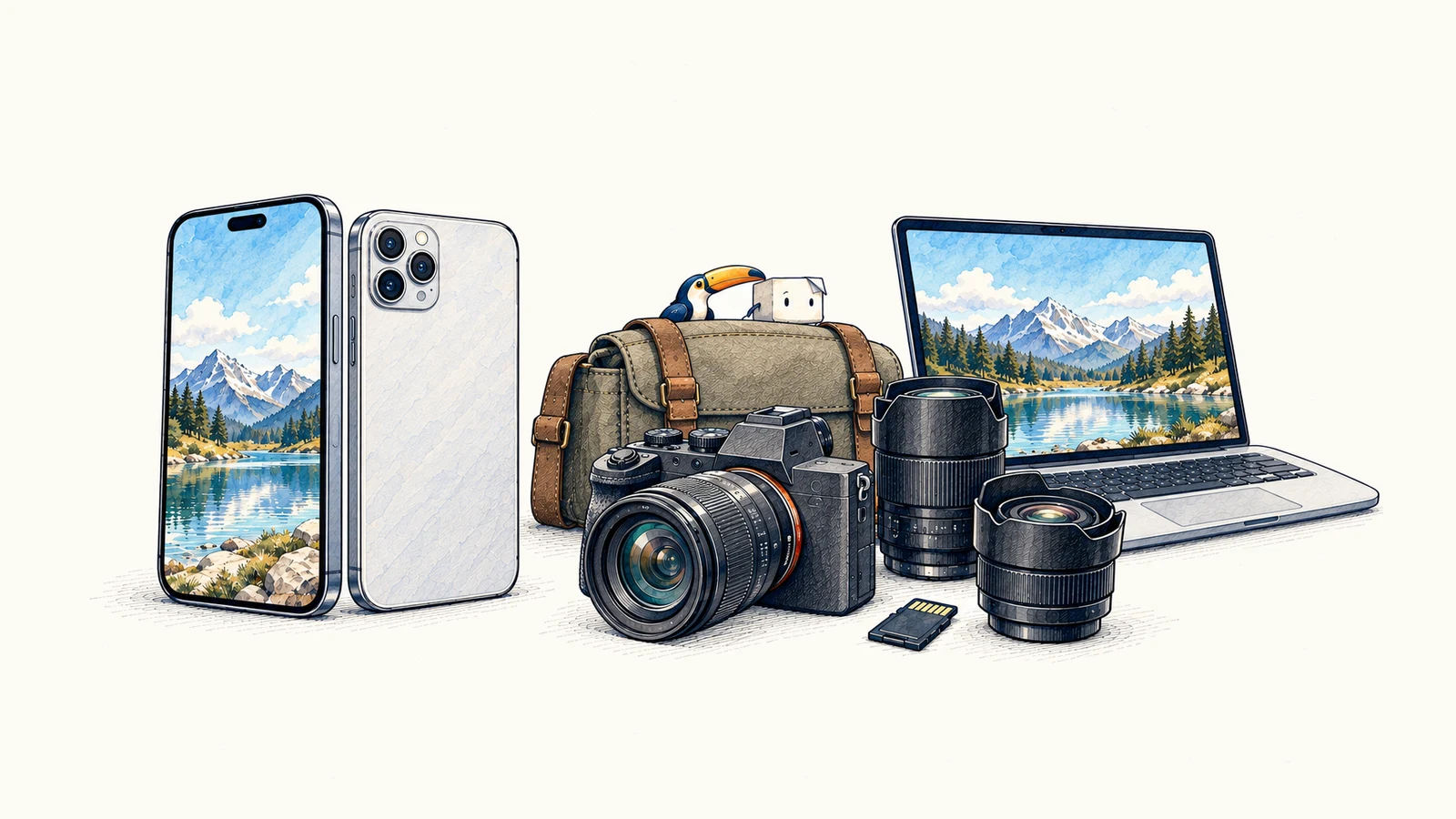
I felt this directly on a recent family trip to Costa Rica. I brought a Sony A7R VI and a couple of Sony G Master lenses. This was not a casual camera setup. It was a serious, high-end mirrorless kit with exceptional glass, exactly the kind of gear that should have made the iPhone feel unnecessary. And yet, for casual family photos, I kept reaching for my iPhone.
The Sony was clearly the more capable photographic instrument. It had the better sensor, the better lenses, more control, more resolution, and far more flexibility in post.
But most family moments are not controlled shoots. They happen while walking, eating, waiting, laughing, moving through humidity, rain, changing light, and the small in-between moments that make a trip memorable. In those situations, the iPhone was simply the better capture system. It was already in my hand. It did not require a lens choice. It did not change the social dynamic. It did not pull me out of the moment and turn me into “the photographer.”
The dedicated camera still wins when I am intentionally photographing. The phone wins when I am living and want the photograph to come along for the ride.
Take the sunset example. This is one of the most common and most difficult scenes for any camera. The sky is bright. The foreground is dark. The colors are changing quickly. The person taking the photo usually does not want to think about exposure bracketing, dynamic range, raw processing, highlight recovery, or whether the shadows can be lifted later.
They want the photo to look like what they felt.
On a mirrorless camera, you can absolutely capture that scene beautifully. But the usual path requires intent: expose for the highlights, shoot RAW, maybe bracket multiple exposures, maybe use a tripod, and then recover the image later in Lightroom or Capture One.
On an iPhone, the default camera experience does much of that invisibly. Apple says the iPhone’s HDR mode takes several photos in rapid succession at different exposures, then blends them to preserve highlight and shadow detail. By default, iPhone uses HDR automatically when it thinks the scene needs it.
The phone does not ask the user to understand the scene technically. It interprets the scene, captures more data than a single frame, and renders a finished image.
Night mode pushes this further. Apple says Night mode on supported iPhones turns on automatically in low light, with capture times that may take several seconds depending on the scene. It also gives guidance when motion is detected to help reduce blur. Google’s Night Sight took the same idea in an even more explicit direction: capture multiple frames, align them, merge them, reduce noise, and tone map the result into something usable from a handheld device. Google described Night Sight as producing sharp, clean photos in very low light without requiring a tripod or flash.
Google’s HDR+ research describes a computational photography system that captures, aligns, and merges a burst of frames to reduce noise and increase dynamic range. It is not just taking one photo and making it brighter. It is using multiple raw frames, alignment, denoising, tone mapping, and software judgment to create the final image.
This is why the phone feels easier. The mirrorless camera records the scene; the phone also interprets it, edits it, and packages the result for the display and the sharing workflow.
The phone won the default workflow
The important distinction is not image quality in the abstract. It is image quality at the point of use.
A full-frame RAW file may contain more recoverable information than a phone image. But the user has to recover it. They have to know what to do with the file. They have to make choices.
The phone makes those choices automatically.
This is why sunsets, restaurants, family moments, night streets, concerts, and travel snapshots often look better straight out of an iPhone than straight out of an expensive camera. The dedicated camera may have better optics and a better sensor, but it often gives you a technically honest file. The phone gives you an opinionated result.
That opinionated result is the product.
Apple’s camera stack now uses scene understanding as part of the image-making process. Apple’s machine learning research describes how segmentation can identify people, skin, sky, hair, teeth, glasses, and other regions, then use those masks to drive Smart HDR, Photographic Styles, denoising, sharpening, Portrait mode, and semantic rendering.
That matters because the phone is not processing the image uniformly. It can treat the sky differently from a face. It can protect skin tones while changing the look of the rest of the scene. It can denoise a flat sky differently than textured foreground detail. It can decide what parts of the image should feel natural, what parts should feel dramatic, and what parts should be protected from over-processing.
Traditional cameras have image processors too. They have JPEG engines, autofocus systems, subject detection, lens correction, noise reduction, film simulations, and more. But the phone made computation the core capture experience. Most dedicated cameras still treat computation as an option, a mode, or something you do later.
That difference moved the center of the everyday camera experience from capture to computation.
Dedicated cameras are not dead. They are being pushed upmarket.
The dedicated camera market tells the same story.
CIPA's shipment data shows that worldwide digital camera shipments reached 121.46 million units in 2010. Its 2025 report records 9.44 million units. The timing overlaps with the rise of the smartphone as the default point-and-shoot camera, although shipment data alone does not prove causation. The market that remains is structurally smaller and more specialized than it was at the peak. DSLR shipments continued to fall in 2025, while mirrorless carried most of the interchangeable-lens category.
Photography did not die. Casual dedicated-camera ownership largely did.
The person who once bought a Canon Rebel or Nikon D-series kit for vacations, kids, birthdays, and sunsets now already owns a great camera in their pocket. More importantly, they own a camera connected to their photos, messages, social apps, cloud storage, and editing tools.
The phone did not only replace the camera. It replaced the camera workflow.
That is why the dedicated camera’s future is in specialized jobs: birds, soccer fields, weddings, studios, fashion, product photography, cinema, journalism, fine art, macro, and anything that requires reach, speed, lighting control, physical controls, or a file that can survive serious post-production.
I still want a real camera in those situations.
- I do not want to photograph wildlife with an iPhone.
- I do not want to shoot a basketball game from the baseline with a phone.
- I do not want to light a studio portrait, tether into a professional workflow, and rely on a phone’s semantic rendering to decide what skin should look like.
But that is exactly the point. The dedicated camera is no longer the general-purpose answer. It is the high-intent answer.
So why do camera manufacturers not just add computational photography?
The more accurate answer is that they do add some of it. They just have not turned it into the center of the product.
OM System is probably the most visible example. Its OM-3 has a dedicated computational photography button and built-in features such as Live ND, Live GND, High Res Shot, Focus Stacking, Live Composite, HDR, and AI subject detection. Fujifilm's X-H2 can record 20 sensor-shifted RAW frames that its Pixel Shift Combiner software merges into a 160-megapixel image. Nikon’s Z8 pixel shift workflow is similar in spirit: it is intended for static subjects, usually on a tripod, and the images are merged later in Nikon NX Studio rather than in-camera.
Canon and Sony also have AI and computational features, but they tend to show up in narrow parts of the system. Canon’s EOS R5 Mark II manual describes neural network noise reduction as a deep-learning process that can create clearer JPEG or HEIF images, while cautioning that the processing may take time. Sony’s Alpha 1 II uses an AI processing unit for subject recognition, autofocus, tracking, and pose estimation, which is extremely valuable, but that is not the same as a phone-style multi-frame computational image pipeline for every shot.
This is the gap.
Camera companies have computational tools.
Phone companies have computational defaults.
There are several reasons for that.
- First, a phone is a vertically integrated system. Apple, Google, Samsung, and other phone makers control the sensor module, lens stack, ISP, neural processor, display, operating system, camera app, photo library, and sharing workflow. They can tune the whole system end to end. A mirrorless camera is a platform. It may support dozens or hundreds of lenses, flashes, filters, adapters, profiles, codecs, RAW workflows, and professional expectations. The variability is much higher.
- Second, professional photographers value predictability. A phone can make hidden semantic decisions because most users want a pleasing result. A working photographer often wants a controllable file. If the camera decides to brighten one face, darken a sky, smooth a skin region, or locally sharpen hair, that may be helpful for a family snapshot. It may be unacceptable for commercial work.
- Third, multi-frame capture has costs. It can introduce latency. It can create ghosting. It can fail with moving subjects. It can heat the processor. It can drain the battery. It can slow down review, burst shooting, and buffer clearing. In the contexts where dedicated cameras still win, those tradeoffs matter.
- Fourth, the economics changed. The phone industry has the scale to pour massive investment into computational photography because the camera is one of the reasons people upgrade phones. The dedicated camera industry is now much smaller. In a 2023 DPReview interview, Sigma CEO Kazuto Yamaki said smartphone image quality had improved dramatically through computational photography and that camera and lens manufacturers needed to learn from it, while also respecting the culture and quality expectations of serious photography.
Camera makers cannot simply copy the phone: professional workflows impose different requirements. But they also cannot ignore what the phone proved about computation as a default.
The next camera should be more like an AI capture system
The opportunity is not to turn a Sony, Canon, Nikon, Fuji, Leica, or OM System camera into a smartphone.
The opportunity is to combine the strengths of both systems.
Imagine a mirrorless camera that treats computation as part of capture, not just post-processing.
- It could detect that a sunset exceeds the dynamic range of a single exposure, automatically capture a short RAW burst, align it, merge it, and output both a finished image and an editable computational RAW with a transparent sidecar.
- It could make the computational choices visible: sky mask, face mask, highlight recovery, shadow lift, denoising strength, tone curve, motion rejection.
- It could let the photographer roll those choices backward.
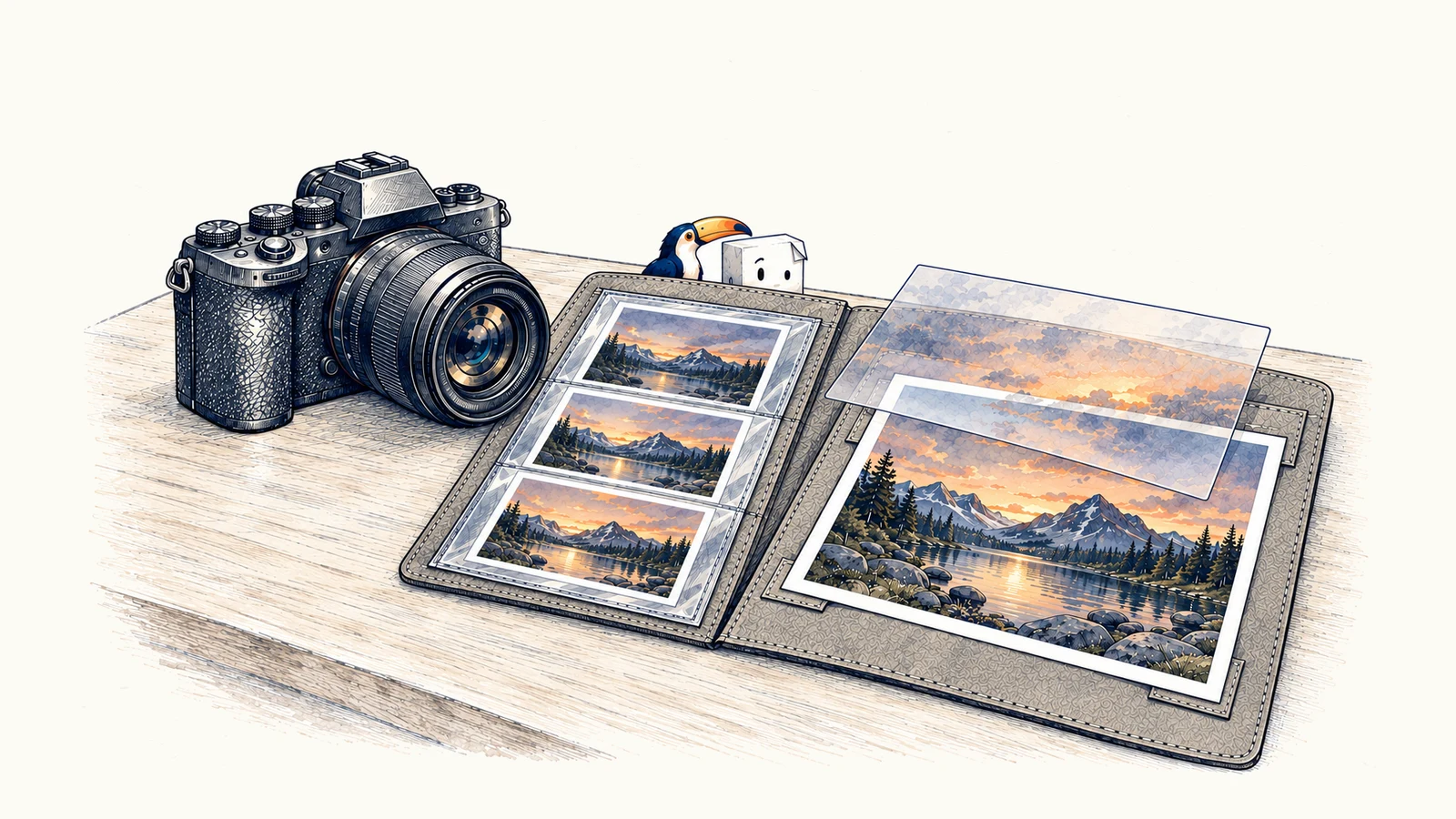
- It could create a JPEG for immediate sharing, a high-quality HEIF for modern displays, and a RAW stack for later editing.
- It could use AI not to make fake photos, but to reduce friction: focus miss detection, duplicate grouping, subject-aware culling, exposure safety checks, lens-specific correction, depth-aware sharpening, and automatic transfer into the editing workflow.
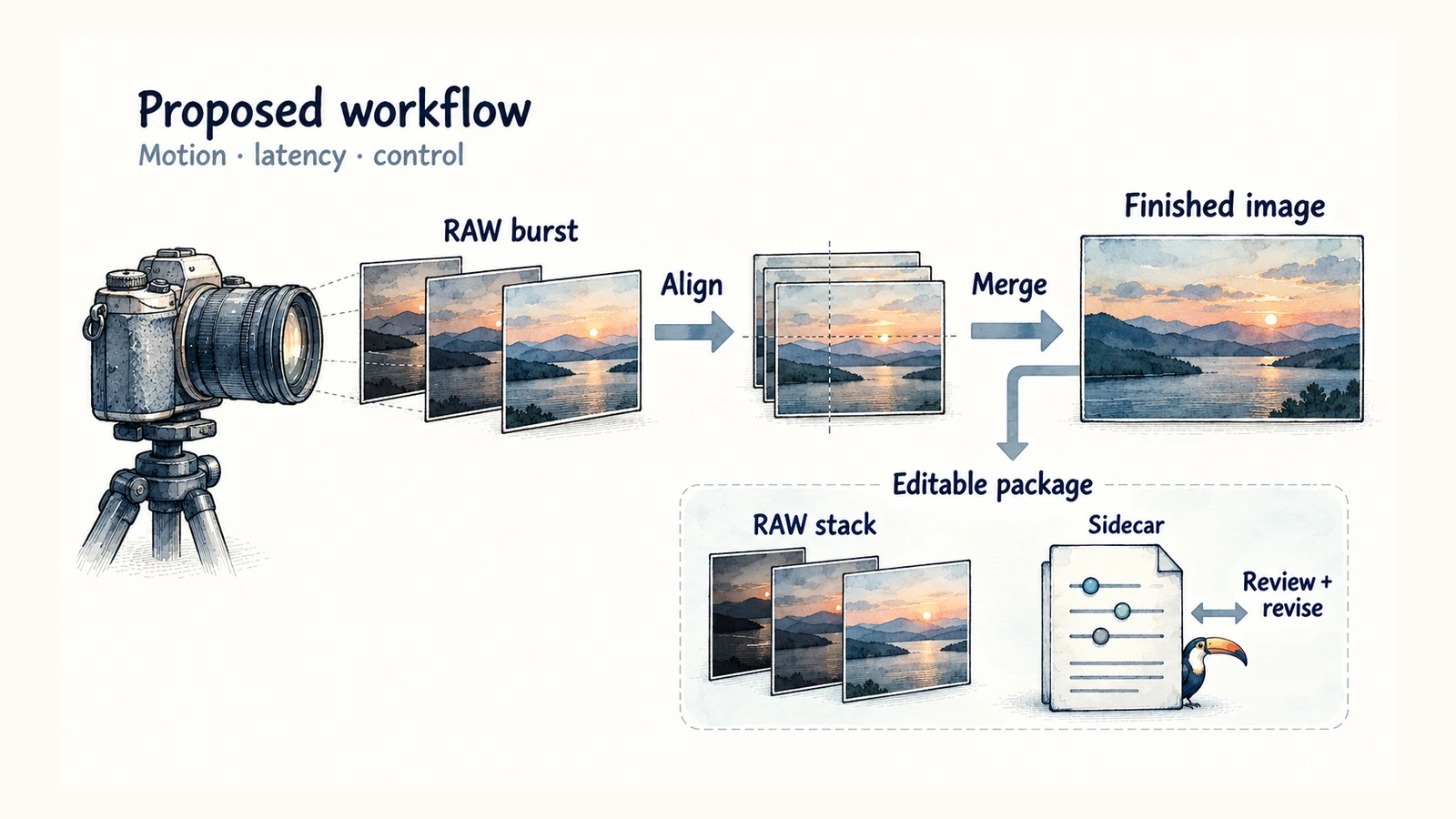
That would be a professional computational camera: a serious imaging system where the software exposes its decisions and respects the photographer's control.
This is where camera makers have an opening. Their advantage is not that they can beat the phone at being a phone. Their advantage is that they can apply computation to better sensors, better optics, better ergonomics, longer lenses, faster shutters, strobes, and professional workflows.
The future camera should not ask the user to choose between optical quality and computational intelligence.
It should deliver both.
The image is made by the system
The camera body, lens, and sensor still matter. But the image is increasingly made by the full system: capture, computation, display, editing, and distribution.
The iPhone can win the sunset even when the mirrorless camera has better glass because it performs the interpretation by default. The mirrorless camera often waits for the photographer to do that work.
For professionals, that control is part of the craft. For the casual user who just wants the picture, it is friction. The dedicated camera is therefore becoming more specialized, more intentional, and more professional.
The phone owns the everyday memory.
The dedicated camera owns the deliberate photograph: sports, wildlife, studio work, commercial shoots, weddings, cinema, and the moments where physics, optics, timing, and control still matter.
The next major step in photography will come when camera makers stop treating software as an accessory and make it part of the shutter press. The lens remains essential, but the pipeline is becoming the camera.