Character design · Interaction · Animation
Creating the Avatar
A small painted bird became a surprisingly demanding test of how software, illustration and attention fit together.
An open workshop. Working behaviors and unresolved animation defects are documented separately.
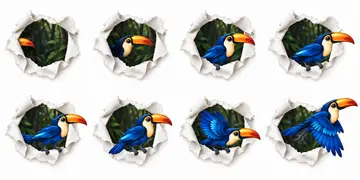
Following the reader
This began as a weekend personal website project. The original idea was to add article metadata and content classification so a companion could follow a reader, find somewhere sensible to perch and draw attention to an important section. The bird needed a reason to move, and the writing needed room to remain the main event.
The implemented reading moments are editorial annotations: takeaway, funny, thoughtful and surprising. A stable passage identifier connects the marked block to a visible cue. The controller measures that block and nearby supports, checks obstacles and cooldowns, then chooses whether to look, move or remain still. It does not infer a reader’s emotions or classify every sentence with a language model.
- Content: a curated MDX marker identifies a passage and its intended reading moment.
- Attention: visibility, proximity, current action and a per-cue cooldown determine eligibility.
- Movement: measured borders, image edges and section boundaries offer real support; text and controls remain obstacles.
- Conversation: clicking the companion opens Ask Me Anything with a public page or passage locator. The server resolves canonical content rather than trusting supplied passage text.
Broader automatic classification and richer semantic choreography remain possible next steps. The current system uses explicit metadata, bounded rules and visible page geometry.
How the painting moves
The accepted character keeps its orange bill, cream chest and blue feather treatment. An early volumetric rendering study changed that identity too much. The retained approach starts with painted views and deliberately authored poses, then registers them in a common 320-pixel coordinate space.
The production renderer combines pose textures, motion fields, anatomical ownership masks, hidden backing paint and selected triangulated surface maps. It is a 2D painted system with changing perspective. It is not a complete three-dimensional skeleton, and the eye and contact annotations are measured landmarks rather than universal bone joints.
Attachment and occlusion contract
- Head, bill and eyes
- Bill and eye ownership must follow the same head surface. Disagreeing source silhouettes can create doubled features during interpolation.
- Torso, shoulder and wings
- Concealed torso paint fills areas exposed by lifted wings. Physical near/far wing identity must survive a turn.
- Feet and tail
- Measured contacts anchor the planted foot while the body moves. Tail roots must remain attached and retain their winding through the common surface map.
The gallery overlays retained eye and contact coordinates on each pose. The aviary’s live contact guide marks the selected support; its close-up is an inspection of the actual render, not a claim of additional painted detail. Runtime color cells are currently 160 × 160 pixels, with 320 × 320 geometry. Larger source sheets remain available separately.
Observe, then inspect
The aviary runs the same page controller, measured surfaces, resource encounters and painted renderer as the website. The clip bench exposes every catalog entry separately, including unfinished material. Opening it transfers character ownership to the aviary.
The retained artwork
Browse native paintings, body-part evidence, earlier studies, registered poses and production atlases. Inspect actual pixels and source dimensions without enlarging thumbnails into supposed originals.
From a painting to a behavior
The retained source sheets and their provenance are the starting point. Registration recipes extract a view, place its contacts and eye landmarks in a shared coordinate space, and retain hidden paint for surfaces revealed during movement. Masks assign visible pixels to their anatomical owner. Adjacent poses then need a correspondence map that keeps their shared attachment points together.
A clip specifies its pose route, timing, support state and recovery. The movement controller supplies the route through the page, planted foot targets and heading. The renderer supplies the painted pose between those targets. Readiness holds keep an action from finishing while its textures are still loading; interruption paths return through compatible poses before admitting another activity.
Calm, curiosity, hesitation and alertness are design interpretations expressed through posture, gaze and pauses. A glance leads a move; a crouch precedes release; a landing finishes before inspection. Quiet periods and per-cue cooldowns make the repertoire varied over time. They are not an attempt to infer the bird’s internal emotions.
The complete paper ritual belongs to the homepage, where its opening is attached to the actual logo and page. Use the toucan controls there to request Return home, then Come out. The aviary exposes the same painted poses, while the homepage remains the reference for paper occlusion and session restoration. Inspect the homepage sequence.
Behavior inventory
The clip selector is generated from the actual catalog, including both authored directions. Three retained catalog entries are not enabled in ordinary behavior; the inspection bench identifies them. A clip name alone does not certify natural movement.
| Family | Sequence | Implementation boundary |
|---|---|---|
| Rest and attention | Breathing, blinks, glances, inspection, quiet closed-eye rest and directional turns. | Enabled. Some turning attachment boundaries remain under repair. |
| Supported movement | Separate step and hop families, crouch, leg push, airborne passage, contact and recovery in both directions. | Hop and step repairs installed. Full project regression is tracked separately from candidate reviews. |
| Flight | Takeoff, side and three-quarter wingbeats, glides, banking, approach and landing. | Enabled. Large wing-fold transitions still show interpolation defects; experimental repairs are not installed. |
| Feather care | Wing and breast preening, lifted-wing care, stretching and deep tucked rest with recovery paths. | Enabled in both directions. Quiet closed-eye rest and a deep bill tuck are different actions. |
| Fruit and water | Notice, approach, grasp, lift/toss, swallow and removal; water entry, bathing, exit, shake and preen. | Enabled with right-facing authored art, safe-surface admission, cooldowns and interruption cleanup. |
| Paper entrance | Rip, curious emergence, flap contact, page departure, home approach, inward jump, closure and logo wink. | Homepage owner and session restoration implemented. Paper parts mask concealed anatomy. |
What real toucans contributed
The silhouette resembles a toco toucan, with a deliberately stylized blue body. Zoo accounts support strong-footed branch hops and flap-and-glide flight. Recorded preening samples show the bill reaching the upper wing and back, followed by an upright recovery. Research on sleeping tocos supports a deep bill tuck. Comparative bird studies inform the ordering of push-off, braking and contact, without supplying toco-specific force or timing measurements.
Website timings, quiet periods, route limits and the frequency of fruit or water are interaction-design decisions. Sampled footage cannot establish uninterrupted foot contact or a measured wingbeat frequency.
The difficult part was continuity
A convincing pose did not guarantee a convincing movement. Two attractive paintings could disagree about where a wing attached, which cream edge belonged to the neck or how much tail sat behind the body. Blending them exposed holes and doubled contours. More intermediate motion did not repair that disagreement.
The hop repair connected common body and tail surfaces while preserving deliberate foot release. Turning and large flight folds still expose the limits of the original representation. Those candidates remain experiments until a complete movement, its recovery and its neighboring actions pass at normal and quarter speed.
The practical next test is one complete bilateral turn or wing-fold movement built from consistent shared parts and complete concealed anatomy, compared with a deliberately authored frame sequence. Existing paintings, behavioral scheduling, page geometry and source tooling can be retained. A wholesale rig replacement has not been started.
Quality checks separate numerical integrity, runtime behavior and visual acceptance. A reproducible build can prove that the same assets were installed; it cannot prove that a bird looks alive. The project therefore preserves source dimensions, rejected approaches and explicit limitations alongside the working interaction.