Article
May 6, 2026
8 min read
How Much More Can We Do With the Same?
AI changes how product teams ideate, prototype, evaluate, and launch. The real leadership challenge is turning that speed into better judgment and customer value.
By Cristiano Pierry
AI is software that can infer from data and context to produce predictions, recommendations, content, decisions, or actions that previously required human judgment.
That is the practical definition I use. It is imperfect, but it helps distinguish AI from both science-fiction claims and ordinary automation. As a capability layer, it lets systems perceive, predict, generate, reason, decide, and act with varying levels of autonomy.
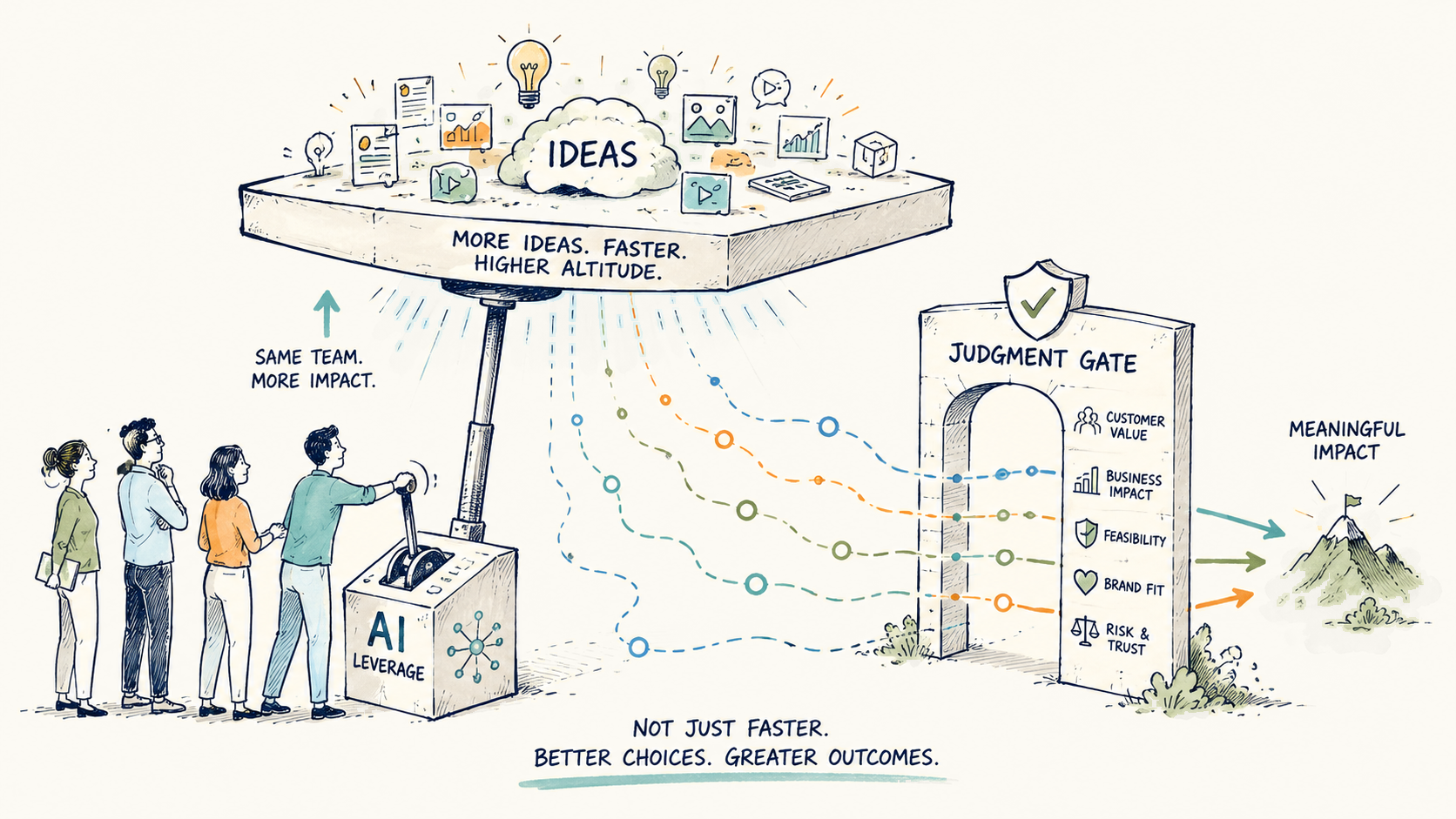
For product teams, the biggest shift is not just that AI helps us move faster. It is that AI collapses the distance between idea, prototype, evaluation, and launch.
The risk is that teams confuse speed with strategy, output with quality, and demos with durable product value. Leadership judgment becomes more important because AI can accelerate weak thinking as easily as strong execution.
AI changes the altitude of product work
Historically, a lot of product development has involved translating ideas from one format to another. Strategy becomes a PRD. The PRD becomes a design. The design becomes tickets. The tickets become implementation. The implementation becomes analysis. The analysis becomes another round of strategy.
AI compresses that translation layer. A product manager can prototype earlier. A designer can explore interaction models faster. An engineer can move through boilerplate, debugging, and implementation alternatives faster. A data scientist can turn analysis into product-facing insight faster. Researchers can synthesize customer feedback more quickly. Editorial and merchandising teams can experiment with positioning, curation, and audience targeting in more dynamic ways.
That changes the altitude of product work. We do not have to debate every idea abstractly. We can prototype it, test it, inspect it, and evaluate it much earlier in the process.
But AI will not automatically tell us which ideas are strategically right, brand-appropriate, customer-worthy, technically sound, or operationally safe. It gives us more options. It does not tell us which ones deserve organizational energy.
Choosing which options deserve organizational energy remains our job.
Product teams need to think about AI in three layers
- The first layer is AI as a productivity tool. It helps with synthesis, prototyping, research summaries, competitive analysis, design variations, copy, test plans, debugging, and documentation. This is where many teams start, and it is useful. But it is only the beginning.
- The second layer is AI as a product capability. AI can power better search, personalization, recommendations, content understanding, conversational interfaces, creative tooling, experimentation workflows, and operational systems. This is where AI moves from helping us build the product to becoming part of the product itself.
- The third layer is AI as a change in user expectations. Customers are going to expect products to understand more context, require less friction, feel more adaptive, and help them get to the right outcome faster.

Product experiences that feel static, generic, or overly manual will start to feel increasingly dated.
The better question is not “Where can we add AI?” but “What customer decision, workflow, or pain point can now be rethought because AI exists?”
Where can intelligence reduce friction, improve relevance, or create a better experience? How do we make these capabilities feel useful, trustworthy, explainable, and human instead of magical, confusing, or intrusive?
Those are product questions with technical consequences.
The disciplines are getting closer, but accountability still matters
AI is bringing product, design, engineering, research, data, and editorial disciplines closer together, especially in the exploration phase.
A PM can build a rough prototype. A designer can explore product logic more deeply. An engineer can evaluate implementation paths faster. A researcher can synthesize patterns more quickly. An analyst can make insights more actionable. Editorial and merchandising teams can test how curation and positioning might change the customer experience.
That shared ability to make ideas tangible is powerful. It means teams can reason together around something closer to the actual experience instead of debating abstract requirements, static mocks, or long documents.
But there is also a risk. We can blur the difference between prototype and production.
Just because a PM can build a demo does not mean we can skip engineering discipline. Just because design can generate many variations does not mean we have a coherent experience. Just because engineering can move faster does not mean the product problem was worth solving.
The disciplines are getting closer at the exploration layer, but we still need clear ownership at the production layer. Product owns the customer and business problem. Design owns the experience quality and interaction model. Engineering owns system integrity, scalability, reliability, security, and maintainability. Research owns the depth of customer understanding. Data and analytics own measurement discipline. Editorial and merchandising bring taste, context, business priorities, and cultural judgment.
AI should become part of the product decisioning layer
In a streaming product, AI fits across the full customer lifecycle, but it shows up differently at each stage.
At acquisition, AI can improve audience understanding, positioning, and personalized messaging. During onboarding, it can reduce cold-start friction. Discovery brings together search, recommendations, artwork, metadata, trailers, summaries, and conversation to help customers decide what to watch. Playback and retention create different opportunities around recaps, next-best-watch decisions, live moments, content affinity, and churn signals.
Across those stages, the larger point is this:
AI should not be a separate surface sitting off to the side. It should become part of the product’s decisioning layer.

It should help the product become more adaptive, more contextual, and more useful throughout the customer journey.
In streaming, the job is to turn a large catalog into a personal, relevant, and valuable experience. AI gives us new ways to do that, but only if we connect the technology to real customer problems and real product strategy.
Faster ideation makes judgment more important
AI makes ideation cheaper. That means the bottleneck moves from idea generation to idea selection.
My bar is not, “Can we make a demo?” My bar is whether the work solves a real customer problem, improves a measurable business outcome, fits the product strategy, can be operated responsibly, and can be evaluated honestly.
I think we need to separate three different types of quality.
- Prototype quality asks whether we can show that something is possible.
- Product quality asks whether it is reliable, usable, fast, safe, accessible, and coherent with the broader experience.
- Strategic quality asks whether this is the right thing to spend organizational energy on.

AI helps us generate more paths, but it does not remove the need for taste, prioritization, experimentation, and leadership judgment. In fact, the faster ideation gets, the more disciplined the release gate has to become.
Policy creates safe lanes
Every company adopting AI has to create rules that are clear enough to protect the company, customers, partners, IP, employees, data, privacy, and trust, but practical enough to help teams move.
Good policy should not only be a list of things people cannot do. It should create safe lanes. It should make clear what teams can do, what requires review, what is prohibited, which tools are approved, how to handle sensitive data, how to handle copyrighted material, how to evaluate outputs, and where to go when something is unclear.
Risk prevention without practical guidance slows useful work; speed without controls creates avoidable risk. Good policy makes responsible movement possible.
AI changes leverage before it changes the org chart
I do not think the right frame is simply, “AI replaces jobs.” The more immediate and practical frame is that AI changes the leverage of every function.
For PMs, leverage shifts from document production toward judgment, problem selection, strategy, experimentation, and clarity. Designers can spend more attention on adaptive and trustworthy experiences; engineers on architecture, reliability, integration, security, and production quality. Research still grounds faster cycles in real people. Analytics and data science establish whether AI-driven experiences improve outcomes. Editorial and merchandising judgment remains essential because generation does not supply taste, cultural context, franchise value, or brand strategy.
Over time, team size and structure may change. Smaller teams may be able to do more. Some coordination layers may become lighter. Some work will become more automated. But I would be careful about jumping immediately to headcount conclusions.
The first-order effect should be higher leverage. The second-order effect may be different org design.
The smart companies will not look at AI and ask, “Can we do the same with less?”
They will ask, “How much more can we do with the same?”
What success looks like
Successful AI adoption means AI stops being a novelty. It becomes embedded into how we work and how the product creates value.
Internally, success means teams use AI to move faster, think more clearly, prototype earlier, evaluate more rigorously, and reduce repetitive work. Product reviews become more prototype-driven. Research synthesis becomes more continuous. Experiment setup and analysis become faster. Content operations and metadata workflows become more intelligent.
In the product, success means customers find something they love more quickly and more often. Search works better. Recommendations feel more relevant. The homepage feels more adaptive. The product understands context better. We use content metadata, behavioral signals, creative assets, and editorial judgment in smarter ways.
At the company level, success means an operating model that is fast, safe, measurable, and differentiated—and produces customer impact, team leverage, and business outcomes beyond a collection of pilots.
AI will not make judgment obsolete. It will make judgment more visible.
When teams can generate more ideas, prototypes, analyses, and product paths than ever before, leadership becomes less about asking whether something is possible and more about deciding what is worth building.
AI gives companies more capacity for experimentation, learning, relevance, and customer value. The leadership challenge is to turn that capacity into stronger decisions rather than simply more output.
This writing reflects my personal perspectives on product management, AI, and content discovery. It does not represent the official position of my employer or any affiliated organization.