Article
May 1, 2026
2 min read
The Missing Layer in AI Adoption
AI changes who can contribute. But only if companies remove the friction between having an idea and making something real.
By Cristiano Pierry
The Next Office Amenity: A Safe Place to Build
I’ve been working with a group of product managers on empowering them to become builders.
The aim is to help them move beyond requirements into prototyping, testing, evaluation, debugging, and direct product shaping.
One of the first obstacles we ran into was access. To build anything meaningful, you often need the right GitHub permissions, development environment, cloud access, model access, data access, behavioral data, content metadata, observability tools, and enough system context to understand what you are touching.
For most people who are not software engineers, setting up a development environment can be complicated and tedious. By the time the environment is ready, the excitement to build may already be gone.
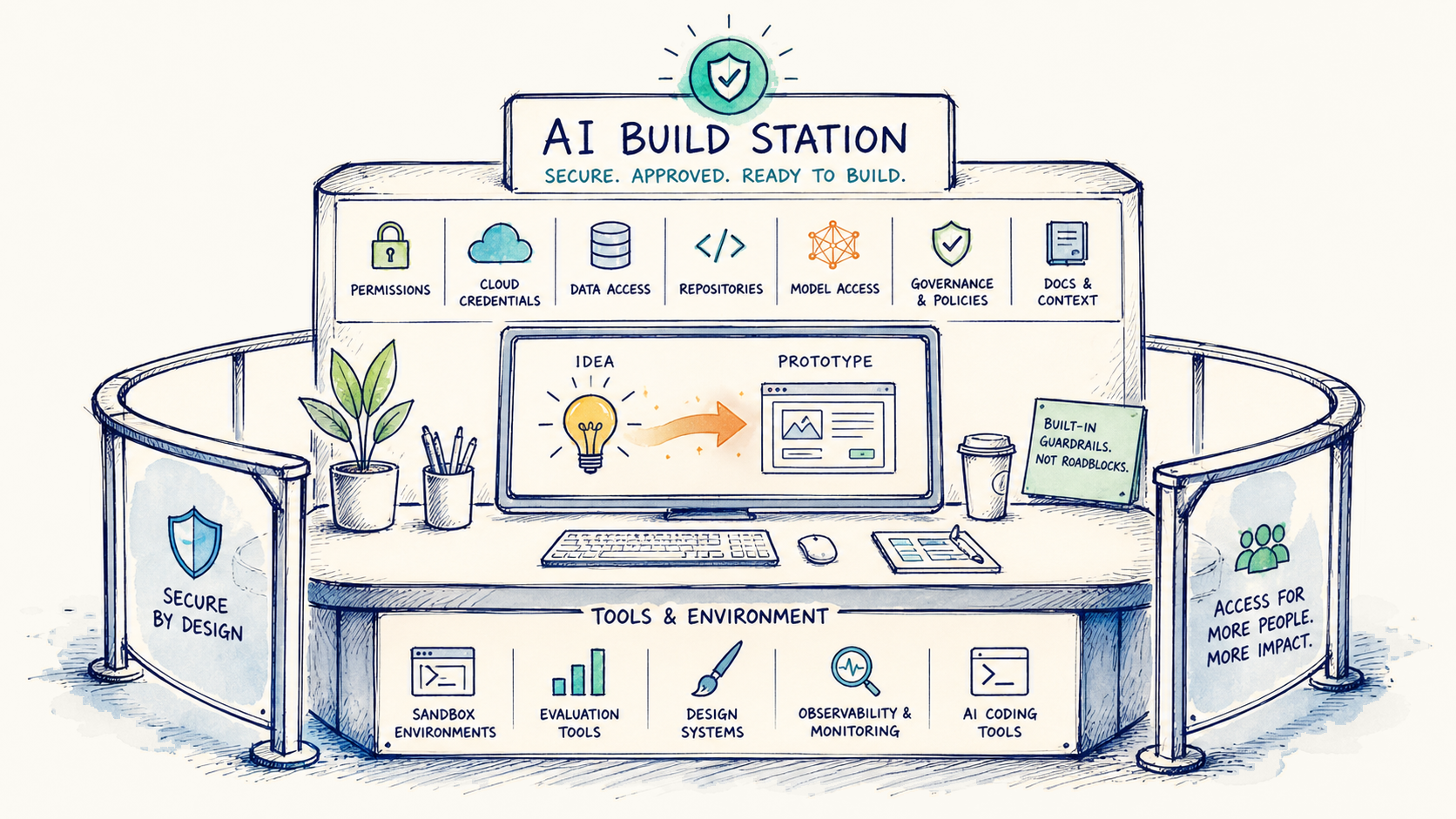
That got me thinking, half seriously and half as a thought experiment: what if companies had AI build stations across the office?
Imagine a secure, preconfigured environment where employees can sit down, use frontier AI tools, and immediately start exploring. The right repositories, sandboxed data, evaluation tools, design systems, documentation, and guardrails are already there.
- A product manager could prototype a feature.
- A designer could test an interaction.
- A data scientist could inspect a ranking issue.
- An engineer could debug something faster.
- A support or operations teammate could turn recurring customer pain into a tangible product improvement.

The point is not to bypass controls. It is to design the controls into the environment so more people can safely participate in building.
The physical build station is a thought experiment. The durable idea is a frontier AI environment with access, context, permissions, and governance designed in from the start.
Today, many companies are deploying powerful AI tools into environments that were not designed for this kind of broad-based building. The model can help you write code, but it cannot always access the systems, data, or context needed to make that work real.
That gap is where the next generation of internal platforms will matter.
AI changes who can contribute. But only if companies remove the friction between having an idea and making something real.
Access, developer experience, and internal platforms are strategic choices. The next useful office amenity may be a safe place where more people can build.
This writing reflects my personal perspectives on product management, AI, and content discovery. It does not represent the official position of my employer or any affiliated organization.