Article
March 9, 2026
4 min read
How New Graduates Can Build Leverage in an AI World
Entry-level product work is changing, giving aspiring PMs new ways to demonstrate judgment, technical range, and end-to-end ownership.
By Cristiano Pierry
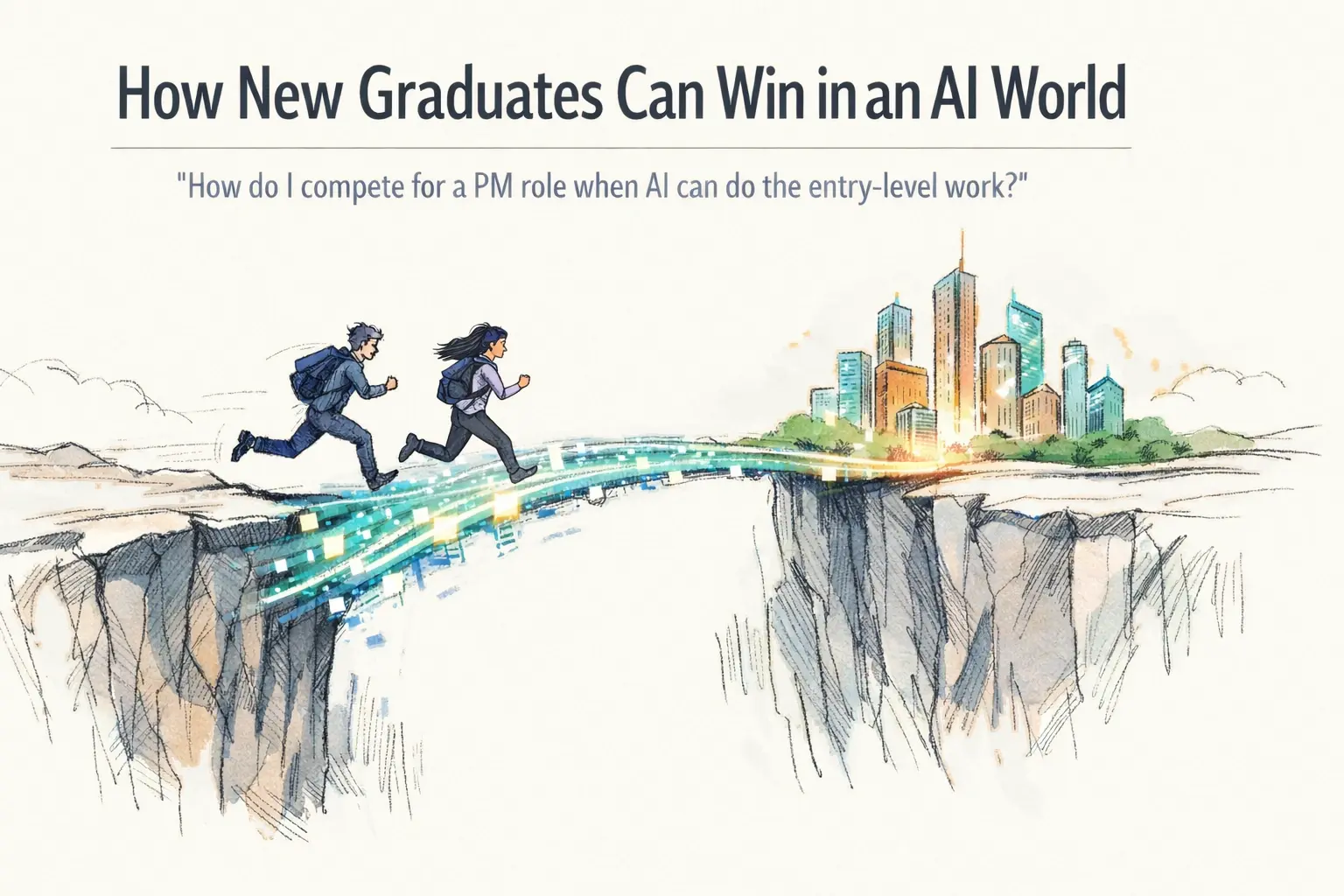
Every week, someone in my LinkedIn feed declares that entry-level roles are dead and AI has replaced junior employees. I get why the narrative sticks. AI can draft PRDs, analyze data, summarize research, generate wireframes, and ship functional code. When I talk with computer science juniors and seniors preparing for their first product management interviews, I can feel the anxiety.
But here is what I want them to understand: those tasks were never the product. PRDs, backlogs, and status updates were always just tools.
The real job has always been to create clarity, exercise judgment, and build products that solve real human problems.
I have led product teams across streaming, e-commerce, search, and mobile. I have repeatedly seen that when a new tool lowers the cost of execution, knowing what to build and why becomes more valuable.
For aspiring PMs, the bar is rising, but so is the leverage available to you. Early-career builders who embrace an AI-native mindset have a real advantage. You are not unlearning years of process built for slower cycles. You can design your entire operating system around modern tools from day one.
A more useful question than “How do I compete with someone who has ten years of experience?” is “How do I use AI to turn my potential into visible evidence of capability?”
I would focus on six practices:
Get fluent in AI-assisted prototyping. You do not need to be a full-time engineer, but you should be able to turn an idea into a working artifact using AI coding tools, lightweight backends, APIs, and version control. A functional prototype changes the conversation faster than any slide deck.
Invest in structured problem framing. AI can generate outputs all day long, but it cannot reliably define the right problem. Breaking ambiguity into components, defining success metrics, and articulating trade-offs are the highest-leverage skills you can develop.
Develop real data fluency. Interrogate dashboards, design simple experiments, and interpret results with nuance. Connecting your decisions to measurable impact signals a maturity that goes well beyond tenure.
Build judgment around models. Learn to design prompts intentionally, evaluate outputs systematically, and define guardrails. In an AI-enabled environment, discernment matters far more than speed.
Practice end-to-end ownership. Pick a small problem and carry it all the way through: clarification, build, testing, iteration, reflection. End-to-end ownership gives interviewers stronger evidence of how you think and learn.
Sharpen your communication. Clarity drives decisions and aligns teams. In faster development cycles, confusion compounds quickly. The person who can make complexity legible will always be in demand.

From my vantage point hiring and building product teams, I am not looking for someone who can produce a document in isolation. I am looking for agency. Can this person take ambiguity and turn it into motion? Can they use modern tools to reduce friction? Can they demonstrate judgment when execution is easy but the consequences are complex?
One concrete signal is an Amazon posting for a "Senior Product Manager, Builder". It called for rapid functional prototypes with AI coding tools, automated data analysis, LLM-supported strategy, and applications using generative AI patterns such as RAG. A preferred qualification was a portfolio of functional projects built using AI tools.
A portfolio should make your judgment visible.
Although that is a senior role, many of its underlying capabilities can be practiced before a graduate’s first full-time product job because the tools, documentation, and inexpensive infrastructure are accessible.
Jevons's Paradox offers one way to think about the opportunity: when a technology lowers the cost of a capability, demand can expand as new uses become viable. AI may follow that pattern in product development. Cheaper execution makes more experiments possible, shifting the constraint toward judgment and ownership.
The strongest early-career candidates I have seen bring proof. They bring working prototypes, clear analyses, and honest reflections on what failed and why. They operate like builders long before anyone gives them the title, and that is a signal worth taking seriously.
If you are early in your career, focus on visible evidence of capability. Ship small but real projects. Publish concise reflections on your decisions. Go deep on one AI workflow instead of skimming many. By the time you apply for full-time roles, you should not have to say you want to be a PM. You should be able to demonstrate that you already think, build, and learn like one.
Entry-level product work is becoming more technical, more autonomous, and more outcome-oriented.
For new graduates, the practical response is to make capability visible: build, explain the decisions, show what failed, and demonstrate how you learned.
This writing reflects my personal perspectives on product management, AI, and content discovery. It does not represent the official position of my employer or any affiliated organization.