Article
February 14, 2026
3 min read
Lean In, Learn, Build: How Did You Become a Better Product Manager This Week?
Frontier AI is changing product work quickly, making continuous learning, practical building, and durable curiosity essential habits for PMs.
By Cristiano Pierry
Frontier AI is already changing how product managers work alongside design and engineering. The exact destination is uncertain, but the profession is moving quickly enough that our learning habits now matter as much as the knowledge we already have.
I often find myself asking what will remain recognizable about the traditional Product Manager 18 months from now. I expect more of us to operate as builders: people with high agency and taste who can direct work across humans and AI agents, then judge whether the result is actually good.
Having spent my career in product, I am energized by mentoring the next generation of PMs. But a degree cannot remain a static credential.
The notion that a university education could sustain a 40-year career might have been true in the mid-20th century, but it hasn't been true for a long time. It certainly hasn't been true for me.
I look back at my own Computer Science education at WPI. I remember the AI courses taught by Professor Michael Gennert a lifetime ago. At the time, "state of the art" meant LISP programming, expert systems, and the first "AI Winter." When I compare those concepts to the AI systems I have worked on across search, e-commerce, and media technology, there is almost no technical resemblance. Yet, those classes sparked the curiosity that remains my greatest asset.
To stay relevant and lead a whiteboard discussion with a PhD who graduated last year, I have had to treat my education as a living document.
Whether it was my "summer of learning" where I picked up iOS programming, founding Barcbots (a Vex Robotics club), or my recent immersion into LLMs and Generative AI, I've had to constantly evolve. My computer science degree has been rewritten a dozen times through podcasts, Coursera, and executive education at UC Berkeley, even if I don't get a new diploma to hang on the wall.
This is a hard lesson to internalize, especially as I pay tuition for my four children. With three having attended UC Berkeley, U Michigan, and UW Madison, and my youngest graduating high school this year, the investment is significant. However, I remain confident that higher education is time well spent. It is a privilege they take seriously. They are learning how to learn, how to collaborate, and how to challenge the status quo.
Their technical coursework will age. Their ability to remain curious is what will let them keep learning as the tools change.
With that in mind, I am starting a new series for my cohort of product managers and aspiring builders.
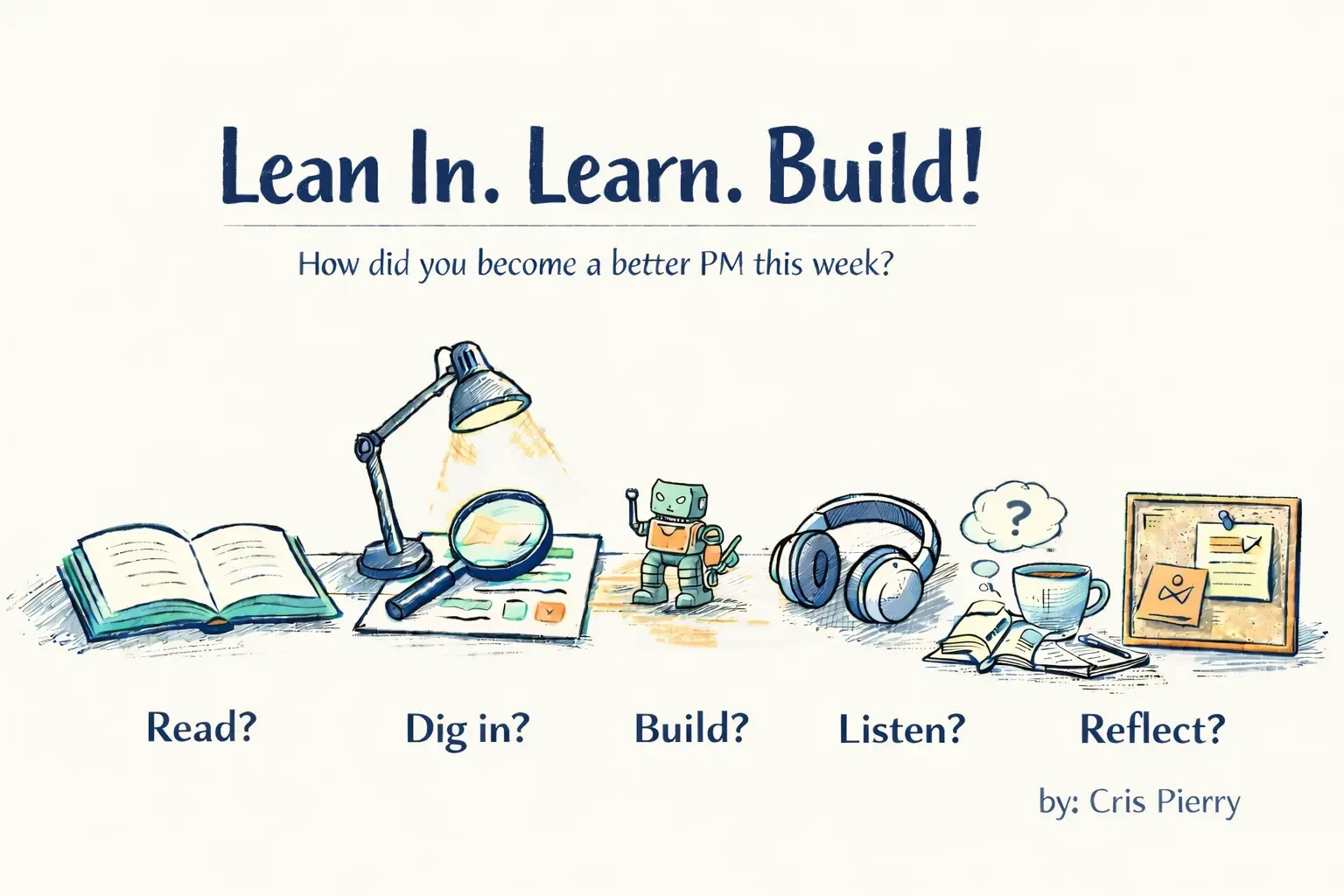
How did you become a better PM this week?
- Did you read? I highly recommend Stephen Witt's The Thinking Machine, about Jensen Huang and Nvidia, or Ethan Mollick's Co-Intelligence.
- Did you go deep? Did you find a customer insight through raw metrics rather than a summary report?
- Did you build? Did you prototype a feature using Lovable, Replit, or Cursor instead of just writing a PRD?
- Did you listen? I suggest Lenny's Podcast with OpenAI's Sherry Wu for a look at the new frontier.
- Did you reflect? Read Matt Shumer's "Something Big is Happening" and ask yourself if you are ready.

It is easy to let a day disappear into the "calendar tetris" of meetings and tasks. I want this weekly question to make growth concrete: seek new knowledge with AI, learn from experts, build something, and remain responsible for the judgment.
As Alan Kay famously said, "The best way to predict the future is to invent it."
I am leading by example. This coming week, I am challenging myself to publish a functional app or service using Lovable and OpenAI Codex.
What will you do to become a better PM by the end of the week?
This writing reflects my personal perspectives on product management, AI, and content discovery. It does not represent the official position of my employer or any affiliated organization.