Article
July 1, 2026
6 min read
Modernizing Discovery and Promotion in Personalized Products
Modern discovery systems balance personal relevance, popularity, momentum, and strategic intent without letting promotion overwhelm user value.
By Cristiano Pierry
A useful pressure test for a discovery system is a title the business urgently wants to amplify, but only part of the audience is likely to value.
The simple answer is to force exposure. The harder product question is how much strategic intent should influence a personalized experience, where that influence belongs, and when the system should decide that the user has seen enough.
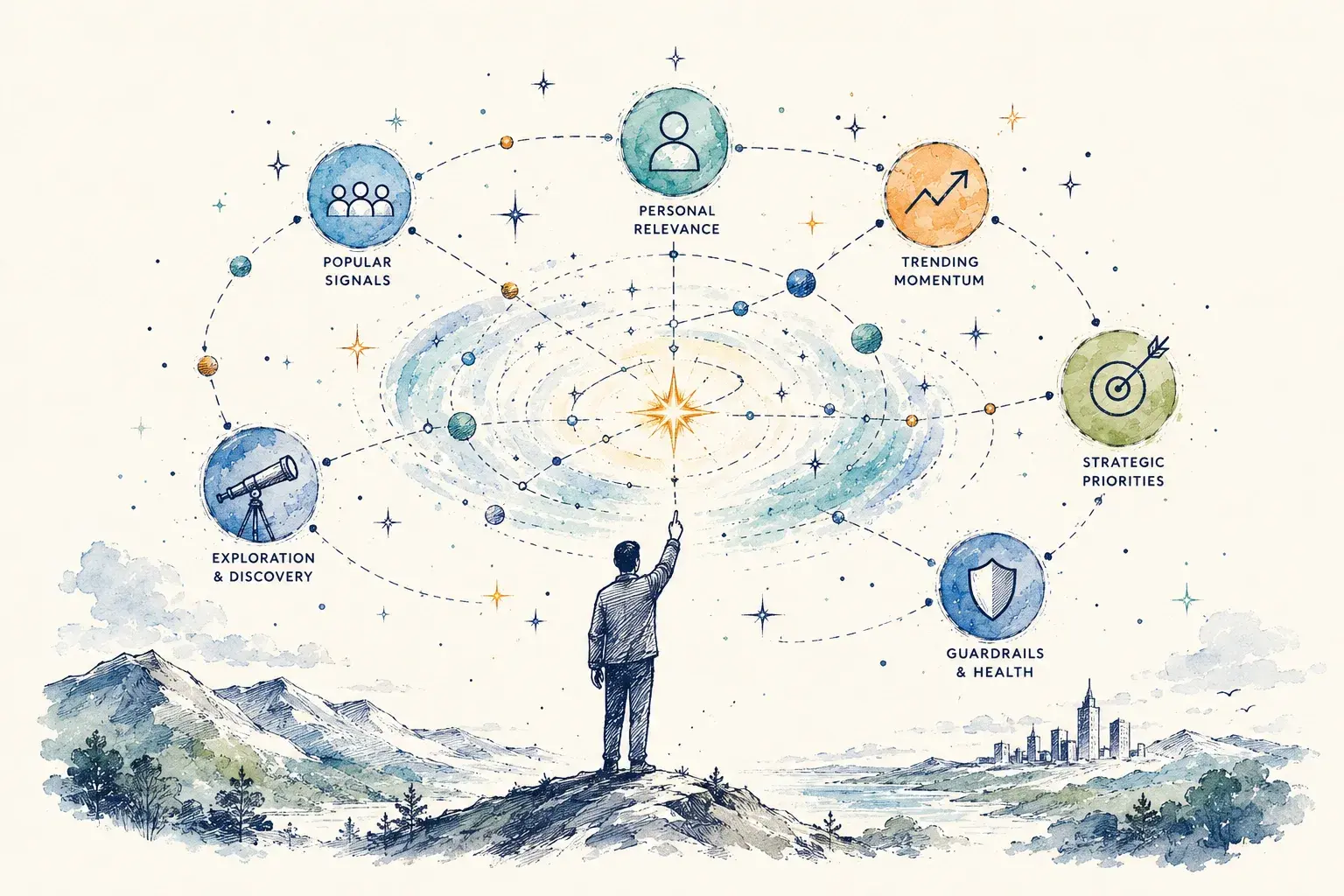
That question reveals what modern discovery systems really do. They do more than predict the next click. They allocate attention among four forces: personal relevance, broad popularity, current momentum, and strategic intent. The work is not choosing one force. It is deciding how much authority each receives in a particular context.
A new user may need more help from popularity because the system has little behavioral evidence. A deeply engaged user gives the product more reason to trust personal signals. A seasonal event may justify additional weight for what is trending. A major launch may deserve measured exposure, but it still has to earn a place in the experience.
Promotion should amplify discovery, not compensate for it
Promotion works as an accelerant. At its best, it takes a spark of user interest and gives it oxygen, helping a strong or timely experience find the right audience faster.
When teams repeatedly intervene to make important items visible, I would first look for the deeper failure. The ranking objective may be incomplete. The metadata may not express what makes the item valuable. The journey may give the system too little room to explore. The product may be measuring exposure more carefully than satisfaction.
Using promotion to cover those weaknesses may solve the immediate campaign problem while making the discovery system less trustworthy over time.
Promotion should enhance the discovery engine, not mask its weaknesses.
Four forces, different authority
I think about modern discovery as a blend of four signal families:
- Personal signals describe what may matter to this user: explicit preferences, behavior, affinities, engagement depth, and current intent. They become more useful as evidence accumulates, but they should never eliminate exploration.
- Popular signals describe what is resonating broadly. They are valuable when personal confidence is low and when shared cultural awareness is part of the experience.
- Trending signals describe momentum. Something can be broadly popular without being newly relevant; something else can rise quickly because of a launch, a live event, seasonality, news, or social conversation.
- Strategic signals describe what the business wants to amplify: launches, campaigns, lifecycle priorities, contractual needs, brand moments, or marketplace objectives.
These inputs should not have fixed weights. Their authority should change by user, surface, session, lifecycle stage, and objective. A homepage hero, a search result, a continuation row, and a campaign collection are different decision environments.
Personal relevance also needs room for discovery. A system that only reflects established behavior eventually becomes stale. Popularity can broaden the experience, but it can also concentrate attention around already successful items. Trending signals make a product feel current, but momentum is easy to confuse with durable value. Strategic signals are legitimate, yet they create the clearest conflict of interest because the product is balancing what helps the user with what the business wants the user to notice.
The blend therefore needs both a ranking objective and a governance model. Teams should be able to see which signal changed an outcome, how long that influence lasts, and whether they could defend the decision to the user.
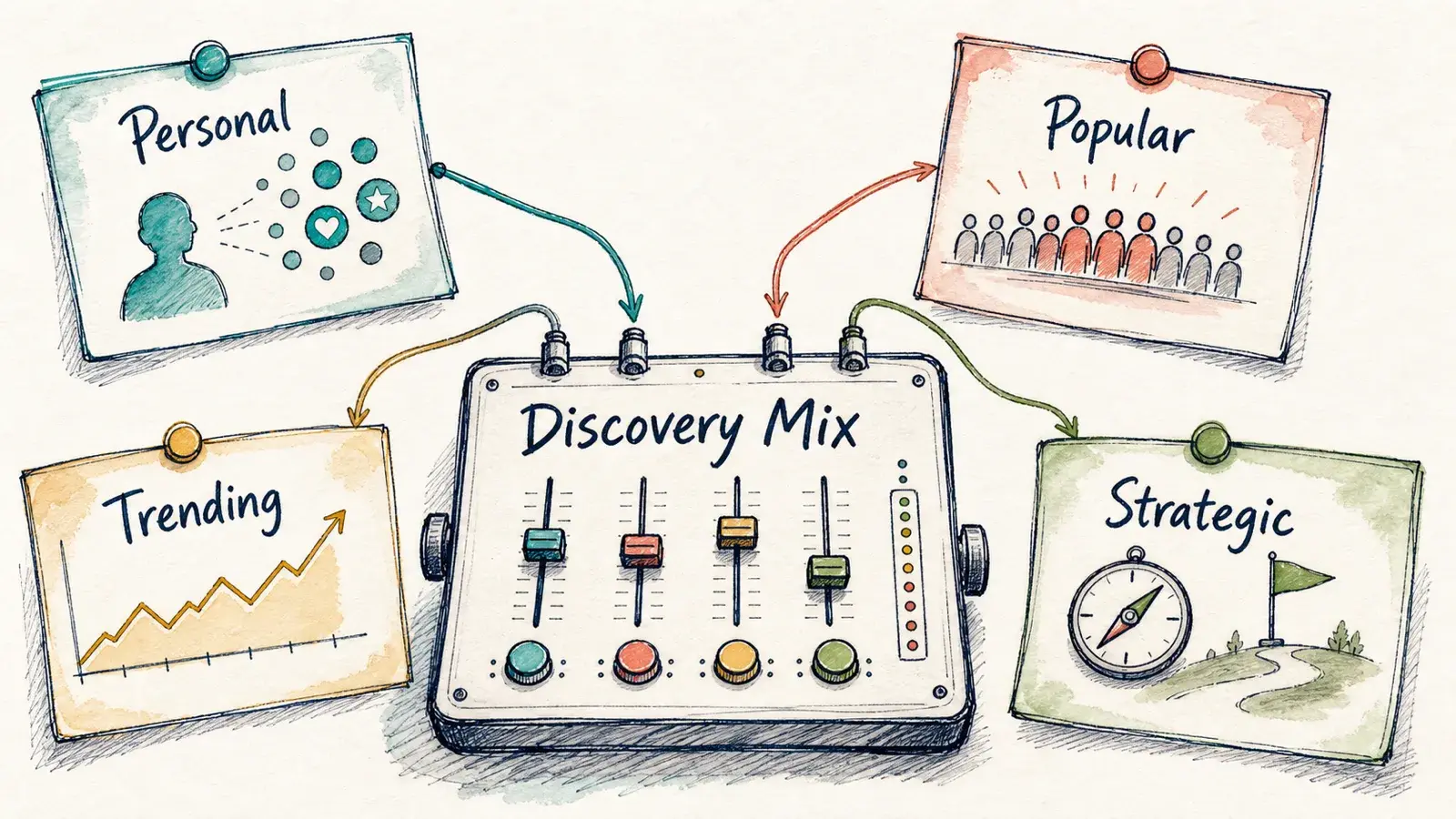
Some promotional needs are constraints. Others are signals.
Human judgment remains essential, but it needs a clear interface with the ranking system.
Algorithms are good at scale, pattern recognition, and rapid adaptation. Human teams bring cultural context, brand nuance, editorial judgment, and business priorities that may not yet appear in behavioral data. The productive question is not which side should control discovery. It is how human intent can enter the system without requiring people to hand-place every result.
Suppose a streaming service is launching a new family title during a holiday week. The business may want meaningful exposure, but universal repetition would be wasteful and annoying. The team has several choices:
- Guarantee one qualified impression to eligible family profiles.
- Add a temporary strategic signal and allow relevance to determine position.
- Create a clearly editorial collection rather than quietly changing personalized rankings.
- Reserve a placement only on surfaces where the launch has a legitimate product role.
Those choices are not interchangeable. A guaranteed impression is a constraint. A temporary boost is a signal. An editorial module is a product decision. Treating them all as “promotion” hides who has authority, how the team will measure the intervention, and when it should end.
Some promotional needs are constraints. Others are signals. Confusing the two produces poor experiences and poor measurement.
Promotion needs an exit condition
Promotion can create fatigue, crowd out organic discovery, and make a catalog feel smaller than it is. It can also distort measurement. Strong performance during a campaign may reflect genuine demand, unusually high visibility, or both.
Repeated placement changes user behavior in ways the campaign dashboard may not show. People learn to ignore a slot. Niche items lose opportunities to gather evidence. The system receives more engagement data for what it already amplified and less for everything it displaced. Without holdouts or post-campaign analysis, a temporary intervention can quietly become self-reinforcing.
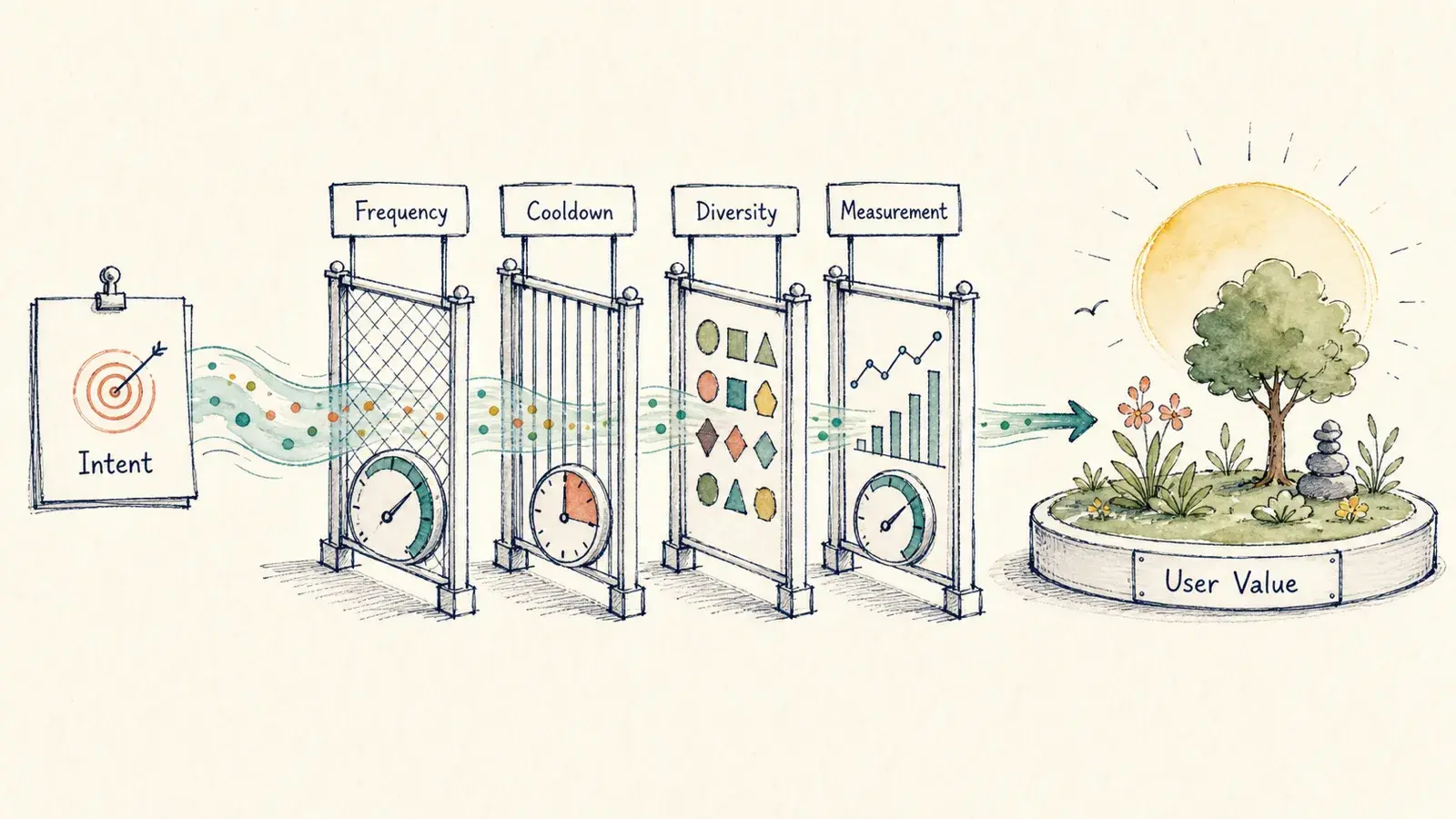
That is why promotion needs guardrails:
- impression and frequency limits
- cooldown rules
- diversity protection
- audience qualification
- holdouts and attribution
- post-promotion measurement
The system should track more than the promoted item. Did the experience remain useful? Did repeated exposure reduce engagement elsewhere? Did the item continue to perform after the campaign ended? Did the intervention teach the system anything durable?
From manual placement to intelligent orchestration
Manual merchandising asks, “What should everyone see?” Intelligent orchestration asks, “What deserves attention for this user, on this surface, in this moment, given both user value and business intent?”
That changes the work of promotion teams. Their role moves toward setting strategy, defining constraints, supplying high-quality signals, and interpreting outcomes. The system can handle more allocation and sequencing, while human influence becomes explicit enough to inspect.
Cold start is a good example. New items need exploration because the system has little evidence. Promoting every new item is not exploration; it is undifferentiated exposure. A healthier approach identifies plausible audiences, tests distribution in controlled ways, learns from early response, and expands only when the evidence supports it.
Metadata quality matters especially here. A new item with expressive, accurate attributes can enter similarity models and audience hypotheses before it has much behavior. A poorly described item may look like a demand problem when the system simply cannot understand what it is. Promotion cannot fix that missing representation; it can only spend more attention on it.
The goal is not maximum exposure. It is faster learning without spending user trust carelessly.
Exposure is an input
A strong discovery and promotion system should create value at several levels, but the measurement logic can remain simple:
- Did the intended audience respond?
- Did the system learn something it can use later?
- Did the experience remain diverse and useful?
- Did value persist after the campaign window?
- Did the intervention improve the ecosystem or merely move attention around it?
Exposure is an input. It is not the outcome.
The best description of these products may not be recommendation engines at all. They are decision systems that allocate attention across personal relevance, collective behavior, cultural momentum, and business strategy.
Promotion belongs in that system, but its authority should always be visible, bounded, and accountable to user value.
This writing reflects my personal perspectives on product management, AI, and content discovery. It does not represent the official position of my employer or any affiliated organization.