Article
September 1, 2026
4 min read
The Student Still Owns the Thinking
An AI tutor can keep office hours open at any hour. The student still has to understand and account for the work.
By Cristiano Pierry
When I wrote about taking my daughter to Michigan, I was thinking about what universities should become when every student carries an AI tutor. Afterward, I found myself with a question closer to home: What should she do with it?
A student can ask for another explanation of a concept that did not make sense in class, work through a derivation at a slower pace, or compare two interpretations of a novel. A question that appears late at night no longer has to wait for the next office hour.
The comparison with office hours only goes so far. The AI may have no access to the instructor's intent, the standards of the course, or the sources a discipline treats as authoritative. It can explain the wrong idea clearly. Access to course material improves its footing without giving it responsibility for what the student eventually understands. That responsibility stays with the student.
Make the AI wait
Most course policies identify permitted use and disclosure requirements. They also define cheating. A student can comply and still ask for a summary before reading the text or a solution before attempting the problem. The submitted work may be accurate. The effort that would have exposed a misunderstanding never happened.
I would look at what the AI asks the student to do before it supplies an answer. Does it request an attempt? Does it offer a hint that leaves the next step open? Does it probe the student's explanation? Those actions show what the student is practicing.
I found two experiments that tested different versions of this problem. A randomized crossover trial involving 194 Harvard undergraduates compared an in-class active-learning lesson with a custom AI tutor covering the same introductory physics material. Across two lessons, students using the tutor showed greater short-term learning gains in less time. The tutor drew from instructor-prepared material and managed its questions, pacing, and feedback.
A randomized field experiment with nearly 1,000 high-school mathematics students produced a more troubling result. Students with a general GPT-4 chat interface performed much better during practice. On a later exam without the tool, they scored 17 percent below students who had never used it. A version built around teacher-designed hints and resistance to complete solutions largely removed that harm, though it produced no improvement on the unaided exam.
The college trial covered two physics lessons, and the high-school trial covered one mathematics program. I am using them here for a limited observation about design. Complete solutions and managed hints produced different kinds of practice.
Students can create some of that friction themselves. I would want my daughter to give the AI instructions such as:
- “Ask what I have tried before you offer a hint. Give me one step at a time.”
- “Read my thesis and the evidence I chose. Find the place where my conclusion reaches further than the evidence.”
- “Quiz me after I finish the chapter. Spend more time on the ideas I explain poorly.”
Each prompt begins with work the student has already done and asks the model to probe it.
This kind of preparation can improve the human conversation around a course. A student can arrive at office hours having tested several explanations and identified the assumption that still does not make sense. The professor can see patterns across weeks of work and judge whether a technically correct answer has missed the point of the discipline. The AI has helped the student arrive with a better question.
What remains when the chat is closed
Students have always developed ideas with help. Books, lectures, experiments, and other people are part of serious thought. AI can now generate and polish an argument around selected evidence in a single exchange. Assistance can cover almost the entire visible product of thinking.
The document alone now gives a professor less evidence of authorship. I would ask the student to account for the choices behind it. Why is the argument organized this way? Which source supports the central factual claim? Where is the evidence weakest? What would change the conclusion? A student who formed the view can usually stay in that conversation when the questions move beyond the submitted page.
An assignment should tell students which capacity it is meant to exercise. A professor may protect an early attempt from AI because working through confusion is the assignment. Later in the course, the same professor may require students to use AI and then defend the choices they made with it. Privacy rules and a clear path back to a human instructor belong in those instructions as well.
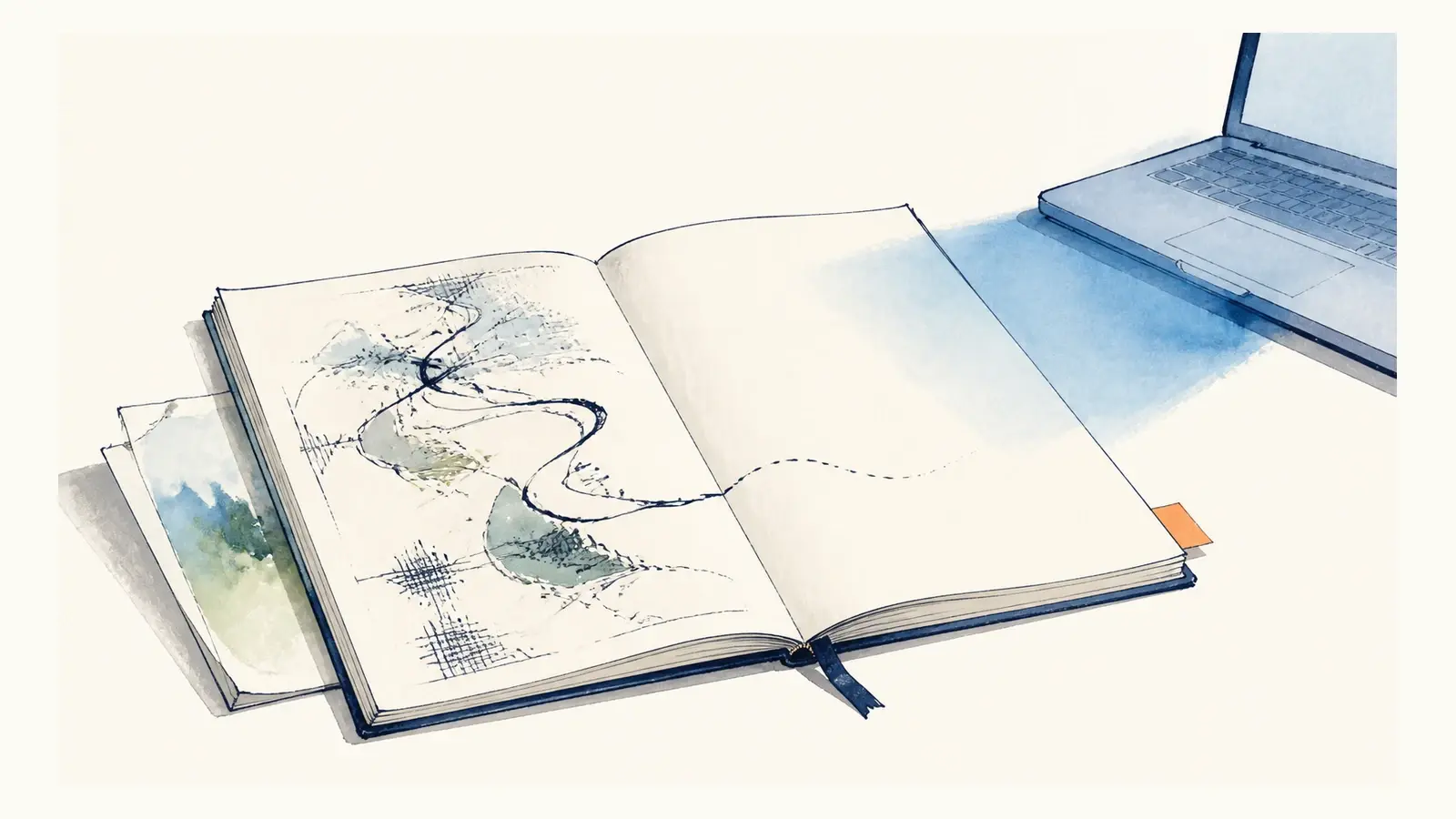
I keep returning to a simple test: close the laptop and continue the conversation. Perfect recall is unnecessary. Students should be able to consult notes and sources. I am listening for an understanding strong enough to survive a new question, a challenge to the evidence, or the discovery that the model was wrong.
When I imagine my daughter using an AI tutor in college, this is what I hope to see. She closes the laptop, explains the idea in her own words, shows me where the evidence came from, and tells me what she still has not figured out.
This writing reflects my personal perspectives on product management, AI, and content discovery. It does not represent the official position of my employer or any affiliated organization.