Article
August 27, 2026
11 min read
What College Is For When Every Student Has an AI Tutor
When broad instructional help is always available, a university's scarce value becomes the people who challenge students and the work they learn to do together.
By Cristiano Pierry

This week, I am taking my daughter to Ann Arbor to begin college at the University of Michigan. Like many parents, I have been thinking about what I hope she finds there: demanding teachers, close friends, and room to discover work that matters to her.
I have also been thinking about what will already be waiting in her pocket.
She will arrive with access to AI that can explain a difficult concept five different ways, generate practice problems, critique a draft, compare theories, or simulate a debate long after office hours end. Michigan itself is building toward this reality. The university says its community has already created more than 3,000 Maizey AI environments, and it has a student assistant connected to university and course information.
That assistant does not make college obsolete. It makes a basic question harder to avoid: when broad instructional help is available to every student at almost any hour, what is the university uniquely there to do?
A university does more than teach undergraduates. It conducts research, preserves knowledge, and certifies expertise. My question is narrower. What should the undergraduate learning experience become when access to explanation is no longer the main constraint?
Much of university teaching still reflects a world in which expertise was scarce, access to it was scheduled, and a professor was the most efficient way to move knowledge from a discipline into a room. Real expertise remains scarce. Broad assistance no longer is. An AI can range across subjects without knowing whether a student is ready, confused, hiding weak reasoning, or becoming more capable. That gap between answering and educating is where the future of undergraduate education sits.
The hard way still matters
The easiest mistake is to apply the logic of workplace productivity directly to education. If AI can produce a competent first draft or solve a routine problem faster, let it do so and move the human to higher-value work. That makes sense when the goal is efficient production. In education, the effort may be the part that changes the person.
A student can finish an assignment with AI and still fail to build the mental structure needed to recognize a bad answer later. Delegating the first draft may produce cleaner prose while removing the experience of discovering an idea through writing. A generated proof can be correct without teaching the student how to find the next one. Better output can conceal weaker learning.
We need to distinguish at least three things that polished AI output tends to collapse. The first is assisted performance: can the student complete this task with the tool? The second is learning: can the student explain and use the idea after the tool is gone? The third is transfer and judgment: can the student recognize when a new situation is different, decide which knowledge applies, and challenge a plausible answer that happens to be wrong?
Early research shows why the distinction matters. In a randomized crossover study of 194 Harvard undergraduates, a carefully designed AI tutor produced higher short-term learning gains on two physics lessons than an in-class active-learning lesson. Students using the AI tutor also spent less time and reported greater engagement. That is an important result, but it is not evidence that a general chatbot can replace a professor or that the same effect will persist across subjects and years.
The researchers did not simply give students a blank chat window. They designed the tutor around established learning practices. It managed pace and cognitive load, asked questions, gave feedback, and structured the interaction toward learning.
Another field experiment involving nearly 1,000 high-school mathematics students found the other side of the problem. A general GPT-4 interface improved performance while students had access to it. When the tool was removed, those students performed 17 percent worse than students who never had it. A safeguarded version relied on teacher-designed hints and resisted giving away complete solutions. It largely removed the negative effect, although it did not produce a positive effect on the later unaided exam.
These studies are early, narrow, and not directly comparable. They support a design principle rather than a verdict. Access to a capable model does not determine whether learning improves. The instructional behavior around the model does.
Calling any chat interface a tutor therefore gives the technology credit for work that belongs to pedagogy. A tutor has to diagnose a misconception, choose an appropriate next step, and sometimes withhold the answer. It needs grounded course material, clear boundaries, and a path to a human teacher.
AI helps learning when it increases a student's engagement with the problem. It becomes dangerous when it removes the engagement that would have produced learning.
UChicago shows the two modes students need
The University of Chicago Law School's new AI strategy is the clearest institutional response I have seen so far. Its phrase for the objective is unusually good: students should learn to think "with, without, and about AI."
Required first-year law classes will largely prohibit electronic devices, and examinations will take place without internet access or apps. Legal research and writing will begin with students doing their own writing, then layer AI into research, revision, and oral-argument preparation. Students completing substantial research papers will have to discuss and defend their reasoning with a professor. Clinics will give students supervised experience using AI in real legal work, where an error has consequences beyond a grade.

This is more thoughtful than either banning the tool or pretending that access can be controlled through honor codes and detection software. It protects foundational work, teaches students to supervise AI, and changes assessment so a polished document is no longer the only evidence of understanding.
I would push the idea further. UChicago is describing an effective strategy for preserving rigorous legal education. The same tension should force every university to reconsider what the institution is organized to provide. Rules about when students may use AI are necessary. They do not answer what faculty time, classroom time, peer relationships, and campus life are for once individual explanation and practice become far easier to obtain.
The most valuable use of a professor's time may no longer be repeating an explanation. It may be seeing the student closely enough to know which explanation, question, or standard that student needs next. That requires noticing the misconception hidden inside a polished answer and choosing a problem that exposes weak reasoning. It also requires the authority of someone who has practiced the discipline and can hold a student to a standard the student cannot yet set alone.
The work starts to look more like apprenticeship than content delivery. Students work beside faculty, practitioners, and one another on problems that resist clean answers. They see how an expert frames the question, what happens when evidence changes a view, and how responsible work proceeds when the outcome affects someone else.
A recent invitation I received described a small experiment in this direction. The participants would read Descartes and Turing closely before meeting. There would be no lecture. The texts would be the authority, the group would work through disagreements together, and an AI tutor would ask questions, identify assumptions, and return the conversation to a particular passage when it drifted. Its job was explicitly not to provide the answer.
The experiment has not happened yet, so I cannot claim that the method works. What interests me is what it is trying to learn. It places AI inside the intellectual environment while reserving interpretation, disagreement, revision, and responsibility for the people in the room.
Build the university around scarce human attention
The most important part of college may become the part we have often treated as adjacent to education: the people a student learns to think with.
Students need friends who will stay with a difficult question longer than an AI conversation lasts. They need collaborators who share enough curiosity to build something together and differ enough to challenge an easy consensus. They need mentors who can recognize growth across months, connect today's confusion with last semester's work, and care about the kind of person emerging from the education.
A university cannot manufacture friendship or assign belonging through a course catalog. It can create better conditions for both. Stable cohorts, repeated encounters, long projects, and physical spaces where students return to the same people give relationships time to deepen. Constantly reshuffling students into large, anonymous classes does the opposite, even if each course is individually excellent.
There is evidence adjacent to this argument, although it should not be overstated. The 2014 Gallup-Purdue Index, a large survey of U.S. college graduates, found strong associations between later engagement and well-being and experiences such as having a caring professor, finding a mentor, or applying classroom knowledge in a substantial project. The study was observational, so it does not prove that these experiences caused the outcomes. It does reveal something uncomfortable: only 22 percent of graduates strongly agreed that they had a mentor who encouraged their goals. Universities know how to create these experiences. They do not make them normal for every student.
AI creates an opportunity to change that allocation. If a course assistant can provide low-stakes practice, answer routine background questions, and give a first round of feedback, faculty and teaching assistants can spend more time on the moments that require human judgment. The time saved can go into sustained conversation, field experience, critique, and creative work that is usually squeezed to the margins.
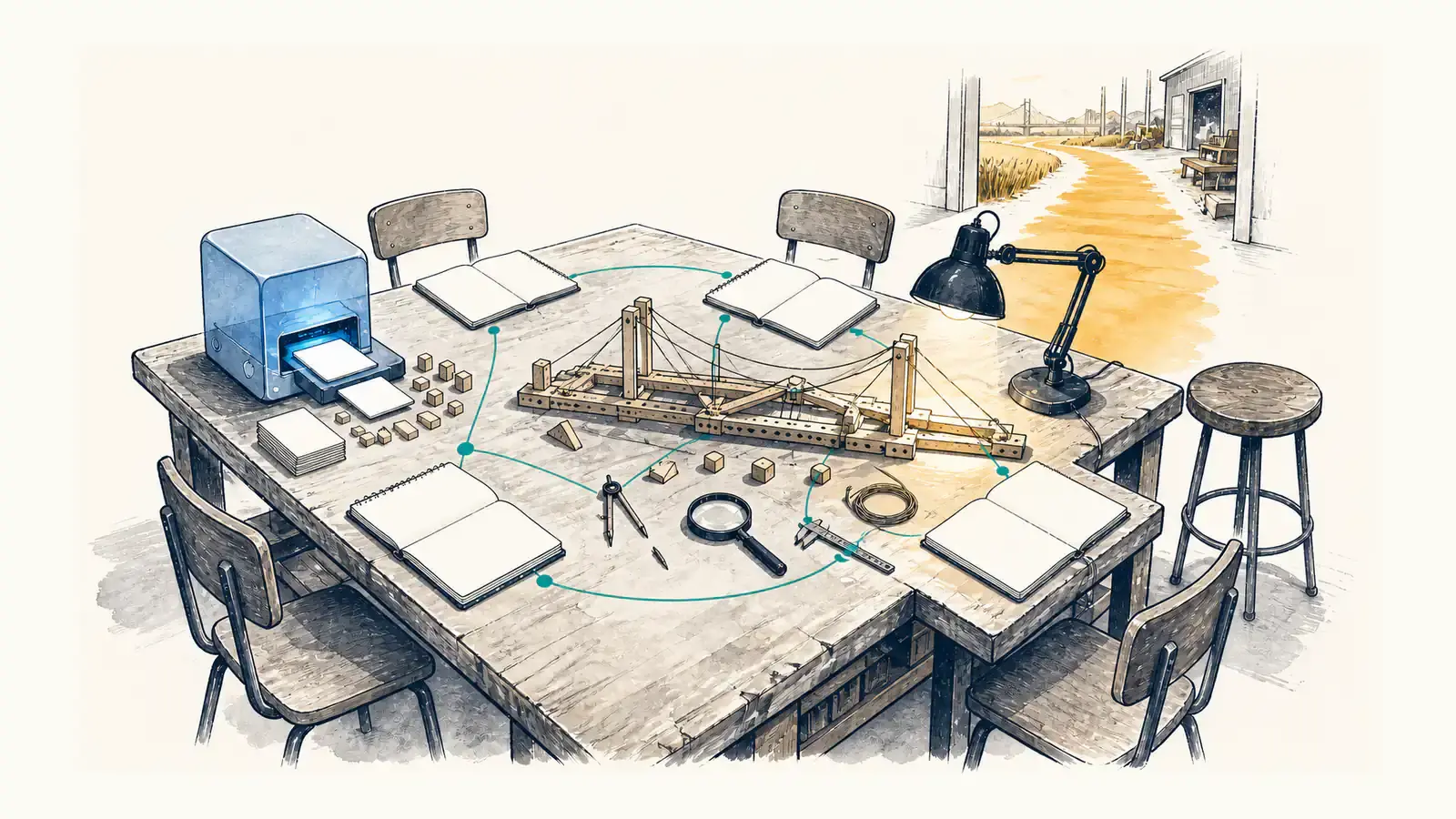
An AI can imitate patience, but no one can hold it institutionally responsible for whether a student learns. It will not be accountable for noticing that someone who spoke confidently in September has stopped coming to class in November. A professor or mentor can carry responsibility for the relationship across time.
The same logic applies to peers. A university cannot celebrate collaboration in its mission while organizing most of the student experience around private performance and competition for position. Individual mastery still matters. Competitive pressure can sometimes sharpen effort. Yet the work students will enter increasingly depends on their ability to use AI with other people, challenge one another's reasoning, and improve an artifact they did not create alone.
Collaboration should become an academic behavior that universities teach and assess, not an informal skill students acquire unevenly through clubs or luck. Poorly designed group work hides free riders and can turn a weak consensus into a polished submission. A shared project should therefore be followed by an individual oral defense. The team can document where AI entered its process while each student demonstrates the underlying knowledge without assistance.
That is a stronger basis for a credential. A take-home paper can now conceal how little of the reasoning belongs to the student. Live questioning, a process record, and an independent demonstration give a professor or future employer more evidence about what the student can actually do.
Imagine a first-year course organized around one consequential problem rather than a sequence of lectures and papers. Students use AI before class to master background material and surface questions they cannot resolve. In the room, a professor leads a seminar that tests their assumptions. Small groups then build something for a real audience while faculty or practitioners critique the work as it develops. At the end, the group presents what it made, each student defends the reasoning, and part of the assessment happens without AI.
The exact course design will vary by discipline. What matters is the combination. A student sitting alone with a chatbot cannot reproduce the pressure of defending an idea to informed peers, the judgment of an experienced practitioner, or the consequence of creating work for someone who will use it. Independent assessment then shows whether the learning belongs to the student.
The real problems do not have to be invented for a class. Research universities already contain laboratories, archives, clinics, and community partnerships where knowledge is being created or applied. Undergraduate education can move closer to that work. The professor's research and the student's learning do not have to occupy separate worlds.
That model also changes what universities must reward. If mentorship becomes central to the value proposition, it cannot remain extra labor performed by generous faculty after research, teaching, and administration are complete. Institutions would need to protect time for it, recognize it in promotion and workload decisions, and design smaller communities inside large campuses where a student can actually be known.
One professor cannot apprentice five hundred students. Large institutions would need layers of human guidance. Faculty can set the intellectual standard while teaching teams and trained peer mentors observe the work closely. Practitioners and alumni can connect study to constraints beyond campus. The structure should make clear who knows each student and who responds when the learning stalls.
The economics will be difficult. Human attention is expensive, and universities face real pressure to serve more students with constrained resources. AI may lower the cost of some practice and feedback, but it does not automatically create more good mentors.
The institution still has to decide that direct human engagement is where it wants to spend the capacity the technology releases.
Access matters too. Some students will arrive fluent with the best tools because their families and schools prepared them. Others will encounter weaker models or no guidance beyond a course policy. Universities should provide a common, privacy-conscious learning environment and teach AI use as part of the curriculum. Asking students to use the tools responsibly without giving them equal access and supervised practice would reproduce the inequality under a new name.
When I leave Ann Arbor, the AI tutor will still be in my daughter's pocket. What I hope the university gives her is a community that makes the questions harder, the work more honest, and learning something she has to do with and for other people.
This writing reflects my personal perspectives on product management, AI, and content discovery. It does not represent the official position of my employer or any affiliated organization.