Article
June 21, 2026
5 min read
The Work Is Not Done Until It Is Reviewable
AI-assisted work is only mature when the artifact carries a review surface: intent, evidence, checks, privacy, and human judgment.
By Cristiano Pierry
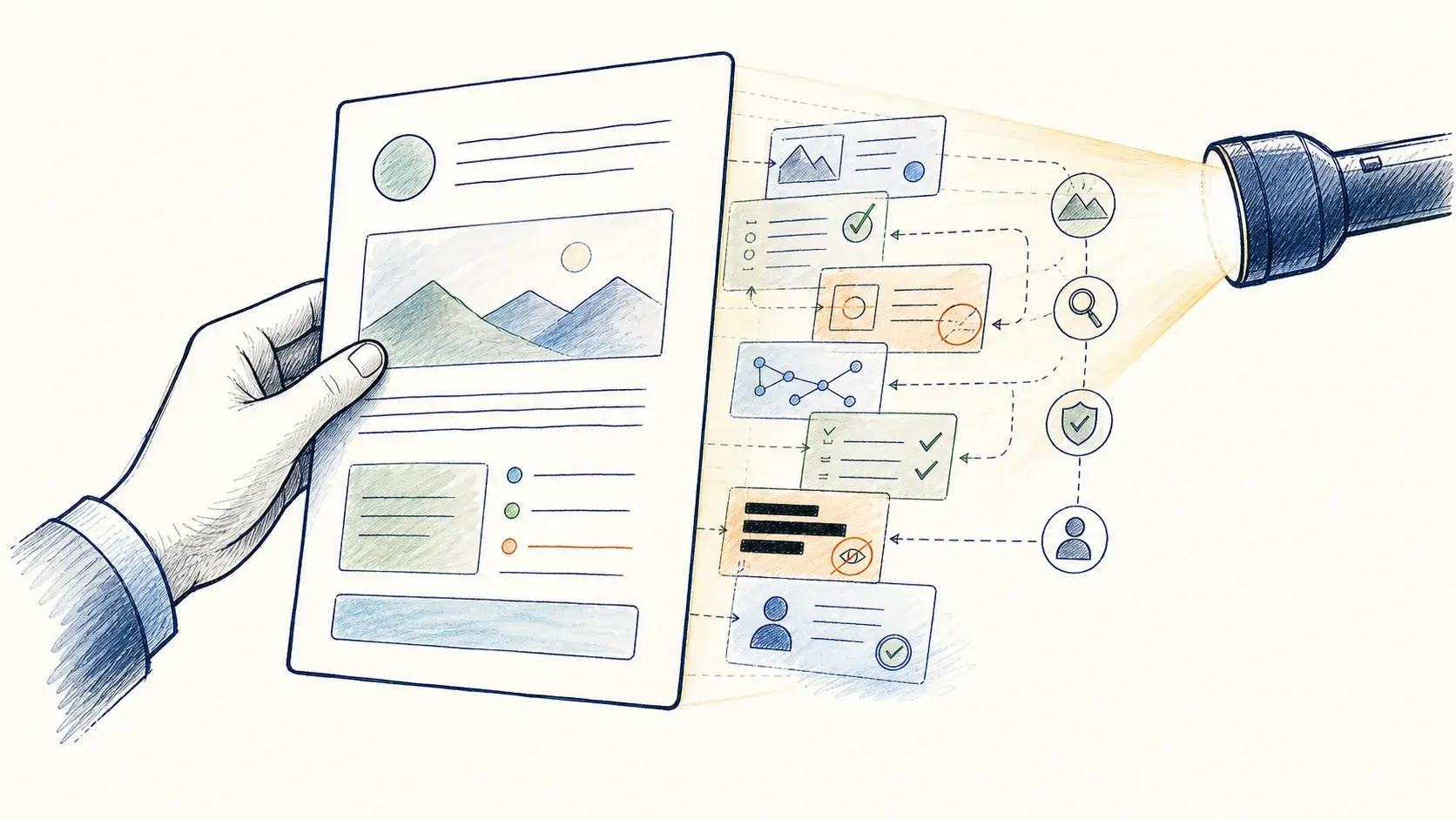
One of the patterns I keep noticing in my own AI-assisted work is that the finish line keeps moving.
At first, the finish line feels like output.
Can the model generate the page? Can it build the prototype? Can it summarize the research? Can it write the first draft? Can it create the deck? Can it refactor the code? Can it turn a messy idea into something visible?
This is the most visible phase because the distance between idea and artifact collapses. Something that used to take days can sometimes appear in an afternoon.
But after enough repetitions, the novelty wears off and a more important question shows up.
Is the work reviewable?
That question has become one of my private tests for whether an AI-assisted workflow is actually mature.
A prototype is useful if I can inspect the decisions behind it. A draft is useful if I can tell which claims are supported and which ones are still loose. A research synthesis is useful if I can trace the sources. A generated image is useful if the reader understands what it represents. A software change is useful if I can see what was requested, what changed, and how it was verified.
The artifact needs a review surface.
This has shown up for me across several projects. In a local-first log viewer, the important product question was not only how many prompts I sent or how many sessions I had. The more interesting question was whether the history of AI-assisted work could become inspectable without exposing private material. If natural language is becoming part of how software gets built, then the conversation around the software starts to matter. The code tells us what changed. The user message often tells us why the change was requested.
That does not mean raw AI logs should be public. They often contain private paths, drafts, source material, pasted text, half-formed ideas, and sensitive details. But it does mean teams will need better ways to preserve reviewed intent. The prompt should not disappear just because the code compiled.
In a conversational evaluation tool, the reviewability question took a different shape. The product needed to show not just a response, but the evidence around that response. What did the system return? Which constraints were checked? Which findings were automated? Which fields needed human review? Where did the conversation branch? Where did it drift?
The work needed to be inspectable by someone trying to make a decision.
The same pattern appears in publishing. A finished article is not simply a generated draft. It has to carry its own trust model. What was observed? What was generated? What was sourced? What was edited? What is the author claiming? What should the reader not infer?
That distinction matters more as AI-generated work becomes more polished. A rough draft announces itself as unfinished. A polished draft can hide its weaknesses. A confident answer can hide missing evidence. A beautiful visual can imply more truth than it deserves. A clean interface can make a fragile workflow feel stable.
The higher the polish, the more important the review trail becomes.
This is uncomfortable because reviewability is slower than generation. It asks us to pause after the exciting part. It asks us to inspect the thing we just made instead of immediately making the next thing.
But I think this is where the durable leverage is.
The first generation of AI productivity was about acceleration. The next generation will be about accountable acceleration.
Can the system help us move faster while making the work easier to inspect? Can it show assumptions alongside options, preserve uncertainty alongside summaries, and run checks alongside builds? Can it help a human make a better decision rather than simply reduce the effort required to make any decision?
When I look back at the projects that taught me the most, they were not the ones where AI simply created something impressive. They were the ones where the workflow forced me to ask better questions.
What does good mean here?
What should be verified?
What can be trusted automatically?
Where does a human need to decide?
What should be redacted?
What should be preserved?
What would make this artifact safe to share?
What would make it useful six months from now, when I no longer remember the context?
Those are not just operational questions. They are product questions.
A team that cannot review its AI-assisted work will struggle to improve it. It may still ship more. It may still create more drafts. It may still produce more prototypes. But it will have a harder time learning from the work because the learning will be trapped in private memory, scattered chats, and unexamined artifacts.
Reviewability gives the work a second life.
It turns a prompt into a record of intent. It turns a generated answer into something that can be challenged. It turns a prototype into a learning artifact. It turns a draft into an argument that can be edited, sourced, and owned. It turns a workflow into an operating model.
For AI-assisted work, the more useful question is: done enough for what?
Done enough to explore?
Done enough to share privately?
Done enough to publish?
Done enough to use in a decision?
Done enough to let someone else inspect it?
Each of those thresholds requires a different level of review. The mistake is treating them as the same.
AI makes rough work look finished earlier. That means the human has to define the threshold more clearly.
For public writing, that threshold includes voice, accuracy, source grounding, confidentiality review, illustration quality, and the final disclaimer. For product tools, it includes evidence, QA, privacy, accessibility, and whether the next person can understand how the thing works. For strategy work, it includes whether the argument is true, not only whether it sounds coherent.
The finish line is no longer "the model produced something."
The finish line is "the work can be reviewed at the level of trust it is asking for." That is the workflow I want to keep building: one that makes artifacts more reviewable, accountable, and easier to improve.
This writing reflects my personal perspectives on product management, AI, and content discovery. It does not represent the official position of my employer or any affiliated organization.