Article
June 22, 2026
6 min read
The Evaluation Layer Is Becoming the Product
AI product teams need evaluation as a visible product surface, not a late report card, because fluent demos can hide weak or unsafe judgment.
By Cristiano Pierry
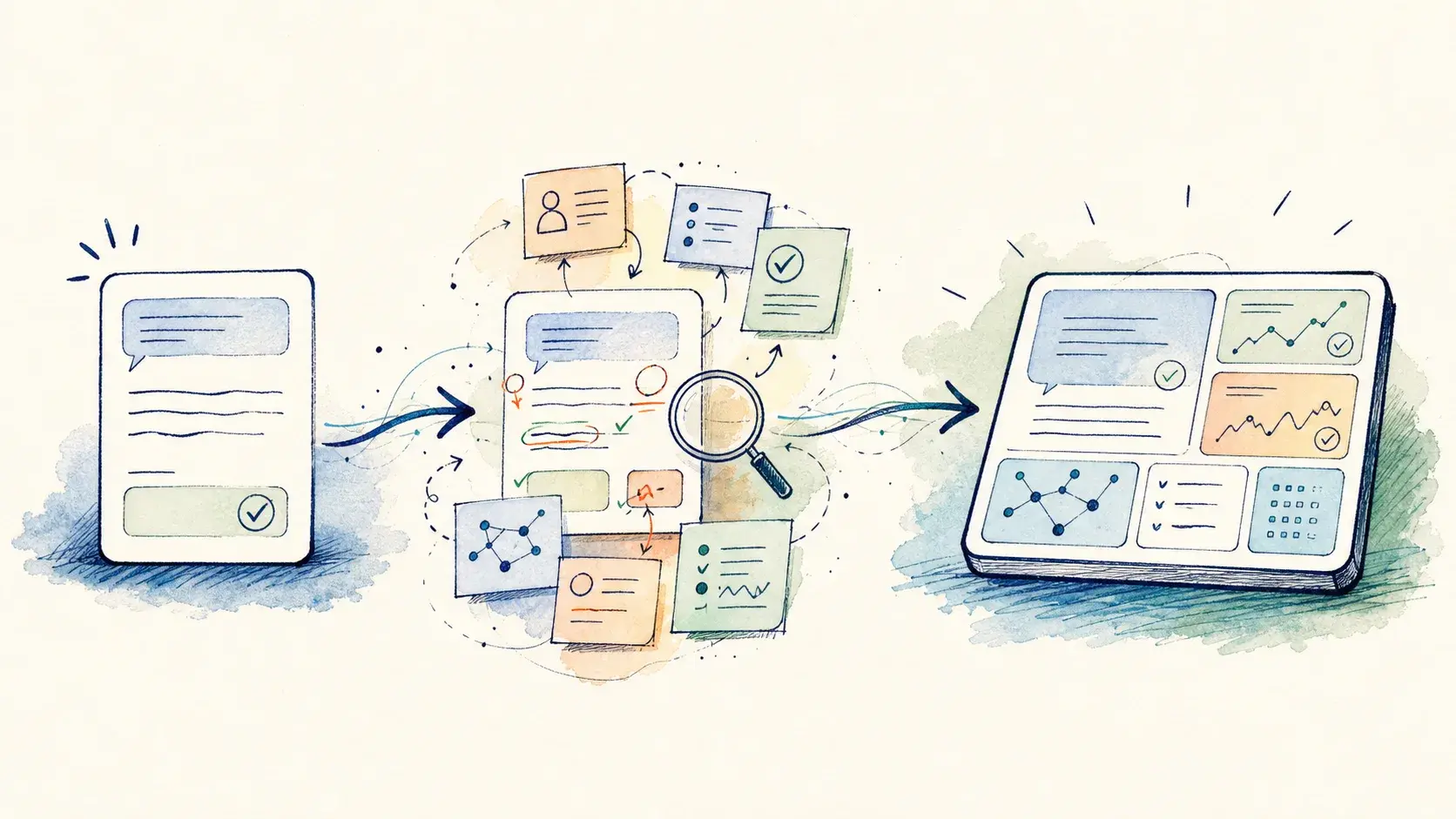
Over the last two weeks, one theme kept showing up in different forms: it is getting easier to build the experience, but harder to know whether the experience is any good.
That sounds obvious, but I do not think it is where most teams naturally put their attention.
When a new AI-assisted product starts to work, the first emotional reaction is usually relief. The demo responds. The page renders. The workflow completes. The agent produces something that feels coherent. A conversational interface can answer a user. A coding assistant can ship a feature. A publishing workflow can turn research into a polished page. A prototype can become surprisingly usable before the team has fully caught up to the implications of what it built.
That speed is exciting, but it can also conceal whether the result is any good.
A system can answer without answering well, generate without producing the right thing, and create a polished artifact without sound judgment underneath it.
In older product workflows, the artifact often moved slowly enough that evaluation arrived naturally. A design review happened before the build. A requirements review happened before implementation. A QA pass happened after engineering. A launch review happened before release. That process could be slow and frustrating, but it created moments where judgment had to enter the room.
With AI-assisted work, the artifact can appear so quickly that the evaluation layer gets skipped, compressed, or treated as optional. The prototype becomes persuasive. The fluent answer feels like evidence. The generated copy sounds confident. The UI makes the system feel more mature than it is.
I think evaluation is becoming a product surface, visible in the way the team inspects and improves the experience rather than confined to a back-office report.
I felt this most clearly while working on a conversational search evaluation tool. The public version uses fixture data and public entertainment metadata, but the product problem is broader than entertainment search. Any conversational product has the same structural challenge: the system can sound helpful while being wrong, narrow, repetitive, unsupported, or unsafe.
A traditional search result can be evaluated with a familiar set of questions. Did the right items show up? Were they ranked well? Did the metadata match? Did the user find something useful?
A conversational experience adds another layer. It must preserve intent across turns, suggest useful follow-ups, avoid narrowing or drift, explain recommendations without inventing facts, recognize missing metadata, and improve the next step rather than fill the screen with plausible language.
That means evaluation cannot stop at the first response.
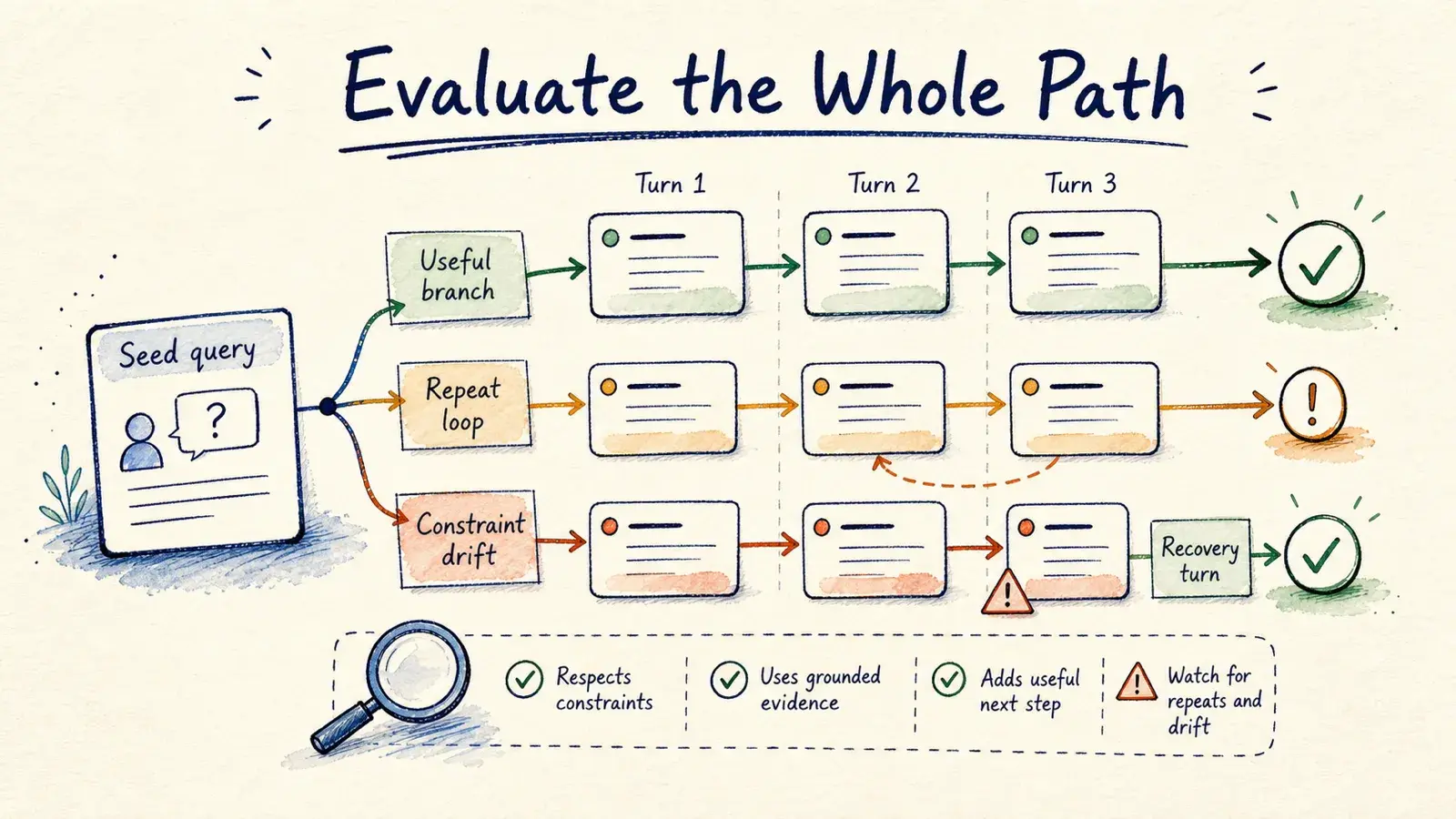
Conversational products need to be evaluated as paths.
A seed query opens a tree. Each follow-up creates a branch. Each branch can continue, repeat, narrow, recover, or drift. The failure mode may not appear in the first answer. It may appear three turns later, when the system starts recycling similar suggestions or quietly drops the constraint that mattered most.
This changes the product job.
The useful question is whether the system can remain helpful as the conversation develops, not merely whether it can produce a first answer.
That requires two kinds of evaluation.
Correctness comes first. Before we talk about taste, polish, or usefulness, we need to know whether the response is valid enough to judge. Did it respect the user's constraint? Did it return the right type of result? Did it avoid unsupported claims? Did it keep generated language grounded in available evidence? Did it avoid risky or inappropriate language? Did it include enough metadata to explain itself?
Quality comes next. Once the response passes basic correctness, we can ask whether it is actually good. Are the results relevant? Are the strongest matches surfaced early? Is the explanation useful or generic? Are the follow-up suggestions diverse? Does the next turn improve the experience? Does the product feel like it understands the user's intent, or is it only producing a reasonable-sounding sentence?
Those two layers should not be blurred.
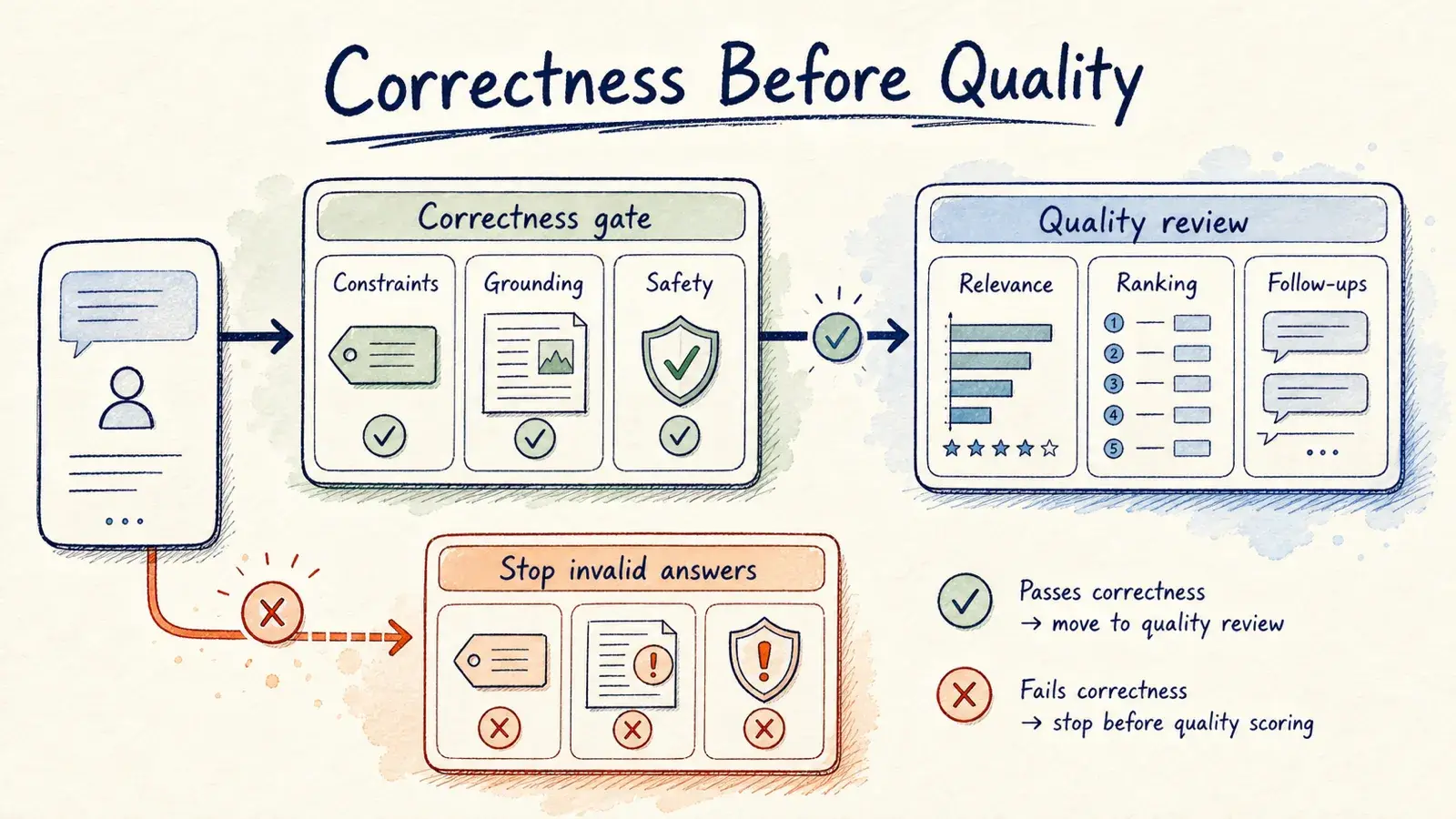
If a system violates a hard constraint, calling the answer "pretty good" is dangerous. If the system passes correctness but feels generic, calling it a failure may also be too blunt. Product teams need a vocabulary that separates invalid answers from weak experiences, and weak experiences from strong ones.
That vocabulary matters because it changes what the team works on next.
If the issue is correctness, the team may need better metadata, stricter gates, better retrieval, better parsing, or clearer constraints. If the issue is quality, the team may need better ranking, better copy, more diverse follow-ups, or a stronger understanding of user intent. If the issue appears only at depth, the team may need conversation-tree evaluation, not more single-query screenshots.
This is why I am increasingly skeptical of AI product demos that do not show their evaluation layer.
A demo can show possibility. It cannot prove reliability.
The evaluation layer is where the team shows what it believes quality means. It is where product judgment becomes inspectable. It is where "this feels good" becomes a set of claims the team can review, challenge, and improve.
This does not mean every product needs a giant formal benchmark before anyone can learn from it. Early prototypes should be allowed to be early. But even an early prototype needs some answer to a simple question: what would make us believe this is getting better?
That answer should be part of the product.
One of the mistakes teams make with AI is treating evaluation like a report card that arrives at the end. I think it is more useful to treat it like a control surface. The team should be able to inspect runs, compare quality over time, review failures, mark false positives, add human judgment, and see where the system is improving or regressing.
The human review piece is important. Not because humans should manually judge everything forever, but because early evaluation systems need to learn what expert judgment actually looks like.
Automated checks can tell you whether a constraint was violated. They can catch missing fields, bad metadata, repeated suggestions, or unsafe language. But product quality often requires judgment. Is this explanation useful? Is the result surprising in a good way or irrelevant in a subtle way? Does this follow-up help the user continue, or does it push them into a dead end?
Good evaluation tools make that judgment visible. They preserve the automated finding and the human override. They let reviewers add commentary. They make disagreement useful. They create a trail of why the team believed something was good enough to move forward.
More AI teams will need this operating model. It is designed to make progress reviewable, not to hold every answer until it is perfect.
AI makes it easier to generate options, prototypes, summaries, interfaces, and workflows.
As output gets cheaper, the scarce skill becomes knowing which output deserves trust.
This is product work. Speed matters, but speed without evaluation only lets a team arrive at confusion earlier.
The better advantage is a team that can learn faster. That requires a way to see where the system fails, where the user experience degrades, where the model sounds confident without being grounded, and where the product is improving in a way that actually matters.
The evaluation layer is becoming part of the product itself.
This writing reflects my personal perspectives on product management, AI, and content discovery. It does not represent the official position of my employer or any affiliated organization.