Note
June 23, 2026
1 min read
Better Loops Have Stopping Rules
By Cristiano Pierry
An agent loop needs more than a sequence of actions. It needs an explicit rule for when to continue, ask, verify, or stop.
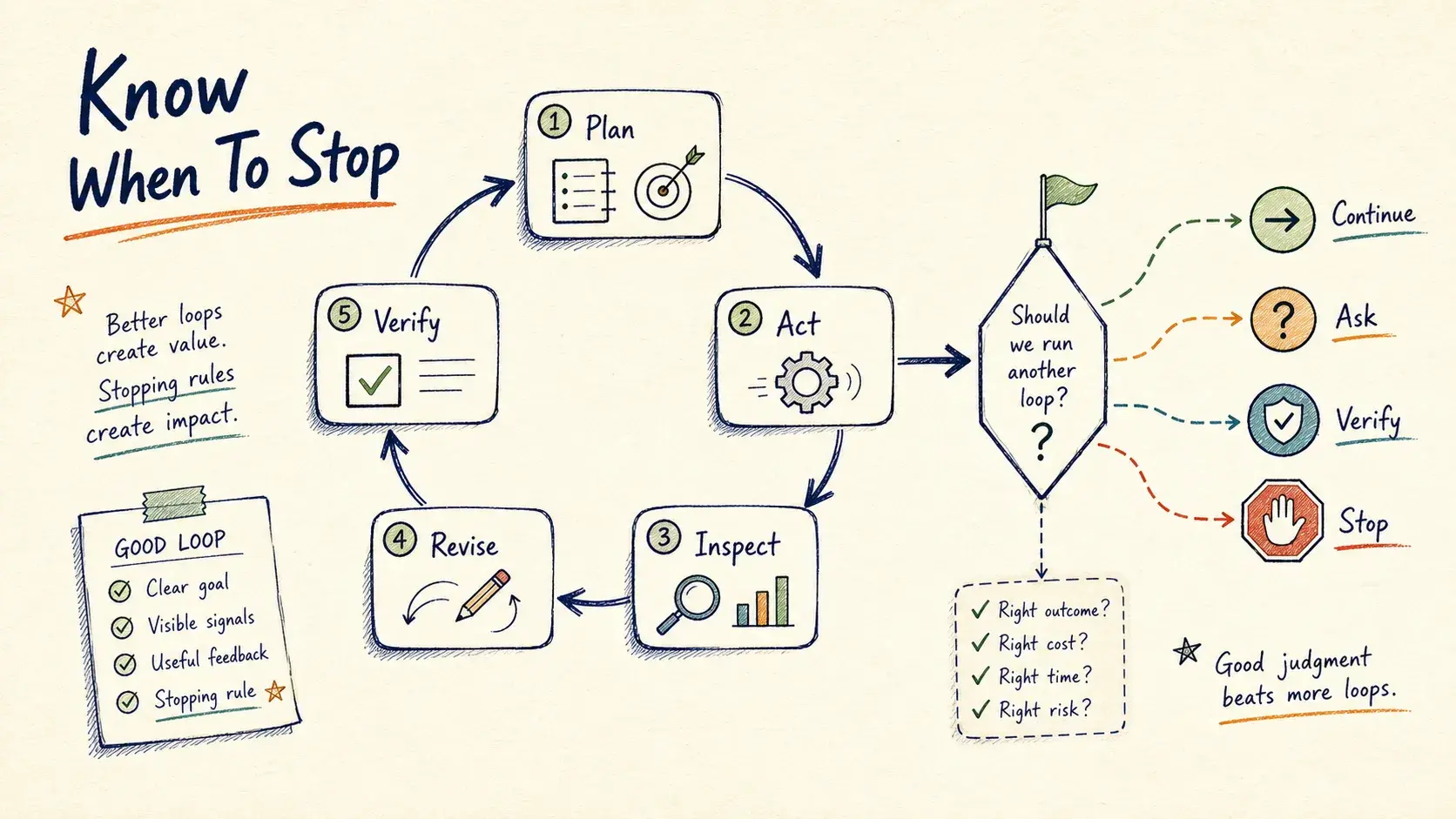
I have been thinking about agent loops lately: plan, act, inspect, revise, verify, and continue.
The sequence is useful, but it leaves out the product decision that increasingly matters in my own work. What tells the loop that continuing is still the right answer?
A loop needs to distinguish several conditions. It may have enough evidence to finish, need another verification pass, lack context that only a person can provide, or reach a decision that requires human judgment. Without those boundaries, the system can reformat, recheck, and replan indefinitely. The activity looks productive while hiding the absence of a quality bar.
A loop without a stopping rule can create a lot of activity that feels like progress.
I do not want to prompt every step, but I still have to define what good means and which uncertainty the system is allowed to resolve on its own. The leverage comes from designing a loop that can proceed without me and can also recognize the point where my judgment belongs back in the work.
This writing reflects my personal perspectives on product management, AI, and content discovery. It does not represent the official position of my employer or any affiliated organization.