Article
November 19, 2026
5 min read
I Asked Astra 6.2 to Build a Rainforest
What started as a one-shot prompt for an Amazon rainforest became a browser simulation where we could watch animals move, feed, and respond to changing weather.
By Cristiano Pierry

The toucan on my website can toss a piece of fruit into the air and catch it. I’ve been working on 2D animal avatars, and a gesture like that gives me plenty to think about. The fruit has to leave the bill at the right angle. The head has to tip back far enough to catch it. Moving that bird into a 3D forest adds a question that a painted animation can take for granted. Where did the toucan get the fruit?
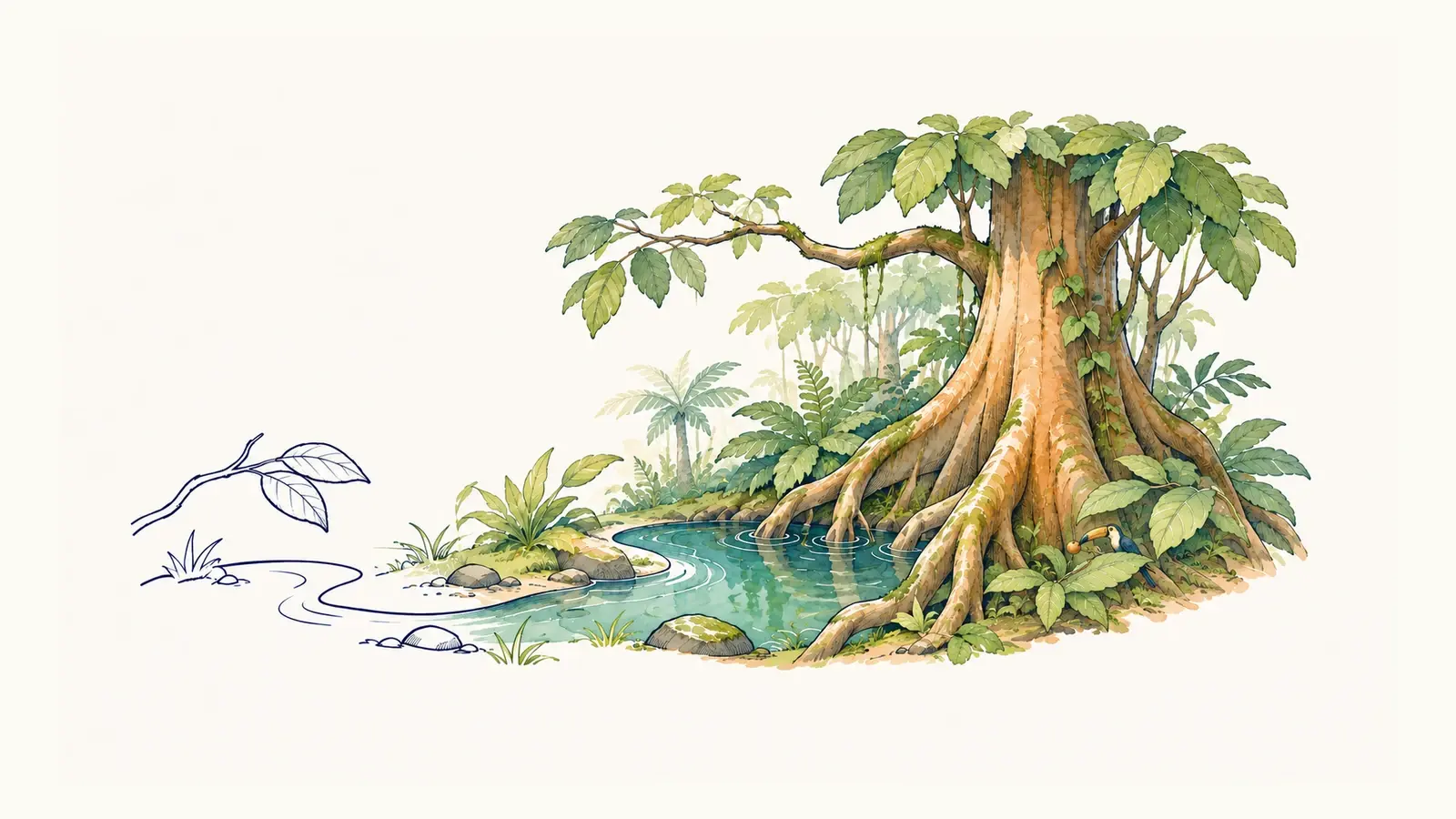
I wanted to try ChatGPT Astra 6.2 on something I’ve been meaning to build for a while. I can read a model’s evaluation results, but I wanted to see what it could do with an open-world simulation of the Amazon rainforest. Our first prompt asked it to build the whole 3D world in one shot. The world we built, Igarapé, begins on the bank of a forest creek.
Getting to a first version I could walk through was easy. That first clearing was roughly 36 by 42 meters, with a creek, birds overhead and enough room to leave the path. Once there was a place to explore, it was much easier to say what needed work. An early recording of the pool showed stones hanging above the creek bed and plants that belonged on the bank growing below the surface. We corrected their placement. Diving to look at the fish turned out to be a good way to inspect the gardening.
From the bank to the canopy
A lot of what makes Igarapé feel immersive is visible from the bank. Broad leaves fill the foreground, and the creek reflects the opening between the trees. You can circle a buttressed trunk, rise above it to see where the macaws fly, or go back underwater and follow a cardinal tetra. There’s a field recording by Félix Blume from Tauary, in the Brazilian Amazon, mixed with the sound of the creek. As you move along the bank, the creek changes position in the stereo mix.
Astra helped us build the forest in JavaScript with Three.js, which draws the scene in the browser. We combined scanned roots and trunks, existing 3D models, and plants built in code. The distant canopy uses a photograph. Close enough to walk around, a tree needs volume, and close enough for something to land on, a leaf needs a surface the animal can actually find. Beyond the original clearing, the engine now generates terrain and vegetation as you travel. You can pick a direction and keep going.
One way to see how those pieces fit together is to change the weather. Hold the time of day steady and bring in a shower. A blue morpho caught in flight can finish its landing, then move from an exposed leaf to one with more cover. Once its wings fold, the blue largely disappears and you see the brown underside with its eyespots. We used photographs of both sides of a museum specimen from Pará to shape and proportion the wings. The forewing and hindwing can sweep separately and overlap as they close. That extra degree of freedom matters most in the last little bit of movement, when the butterfly settles.
Getting the toucan its lunch
The forest runs on a clock that advances in steps of one sixtieth of a second. Rain, wind, plants and animals share that clock. Each animal has rules for choosing what to do and separate code for how its body carries out the choice. Astra helped us write that engine. Once it’s running, a toucan can go about finding lunch with no further prompting from me.
There’s a fruiting branch above the creek. To eat there, the toucan has to reach a feeding perch, grip the bark and bring its bill to a ripe berry. Only then can it pluck it. The bird tips its head, tosses the berry and catches it farther back in its bill. We shortened the model’s bill from about 19 centimeters to just under 18 to bring its proportions closer to museum measurements. We used feeding studies of related toucan species to guide the angle of the toss and the timing of the catch. Some details, including how far the neck moves, are still estimates. I can walk around to the other side of the branch to see how the bird grips it, then look at the recording frame by frame to see where the berry goes.
The engine also runs in Node.js, so we can leave the forest going for two simulated days without drawing a single tree. In one run with 74 animals of 20 species, a frog on the forest floor kept trying to hop past the same obstacle. It accounted for more than 43,000 rejected attempts. It had a perfectly serviceable hop. What it needed was a way to turn around and look for somewhere else to land. After that change, a six-hour replay of the same conditions went from 4,942 rejected exploratory hops across the four frogs to zero. On a short walk I might have taken a frog sitting quietly in the leaf litter as evidence that everything was working.
That’s what I wanted from trying Astra 6.2 for myself. It was easy to get into the forest, and once there I could spend my time on questions as small as the overlap of two wings or as long as a frog’s afternoon. I’ve wanted to do more work with simulations for a while. What happens if the rain comes an hour earlier? I could watch the butterfly from the bank, then compare two unattended runs to see what difference that hour makes by dusk.
This writing reflects my personal perspectives on product management, AI, and content discovery. It does not represent the official position of my employer or any affiliated organization.