Article
November 18, 2026
4 min read
Do We Still Have to Pick Two?
With AI agents, I can keep the features and quality I committed to and ship sooner. The decision is how much I’m willing to spend to get that time back.
By Cristiano Pierry

Codex told me I could have saved about 20 hours that week by using Fast mode. I was on the $500 Pro plan and had 1% of my weekly allowance left, with four hours before it reset. I couldn’t afford to use Fast mode with what I had left.
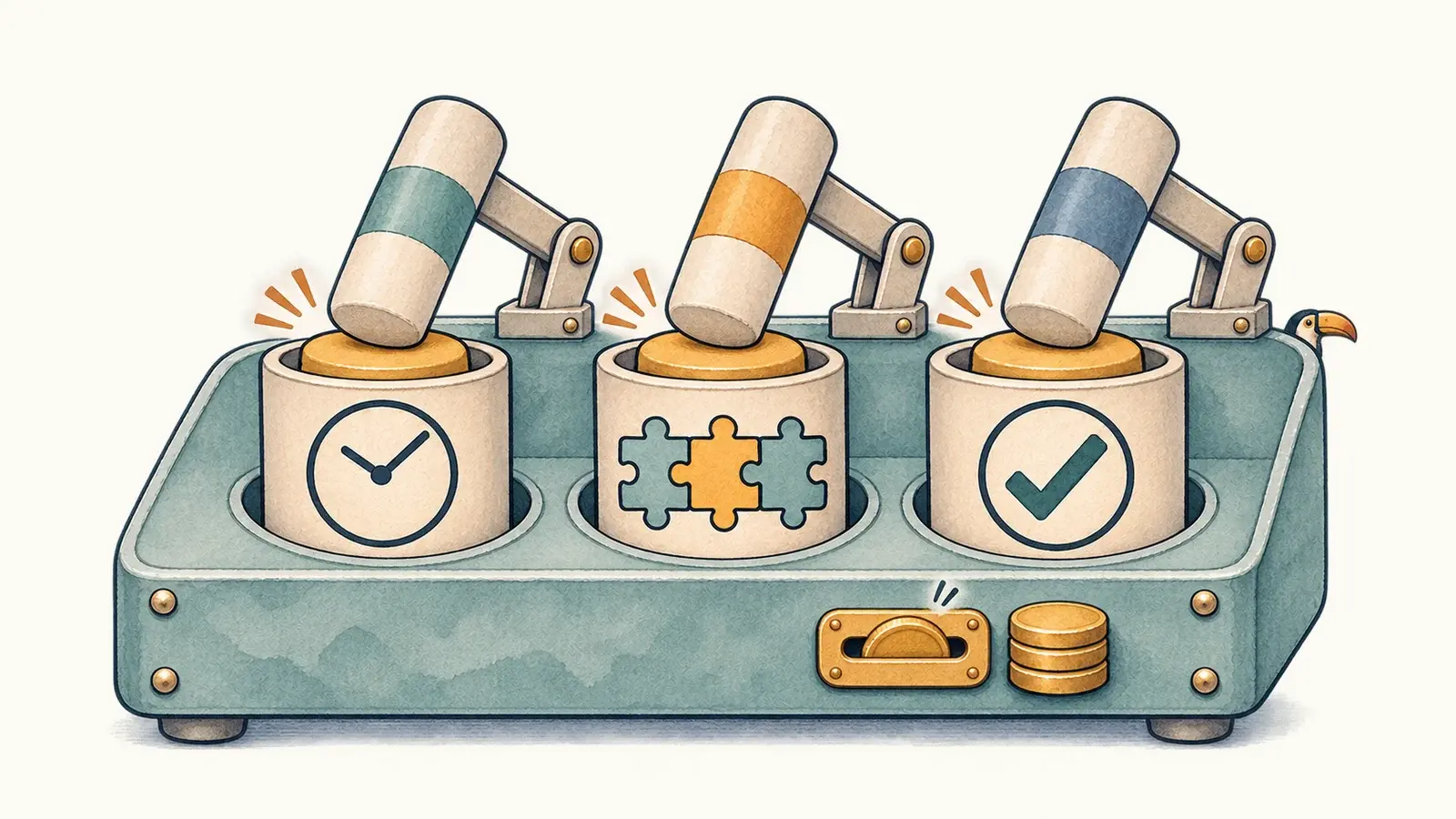
Speed, features and quality. Pick two. With agents, I can have all three. I can decide what I want to ship and how well it has to work, then spend more of my AI budget to get that release done sooner.
In The Mythical Man-Month, Fred Brooks explains why adding people to a late software project makes it later. The engineers who know the project best have to stop and figure out what the new people can take on. They have to bring them up to speed, then fit their work into a project that’s already underway. The people you need to finish the work are the ones you pull away from it.
Brooks’s Law has outlived its usefulness as a rule for adding agents. I can give an agent the requirements and the code and ask it to divide the work. It can trace the dependencies and prepare assignments with the context each worker needs. I can put more agents to work as soon as those assignments are ready. Some of the work of adding capacity can go to the agents themselves.
Say I’m building a watchlist. I want to save a show on my phone, find it on my TV and remove it from my laptop. Once I remove it, it disappears from the phone and the TV too.
I can ask an agent to work out what that takes in the shared service and split up the changes for iOS, Android, connected TV and desktop and mobile web. One agent can build the interaction for a TV remote while another handles touch on Android. Once I have an Android build, I can put a worker on the phone checks while the TV app is still being built. As more builds come in, I can run their device checks side by side.
I can buy time on the shared work too. If the apps are waiting on an agent to finish a service change, I can spend more of my allowance to run the same supported GPT model in Fast or Ultrafast and get the tokens back sooner. Once the service is ready, I can spend the next hour running several jobs at once.
I can also put more agents on a problem where the work takes shape as they go. A team of agents took on a finite version of the Kakeya problem. Imagine a three-dimensional grid where the arithmetic wraps around at the edges. How few points can you keep and still have a whole line in every direction?
One agent started with a standard set of points that covers most directions. It proposed a way to add the missing lines and tested it on a computer. A second narrowed the choices for placing those lines to two cases and showed which used fewer points. Another agent built on that work to count the points exactly and prove that the construction covers every direction when the grid has an odd prime number of positions along each axis. The researchers checked the improved case in Lean. On a grid with 47 positions per axis, it covers all the directions with 11 fewer points than the previous method. It gives a smaller set for infinitely many grid sizes.
Say I want my recommendations to get better at finding what someone wants to watch next. I can put one agent on a signal from the titles a viewer has saved to their watchlist and another on what people tend to watch after finishing a particular series. They can build and test those signals in parallel. I can compare each version with the current model using the same viewing sessions and see where it ranks the titles people went on to watch. Then I can try the signals together and decide what to take into a live experiment.
Do we still have to pick two? With agents, I can ship the full release sooner and hold it to the same quality bar. The decision now is how much I’m willing to spend to get that time back.
This writing reflects my personal perspectives on product management, AI, and content discovery. It does not represent the official position of my employer or any affiliated organization.