Article
November 5, 2026
4 min read
While My Colleagues Tackle Millennium Prize Problems, I’m Tackling Pac-Man
Building a browser game and a verified replay to prepare for a real-time Pac-Man algorithm.
By Cristiano Pierry

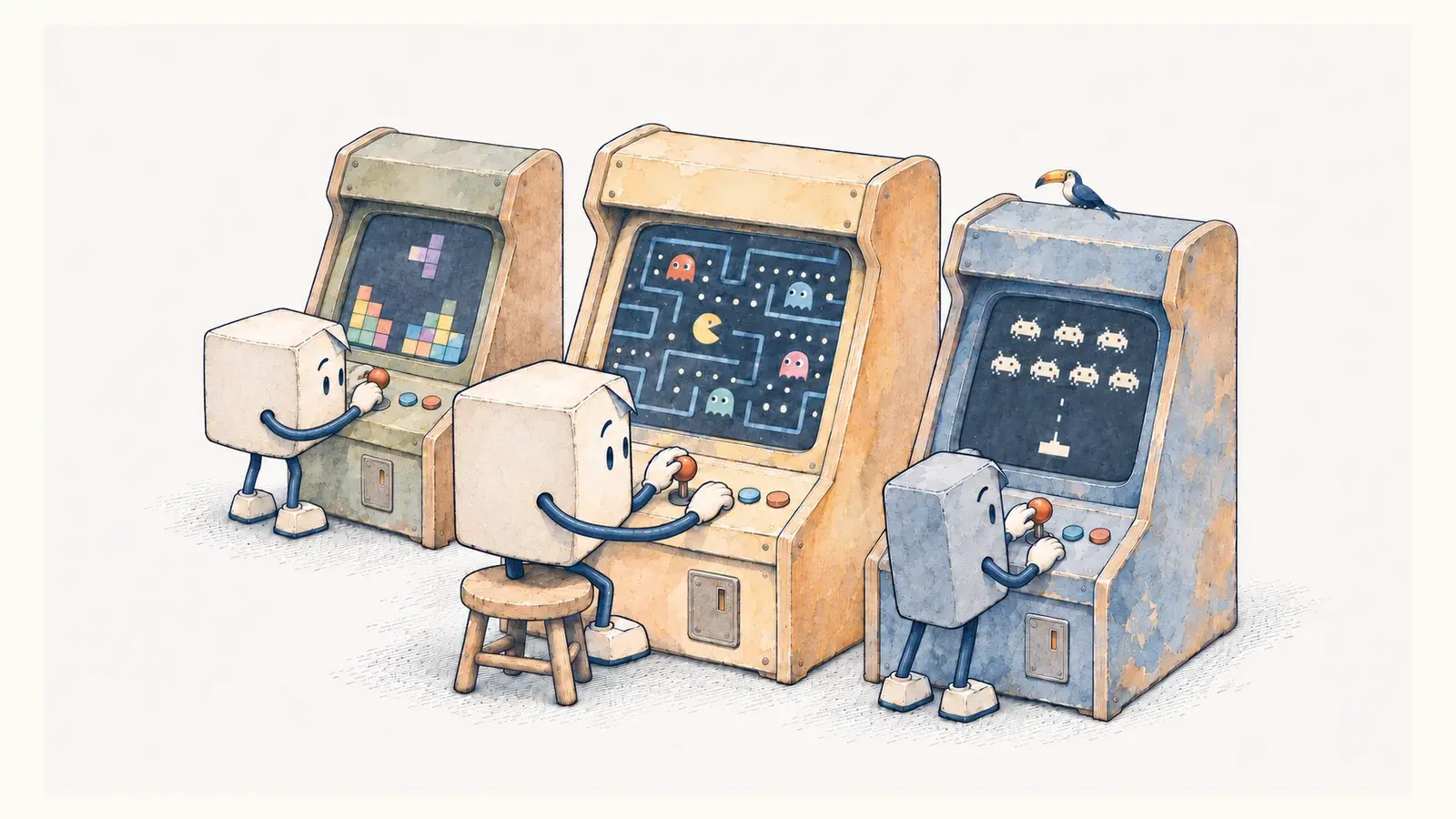
Researchers are using frontier AI tools to develop algorithms for difficult problems in mathematics and computer science. Following my Tetris experiment, I decided to explore what these tools could help me do with Pac-Man, a game from 1980. Humanity has a range of priorities. Mine currently include four ghosts and a cherry.
I want to use these tools to develop an algorithm that makes Pac-Man decisions while the game is running. It should look at the current situation and decide what to do, rather than follow a memorized route through every level. The models would help develop the algorithm; the resulting program would play the game. Before I could evaluate an algorithm, I needed a game to play and a way to check its results.
That became a project of its own: a browser implementation of Pac-Man, a test harness that runs players and checks their results, and a replay of known paths through all 256 levels, or boards.
Getting the game as close to the original as possible
I worked with an AI coding model to research the original arcade mechanics and build a browser version from public descriptions of how the game works. The aim was to reproduce the gameplay closely enough that an algorithm developed here could, in principle, also control the original arcade game.
That involves more than drawing a maze and having ghosts chase a yellow circle. Pac-Man and the ghosts move at different speeds under different conditions. The ghosts have distinct targeting rules, and the time available to eat them changes across levels. Small differences in those mechanics can change whether a route works or fails.
My implementation target was frame accuracy: matching the original gameplay frame by frame. The project record includes comparisons of player and ghost positions, scoring, and timing on selected routes against the original game. The browser version has its own artwork and sound. Those comparisons, together with the known-path replay, give me confidence in the recreation. They establish how it behaves on the tested routes; an algorithm that succeeds here would still need verification against the original arcade game.
Known routes gave me something concrete to check. Pac-Man players have spent decades working out how to get through these boards and maximize the score. The project used published patterns, recorded play, and locally completed sections to produce directional inputs the browser game could replay. Some source material described where to go without supplying every input at an exact time. Turning that into a working replay required resolving those gaps. In the end, we replayed all 256 boards continuously and reached the maximum score for the game’s life settings.
Creating an algorithm that makes decisions from the current game state is the next experiment.
What the score actually establishes
The continuous replay starts a fresh game and reaches board 256 with no deaths on the first 255 boards. It finishes with 3,333,180 points. The harness checks the scoring events along the way, including fruit and ghost captures, rather than accepting the final number alone. The continuous replay preserves the running game between boards.
My game starts with three lives and awards one bonus life at 10,000 points, so the replay reaches board 256 with four lives. A bug in the original arcade game partly corrupts this final board, known as the split screen. Some dots there can be collected again after a death, so extra lives allow more points. Under my four-life settings, 3,333,180 is the maximum; the 3,333,360 arcade perfect score uses six total lives.
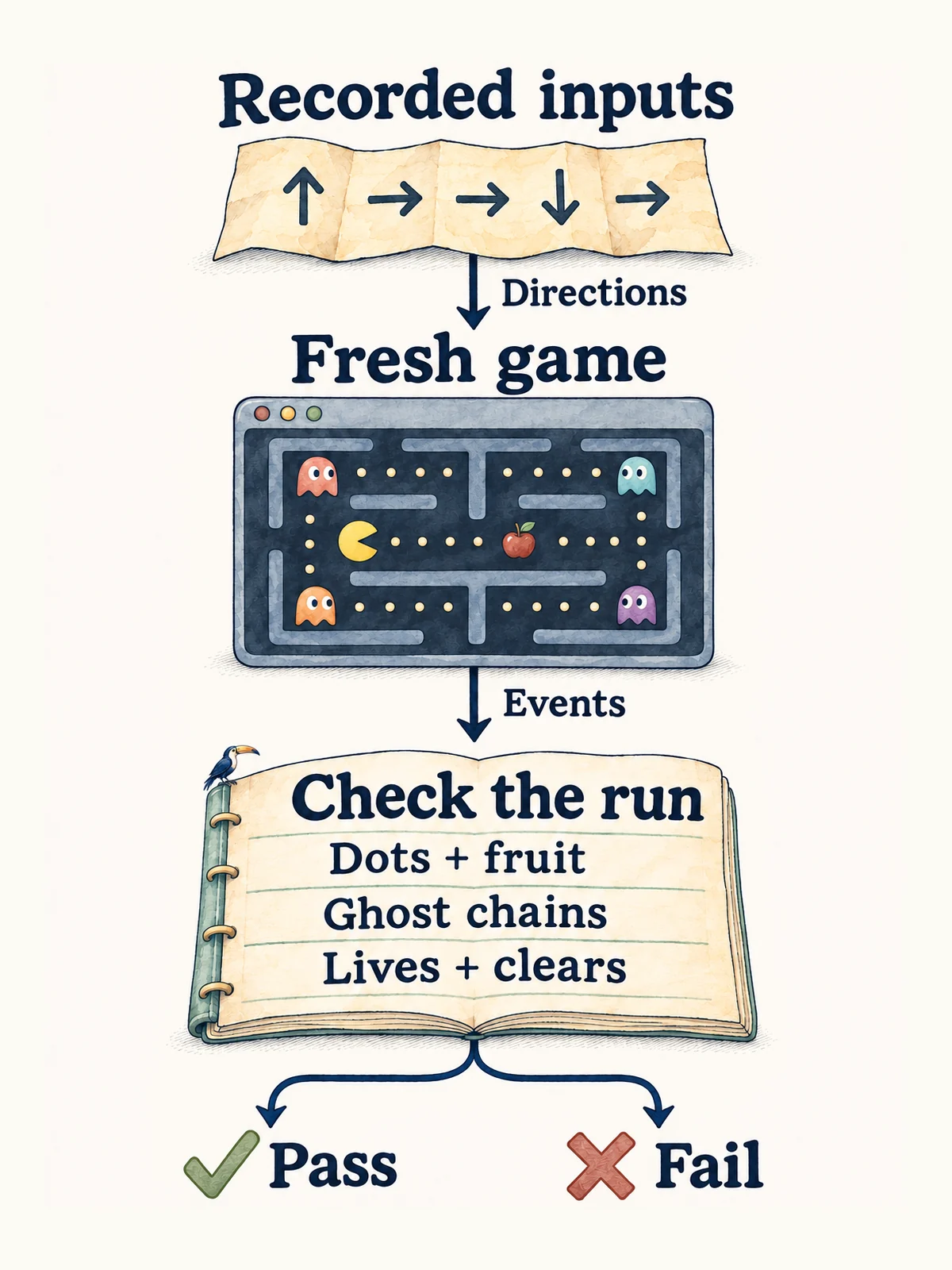
There are also individual board replays. Those are useful for examining a particular section of the game, but completing each board separately leaves open whether the same inputs can work in one continuous game. The fresh-game replay provides evidence for that additional claim.
None of this requires a model to make decisions as the replay runs. Once the directional inputs are recorded, ordinary software executes them. An accelerated simulation can check the whole run without waiting through several hours of play.
Once play is running, the real-time harness advances the game every 16.5 milliseconds, about 61 times a second, without waiting for the player. That leaves at most 16.5 milliseconds to return the next action, and less once communication overhead is taken into account. The algorithm can plan ahead and keep following a valid direction between updates, but it cannot pause the game to finish its search.
I have a game, a known-path benchmark, and a harness that can inspect how a player earned its score. Next, the program has to decide where to turn for itself. I’m looking forward to putting Astra and other models to the test on this very important gap in computer science. Four ghosts have been haunting us since Pac-Man’s first public test in Japan on May 22, 1980. It’s time to call the Ghostbusters and put this challenge to rest.
This writing reflects my personal perspectives on product management, AI, and content discovery. It does not represent the official position of my employer or any affiliated organization.