Note
August 6, 2026
2 min read
Learning to Aim: How Neural Networks Learn
By Cristiano Pierry
Learning to Aim starts with one fixed dart throw and introduces a neural network only when the target, wind, and distance begin to change.
This is part one of a three-part series. The next posts cover its playable Dart Room and the orchestration behind the two projects.
Most explanations of neural networks start with the network. Learning to Aim starts with a problem that does not need one.
Marcelo Pierry and I built the interactive presentation around a robot learning to throw darts. In one fixed room, the robot can tune three launcher controls: horizontal angle, vertical angle, and release speed. Once those controls produce a bullseye, the robot can reuse the same throw. There is nothing for a neural network to add yet.
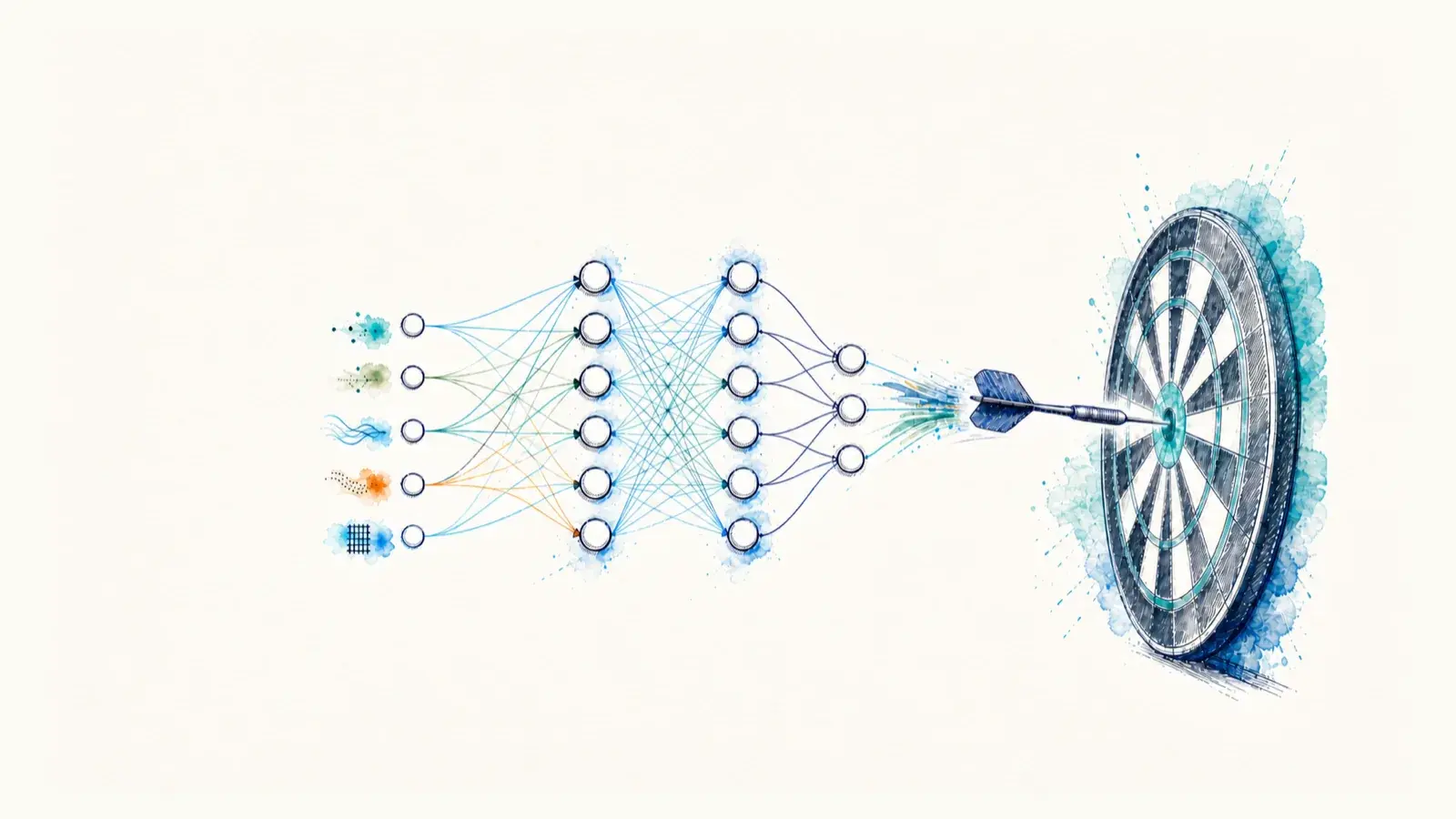
The explanation changes when the room does. Move the target, change the wind, or vary the distance, and the stored throw fails. The robot now needs to read five measurements about the room and calculate three new launcher commands. This is the point at which the neural network enters the lesson.
The experience has a cover and 44 numbered pages. The first 13 establish the experiment in plain language. Pages 14 through 39 open the machinery and follow the same throw through the network and simulator, from output to miss to parameter update. The closing pages separate practice from testing and show what changes during inference.
We kept the model small enough to inspect: five inputs, two hidden layers of six neurons, and three outputs. It has 84 weights and 15 biases, for 99 adjustable parameters. Those numbers are not decorative. Every value displayed in the presentation comes from the same deterministic model transaction, including the dart impact and the parameter update.
The dart on screen therefore comes from the commands the network calculated. Its landing position produces the loss. During training, backpropagation traces how each parameter contributed to that loss, and the optimizer updates the parameters. During inference, those learned parameters stay locked while a new room produces new temporary activations and a new throw.
The presentation also states where the metaphor stops. It uses a simplified software simulator with known, differentiable equations. A physical robot that received only a final score would need additional sensing, modeling, or exploration. The network learns a numerical mapping within defined ranges. It does not see a dartboard or understand what a dart means.
By the time the network appears, the visitor has already watched one stored throw fail. The circles and lines now answer a concrete question: how can the same robot calculate a different throw for a different room?
This writing reflects my personal perspectives on product management, AI, and content discovery. It does not represent the official position of my employer or any affiliated organization.