Article
September 15, 2026
7 min read
The Feature You Kill Defines the Strategy
Strategy becomes credible when a team records the attractive work it declined, the customer promise it protected, and the evidence that would reopen the choice.
By Cristiano Pierry
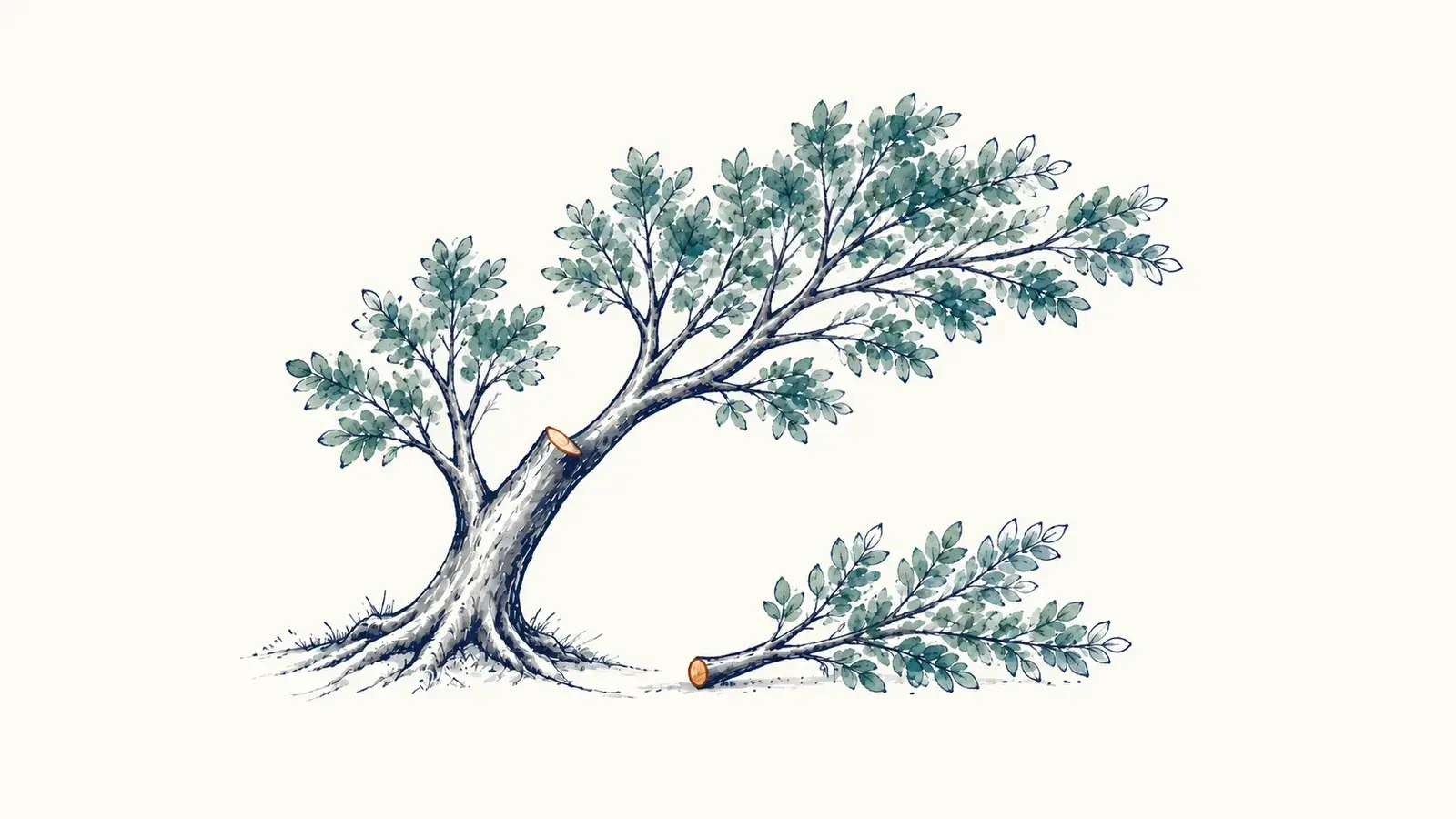
One of the clearer product choices I made on my website was recorded in a small commit: 12 additions, 30 deletions, three files changed.
I was building a public AMA that lets readers ask questions about my work and writing. The assistant had a name, Bob, and the first version Codex produced wanted everyone to know it. Bob appeared in the badge, headline, card, status, and body copy. The page worked, but the interface kept introducing the assistant after the visitor had already met him.
I wrote about it at the time as a problem of product taste and too much UI.
The cleanup removed identity badges, simplified status and supporting copy, hid an idle footer, and changed the input placeholder from “Ask Bob about Cris's work or writing” to “Ask about Cris's work or writing.”
The change did not kill an enterprise feature. The underlying AMA remained, and I have no customer or business outcome that proves the cleanup worked. It was a smaller, deliberate deletion of repeated UI treatment. I use it here because the choice is inspectable: working material existed, I decided it competed with the page's purpose, and I removed it.
For me, it is the smallest useful version of the mechanism behind the title. Product strategy becomes more credible when it can explain an attractive piece of work that will not survive. The explanation matters more than the drama of saying no.
Leave a record of the no
A refusal can take several forms. A new capability may never enter the roadmap. An experiment may work well enough to continue learning but not well enough to scale. A shipped product may lose a layer that functions but competes with a more important purpose. The title uses the forceful word “kill,” but the record should use the precise verb: decline, pause, contain, remove, or stop.
Accepted work often leaves a long trail. The problem statement, design, implementation, launch plan, and result can all be found later. Declined work may leave only a line in a backlog or somebody's memory of a meeting. When the request returns, the team has to reconstruct whether the earlier answer reflected strategy, timing, missing evidence, or one person's taste.
A reviewable refusal needs three things:
- The work being declined. Name it narrowly enough that “we are not adding this control” does not quietly become “we do not care about this customer” or “we will never explore this problem.”
- The promise being protected. State which customer outcome, product behavior, or concentrated capability deserves the attention that the declined work would consume.
- The evidence that would reopen the choice. Identify what the team would need to observe, learn, or see change before reconsidering.
The record is practical rather than ceremonial. Not every discarded sketch or low-quality request needs one. It earns the effort when plausible work is likely to return or set a precedent elsewhere in the product. Three clear lines may prevent a later team from mistaking an old constraint for a permanent principle.
It is also not a claim that every no is correct. The purpose is to make the reasoning visible enough for someone who supported the work to challenge it.
The AMA cleanup can be reconstructed in those terms. The commit does not contain this three-line record, so the reconstruction is retrospective. The declined work was narrow: repeated identity treatment across the page. My interpretation is that the reader's question and the public work behind the answer deserved more space. A reasonable reopening condition would have been evidence that new visitors could not tell what the experience was or what they could ask.
The reopening condition above is a proposed test, not a reported result. I do not have a measurement showing that the removed badges improved comprehension. The value of the record is that it separates what happened from the judgment behind it and from the evidence still missing.
Written retrospectively in one sentence, the choice becomes: remove the repeated Bob treatment to keep the question and public source material central; reconsider if people can no longer understand the experience. That statement is more useful than “simplify the AMA” because it preserves the tradeoff rather than only the direction.
Each field prevents a different kind of strategic inflation. A precise description of the declined work stops a local decision from becoming a sweeping rejection of an audience or problem. The protected promise forces the team to name the opportunity cost rather than using “focus” as a complete explanation. The reopening evidence keeps a current preference from hardening into permanent doctrine.
The record becomes especially useful when the answer is “later.” Sequencing can be the right decision when another capability has to come first or a temporary constraint makes the work premature. A backlog can also become a place where a team stores unresolved contradictions. A strategic pause should say why concentration matters now and what would justify returning. Without that condition, “later” may preserve agreement while avoiding the choice.
Reopening evidence should test the reason for the refusal, not merely record that somebody asked again. If the protected promise is a simple default experience, evidence of repeated confusion or blocked tasks may justify another control. A change in architecture may remove the earlier complexity cost. A new segment may turn an edge case into a central need. The record should make those possibilities easier to evaluate rather than forcing the team to defend the old answer.
A refusal can still be wrong
Removing work is not inherently strategic. Teams may cut good ideas because of cost, timing, staffing, weak execution, or internal politics. A culture that celebrates the number of requests it rejects can become as detached from customers as one that accepts everything.
I find the refusal most informative when the work is reasonable on its own terms. It may help a real audience, fit the product, and be feasible to build. A team can still decide that another promise deserves more attention, but the refusal carries a higher burden. Someone who favored the feature should be able to read the record and understand the tradeoff even if they disagree with it.
The burden matters because “strategic” can become a polite way to end debate. A leader may prefer a cleaner interface or a narrower product and have good reasons for that judgment. Unless the protected promise and reopening evidence are explicit, that leader is asking the organization to trust authority rather than inspect the choice.
Evidence does not remove judgment from the decision. A team may have to act before it can measure every consequence, and some product qualities resist a single clean metric. The record simply makes uncertainty harder to hide. It lets the team distinguish “we know this would dilute the experience” from “we believe it might, and here is how we would learn otherwise.”
The result does not always have to be permanent deletion. A team can contain a capability, narrow its audience, test it on a smaller surface, or pause it until a dependency changes. Those are still choices about how much authority the work deserves. They become strategic when the boundary is deliberate and reviewable, not because the vocabulary sounds decisive.
I would use the title as a pressure test, not a scorecard. Counting rejections would reward stubbornness rather than strategy. If a roadmap can name only what the team plans to build, it may not yet be forcing its priorities to collide. If it can point to a plausible idea it declined, the next questions are more revealing: what did that refusal protect, and what would change the answer?
After the May 2026 cleanup, the AMA headline still said “Ask Bob about Cris.” The personality remained while the cleanup reduced the repeated treatment around it. The site later evolved again, and the current source calls the experience “Ask Me Anything.” That later change does not prove or disprove the earlier judgment.
The May commit did not settle how the AMA should introduce itself. It left a small documented choice I can revisit, and later versions made a different one. For a larger refusal, I would want the same trace of what changed and why, without turning one decision into a permanent rule.
This writing reflects my personal perspectives on product management, AI, and content discovery. It does not represent the official position of my employer or any affiliated organization.