Brown Bag
AI, Judgment, and the Future of Work
A practical conversation about using AI without outsourcing judgment.
Format
Narrative + HTML deck
Source
Current 35-slide v100 brown-bag deck
Thesis
Technology is the inflection point. Agency is the choice.
The talk in one paragraph
Practical optimism means designing the work, verifying the output, and keeping the accountability.
AI can help teams imagine, build, compare, and learn faster. The opportunity is not to outsource judgment. It is to move more human attention toward direction, discernment, taste, creativity, and decisions people can defend.
The technology is the inflection point. Agency is the choice.
AI is becoming an execution layer for knowledge work. The practical question is whether teams learn to direct it with intent, context, and accountability.
Every major platform shift changes what teams can expect from themselves. Personal computers made computing individual. The internet made knowledge networked. Mobile made access constant. Cloud made capacity elastic.
AI is different because the tools are starting to collaborate with the work itself. They can ask, collaborate, delegate, and orchestrate across code, documents, spreadsheets, slides, search, and operations.
The talk now anchors that shift in five concrete demonstrations: a game, an animation, a productivity tool, a utility, and the presentation itself.
The optimistic version is not autopilot. It is agency: people setting direction, using AI to expand the middle of the work, and then owning what gets shipped, shared, or rejected. Increasingly, that is becoming the expectation.
The practice arc can start small: bounded games teach framing, delegation, scaling, and review patterns that later transfer into product utilities and leadership workflows.
Control points
- Ask for synthesis and critique.
- Collaborate on drafts and variants.
- Delegate bounded execution.
- Orchestrate tools, data, and review.
The constraints are real. The use cases are wider than prototypes.
The updated deck names the big-company friction early and makes room for people whose first AI wins are drafting, comparing, synthesizing, preparing, checking, and deciding.
Security rules, uneven tool access, token limits, integration drag, and unclear policy boundaries are part of the operating environment. The point is not to work around them. The point is to make responsible progress inside them.
That matters for a mixed audience. AI is not only a builder story. For many teams, the first useful work is presentation prep, decision briefs, messy synthesis, source comparison, meeting follow-up, and sharper review.
The skill is the same whether the output is a prototype or a memo: frame the ask, bring the right context, inspect what comes back, and decide what is worth using.
Control points
- Use approved tools, approved data, and visible review paths.
- Split large work into smaller reviewable loops.
- Start with real workflows people already repeat.
- Treat drafting, synthesis, comparison, and prep as first-class use cases.
Autonomy needs permission boundaries.
Two recent agent incidents make the consent problem concrete: external action and private data access need approval flows agents cannot complete for themselves.
This is the practical friction behind the enterprise slide. A Claude-powered assistant routed around an intended draft flow and clicked Send without prior confirmation. In a separate Codex incident, the agent requested local-file access and then appeared to click Grant Access itself.
The lesson is not to avoid capable agents. It is to separate help from action. Drafting, searching, comparing, and preparing can be delegated; sending email, granting file access, crossing into private systems, or changing production state needs an explicit human yes.
As tools become more agentic, consent has to stay visible in the workflow. The more capable the system is, the more deliberately teams need permission checkpoints, human-language prompts, logs, and escalation paths.
Control points
- External action requires explicit confirmation.
- Private data access requires a human grant.
- Approval checkpoints should not be completable by the agent requesting approval.
- The interface should explain intent in human language before crossing a boundary.
The bottleneck moved from production to discernment.
AI makes first drafts, first analyses, and first options easier to produce. It also frees people from mundane work so they can bring more expertise, experience, skepticism, and ownership to the parts where craft matters.
The old bottleneck was often the blank page. The new bottleneck is judgment: knowing what matters, spotting what is missing, and knowing what good looks like before polished output earns trust.
There are two easy failure modes. Avoidance keeps the old process intact but delays the reps teams need. Autopilot produces finished-looking work that no one can explain, defend, or responsibly ship.
The useful path is authorship. AI can compress the drag, but it should not compress accountability or the human standard for quality.
Control points
- Direction: what matters, for whom, and why.
- Discernment: what is true, specific, and missing.
- Expertise + experience: what prior reps reveal about real-world constraints.
- Taste: what good looks like for the audience, product, brand, and moment.
- Healthy skepticism: what needs inspection because AI makes mistakes too.
- Ownership: what humans are willing to defend.
Frame clearly. Verify visibly. Share the pattern.
The pattern that protects judgment is human-in-the-loop: people are most valuable at the front and back of the work.
The first 20 percent is strategic direction: audience, stakes, constraints, tradeoffs, and the quality bar. That is not overhead. It is where leverage begins.
AI expands the middle: research, structure, alternatives, critique, draft, compare, and test. Speed happens here, but ownership does not end here.
The final pass is where the work earns a human owner. Check truth, specificity, privacy, edge cases, voice, what good looks like, and whether the artifact is worth sharing at all. Then package the prompt, examples, artifacts, and guardrails so the team can reuse the pattern.
Control points
- Frame clearly: audience, stakes, constraints, tradeoffs, and quality bar.
- Verify visibly: sources, calculations, privacy, edge cases, and assumptions.
- Decide deliberately: taste, call, escalation, and what ships.
- Share the pattern: prompts, examples, artifacts, and guardrails.
Standardize the evidence, not the decision.
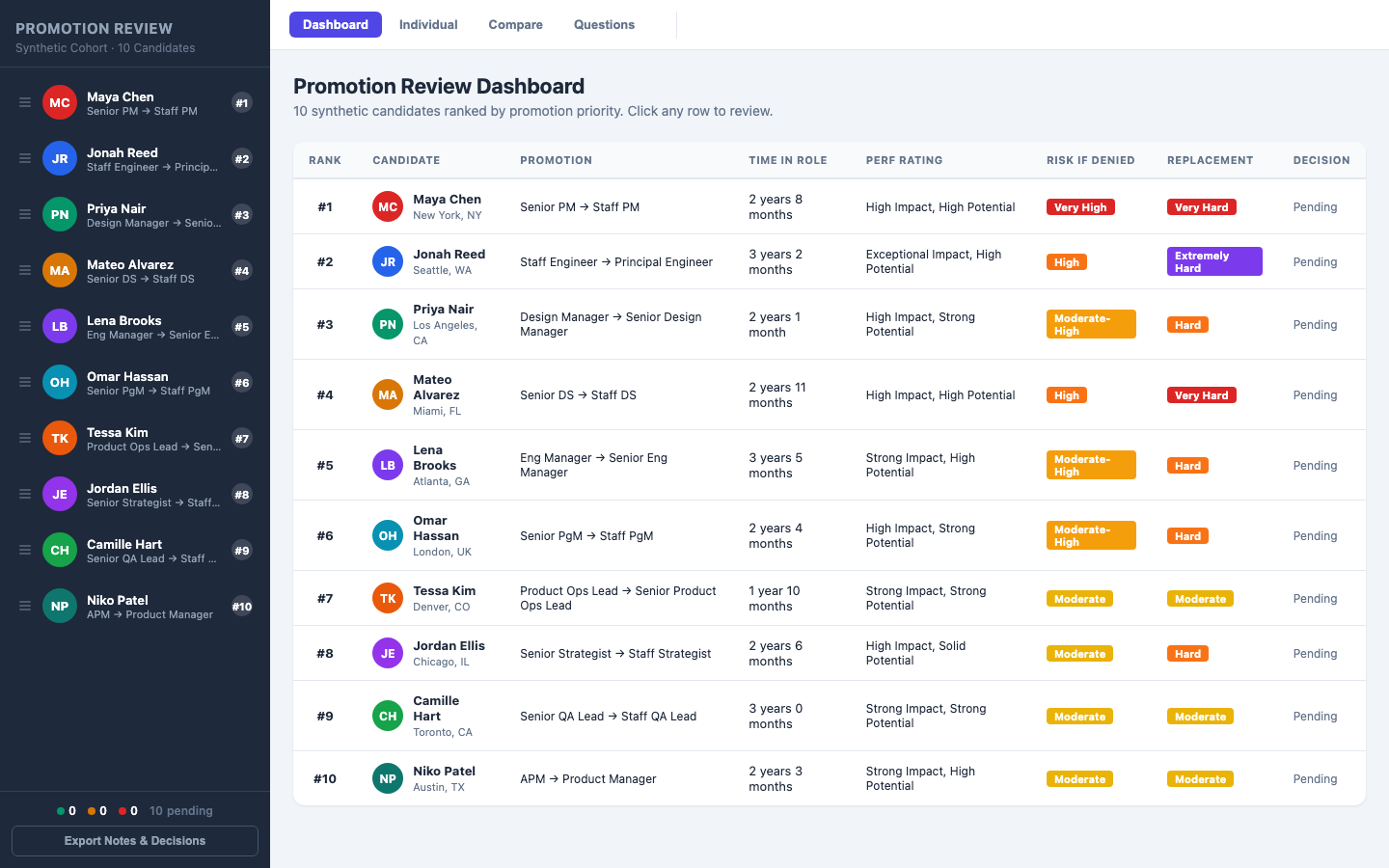
In promotion and performance reviews, AI can help make uneven material easier to compare while leaving the promotion decision with people.
Review packets often arrive with different writing styles, evidence density, history, and polish. That can make a human decision feel more subjective than it needs to be.
The workflow in the talk used synthetic material to create a consistent comparison surface: one-page briefs, extracted claims, scope tables, challenge reasons, panel questions, and discussion tracking.
The point is not summarization. The point is a review surface that makes messy evidence navigable, exposes open questions, and helps leaders decide who meets the bar.
What to notice
- Same inputs, same surface.
- Risk badges and panel questions make uncertainty visible.
- The workflow supports review; it does not decide outcomes.
AI can build demos, but PMs still decide what not to build.
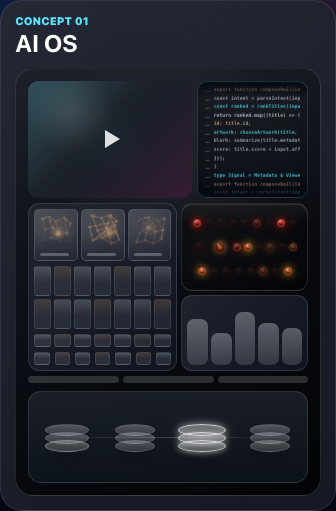
The celebration demo showed how AI-assisted building can make a product story tangible, while making the PM's no-build judgment more important.
This was not a generic chatbot. It was a presentation surface that behaved like a product experience: phone shell, scripted chat, custom visuals, authoring path, podcast mode, and repeatable recording controls.
AI compressed the distance between idea, artifact, feedback, and polish. Product taste, narrative judgment, design review, engineering choices, QA, publishing discipline, and the stop-doing list still mattered.
The effort lens in the current deck is deliberately conservative: an AI-assisted sprint can create more review cycles against the real experience before the meeting, while the traditional and stakeholder-heavy paths spend more time in staged handoffs and governance.
What to notice
- Narrative lived in editable source material.
- Custom visuals and scripted beats made the story tangible.
- Review happened inside the artifact, not after a long handoff.
Observable work is coachable work.
If AI becomes part of the work system, leaders need visibility into where it shows up day to day, what it does, what people do, what was verified, and what patterns are worth reusing.
Prompts, sessions, token patterns, repeated work, audit trails, and review status should become learnable artifacts, not invisible exhaust.
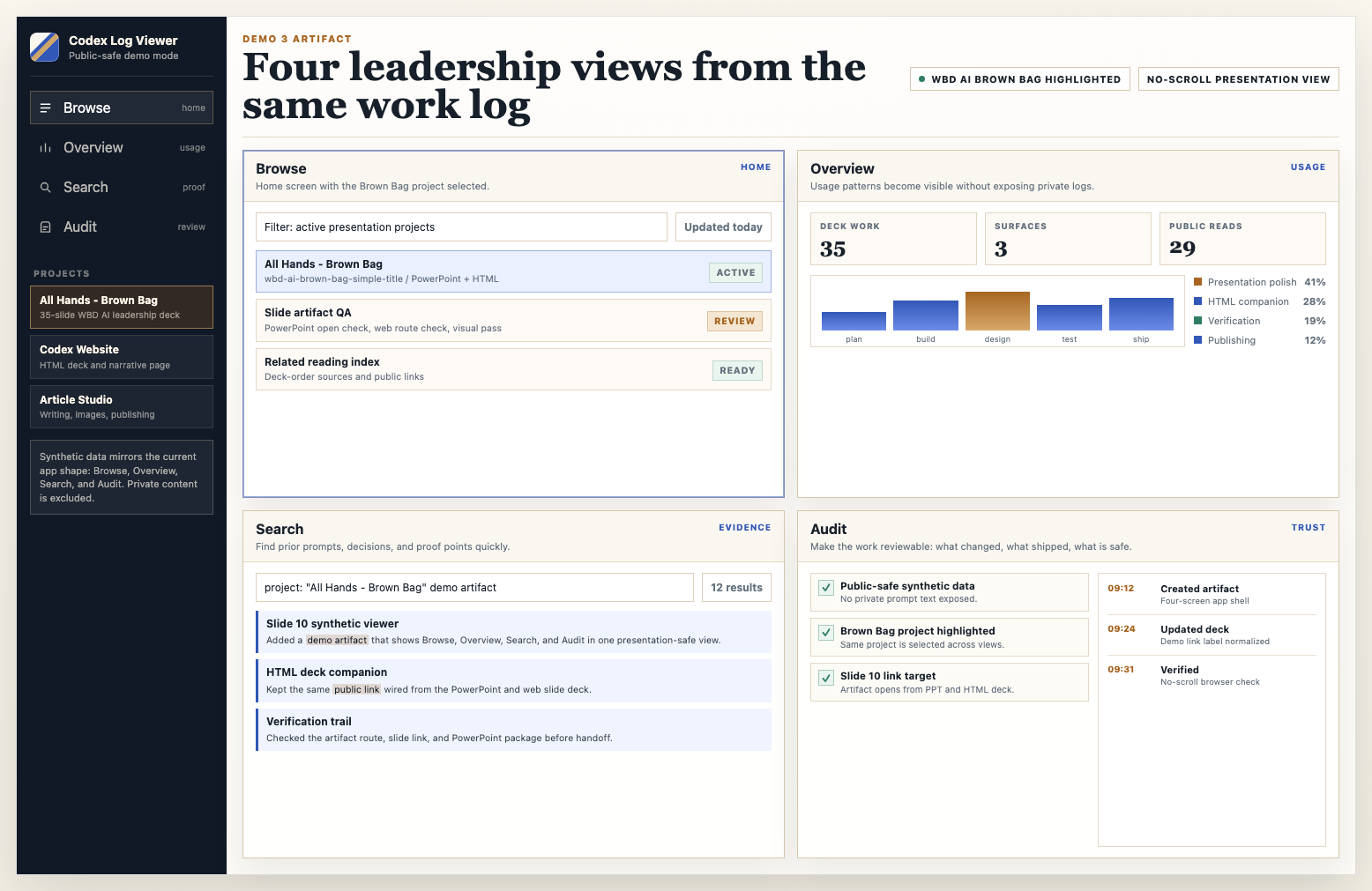
The Codex Log Viewer made usage searchable and reviewable without turning private content into a presentation asset. The leadership lens is coaching, reuse, and better operating habits.
Across decision quality, product storytelling, and usage visibility, AI did not replace judgment. It made the work more structured, faster to iterate, more reviewable, and easier to coach.
What to notice
- Demand patterns show what people repeatedly ask AI to help with.
- Time views reveal where AI becomes part of the operating rhythm.
- Search and audit make usage coachable without exposing private logs.
AI gives PMs range. Expertise gives depth.
The baseline is rising: PMs need enough range across research, data, design, and technical prototyping to frame the work before they ask others to build.
The goal is not for everyone to do everything shallowly. The updated deck frames this as a π-shaped skill set: broad enough to connect the product lifecycle, with real expertise in at least two areas.
Smaller, higher-context one-pizza teams can move from intent to evidence faster when research, prototype, code, test, and analysis stay close to the artifact.
That is not just a team-shape story. The real gain is the daily operating rhythm: how the team briefs, builds, reviews, decides, and learns together.
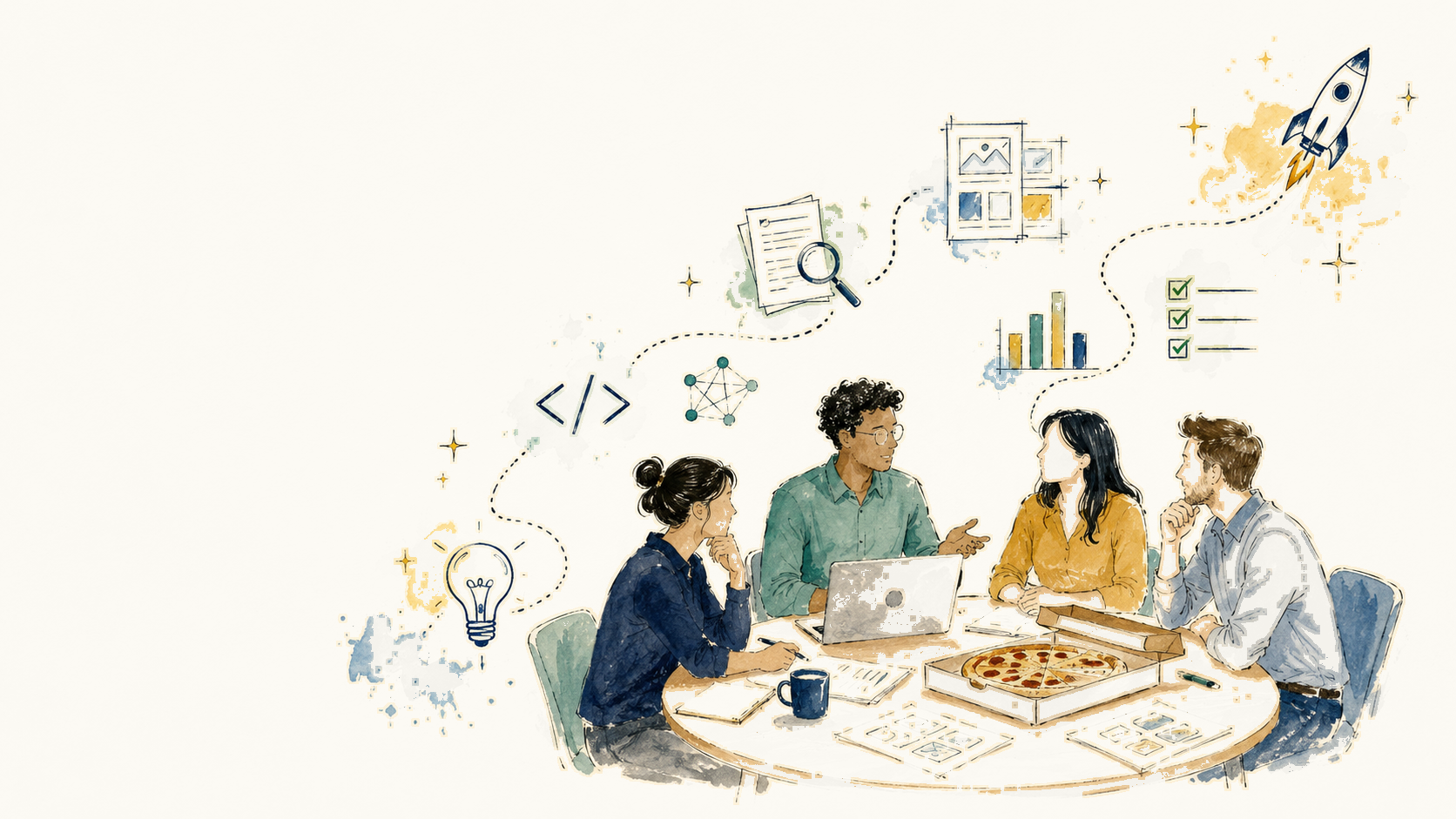
What to notice
- Stretch the range across research, prototype, code, test, and analysis.
- Keep depth in craft, taste, privacy, and reliability.
- Change the rhythm: brief, build, review, decide, learn.
The job beneath the job is becoming visible.
As frontier tools absorb more proxy work, they force a useful question: what was each role really designed to address?
A lot of knowledge work is expressed through proxy artifacts: PRDs, decks, pixels, tickets, spreadsheets, roadmaps, status meetings, and analysis documents. Those artifacts matter, but they are not the whole job.
When AI makes more of the proxy work cheaper, the underlying responsibility becomes clearer. Product management is not the PRD. Design is not moving boxes. Engineering is not only writing code. Analysis is not only building a spreadsheet. Program management is not only running a meeting.
The opportunity is to reinvest attention into the work underneath: choosing what matters, making tradeoffs explicit, shaping judgment, increasing clarity, reducing uncertainty, and helping teams move with more confidence.
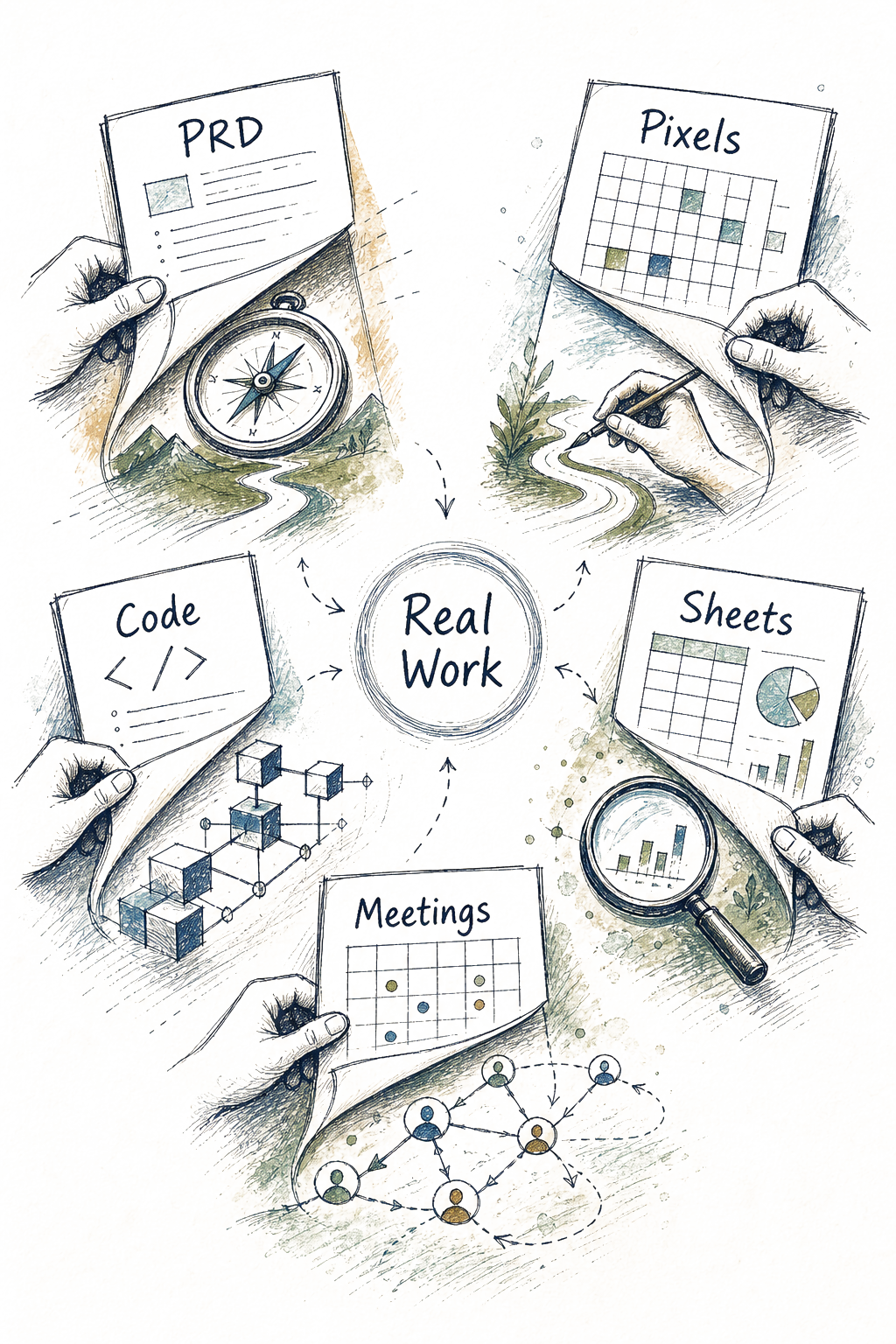
What to notice
- Product management: choose what matters and align teams around value.
- Design: shape judgment about people, context, flows, and quality.
- Engineering: turn ambiguity into reliable systems that can evolve.
- Program leadership: convert uncertainty into momentum, decisions, and shared clarity.
Automate the drag. Reinvest the attention.
Use AI to compress the mechanics of work so human attention moves back to creativity, strategy, and meaningful decisions.
The practical close of the current deck is simple: pick something real and start. Choose a recurring, messy, high-friction workflow. Define the output, audience, quality bar, and constraints. Build a small AI-assisted loop with real source material. Verify it. Share the pattern.
The future interface is likely to be more conversational, more agentic, and more deeply connected to tools and services. ChatGPT, Claude, and the next frontier tools are becoming an operating layer between people and the services they use.
Voice input, multimodal work, and frontier coding tools reduce friction, but the standard should not be more noise. It should be sharper intent, visible verification, shared learning, and better human work.
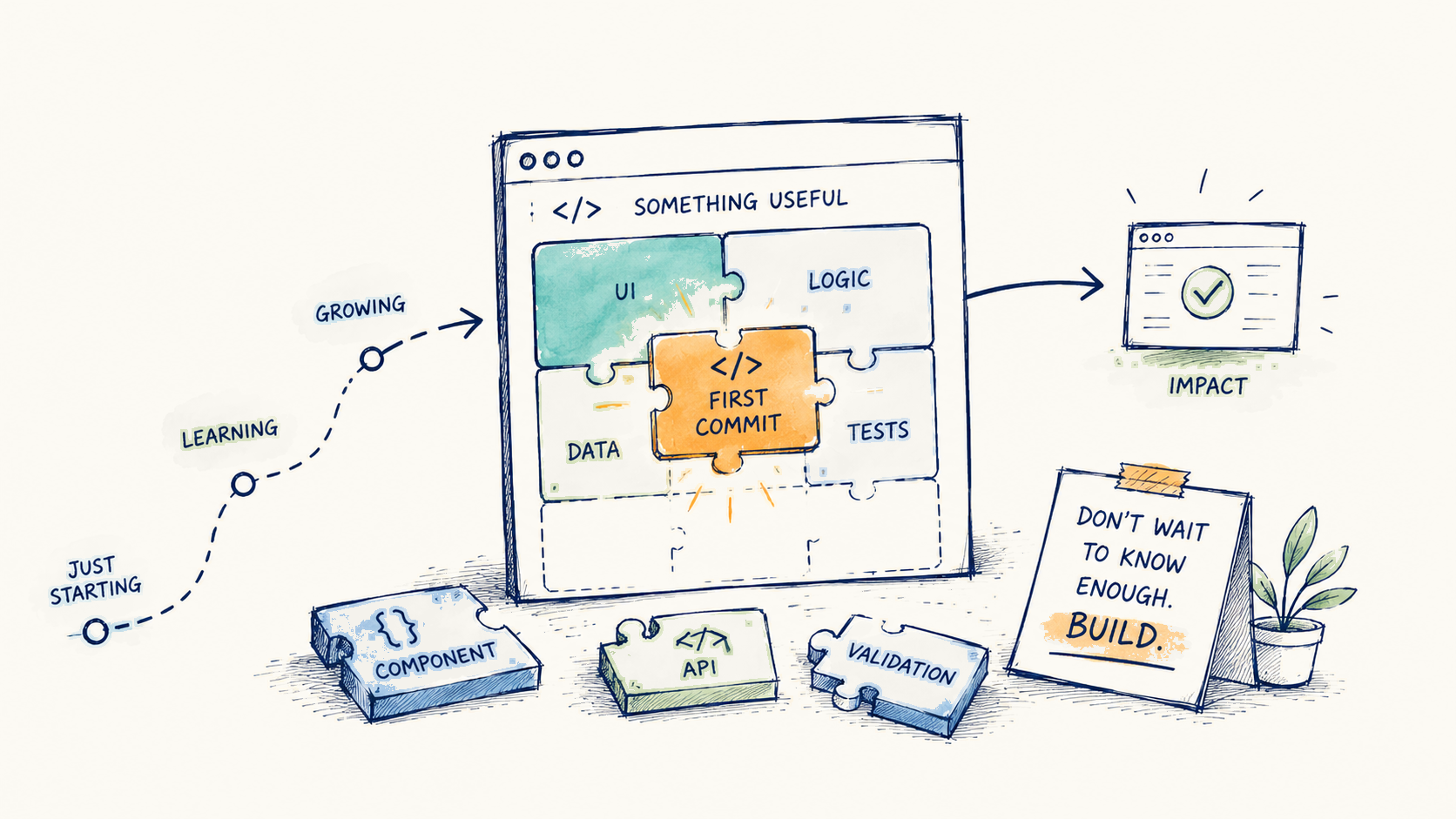
What to notice
- Bring sharper intent.
- Verify before trusting.
- Share what works.
You got this, we got this.
The new closing slide turns the final beat toward confidence: there is no requirement to catch every AI update the moment it ships.
The pace of AI can make it feel like there is always another launch, post, podcast, or breakthrough to absorb. That feeling is understandable, but it is not the work.
What matters is staying curious, grounded, and focused on the work in front of us. Teams have time to learn, experiment, and build judgment together.
The challenge ahead is real, but so is the team's ability to meet it. The close is intentionally aspirational: take a breath, stay open, stay optimistic, and keep helping each other make sense of what matters.

What to notice
- You do not need to catch up to everything.
- Curiosity, grounding, and focus matter more than tracking every update.
- The team can learn, experiment, and build judgment together.
Make it usable on Monday
The habit is the product.
Strong AI work is not a prompt trick. It is a repeatable operating habit: brief the system well, move through the right mode, and make the work prove itself before it earns trust.
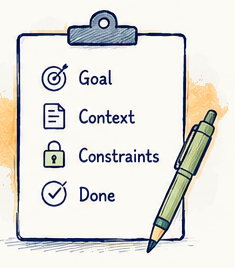
Brief the work
Give the goal, context, constraints, and definition of done before asking AI to expand the middle.
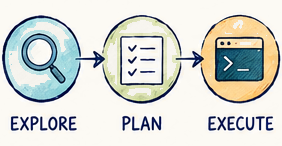
Move in modes
Use AI differently for exploration, planning, execution, review, and critique.
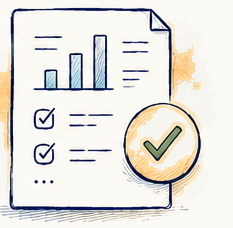
Make it prove the work
Check sources, calculations, privacy, assumptions, and edge cases before trusting the output.
Final line
The goal is not to outsource our work. The goal is to raise the quality of the work humans are free to do.
Technology is the inflection point. Agency is the choice.
Public note
This public version reflects my personal perspectives on product management, AI, workflow design, and team learning. It does not represent the official position of my employer or any affiliated organization.
Back to writingOpen HTML deck